


I'm excited to share the second edition of my book, AI-Enhanced Processes: Powerful Strategies for K-12 Classrooms. Written for educators navigating Generative AI, this book introduces processes that make it clear who is doing the thinking, what type of thinking is expected, and when and how AI should be used. An AI-enhanced process chunks steps, distinguishes between human and AI contributions, scaffolds different types of thinking (including AI literacy), uses action-oriented verbs that deliberately account for AI, and makes thinking visible along the way. The goal is straightforward: to help students and teachers use AI intentionally, in ways that push thinking further rather than skip it.
This work builds on best practices like Project Zero’s Thinking Routines while introducing new language that integrates AI into the learning process with purpose. The idea grew from conversations at the 2023 Future of Learning Conference in Hong Kong, where we developed a shared set of values to guide AI use in education: Transparency, Agency, Process, and Expectations. Since then, I’ve expanded that foundation into a living book that I’ll update each year with new examples, research, and classroom applications. My hope is that AI-Enhanced Processes becomes a practical, grounding resource for educators who want to integrate AI in ways that are intentional, ethical, and human-centered, while keeping authentic student thinking at the core.
The second edition introduces four key processes: (1) Think, Generate, Edit, (2) Generate, Verify, Reflect, (3) Acquire, Analyze, Act, and (4) Process Journals. Below, let’s take a closer look at Think, Generate, Edit and how this one AI-enhanced process can support creativity in schools.
Preview of Creative Process Chapter
This book covers a lot of ground, but creativity may be the topic educators ask about most. What happens to student creativity when AI can generate polished work in seconds? That’s the question this chapter takes on.
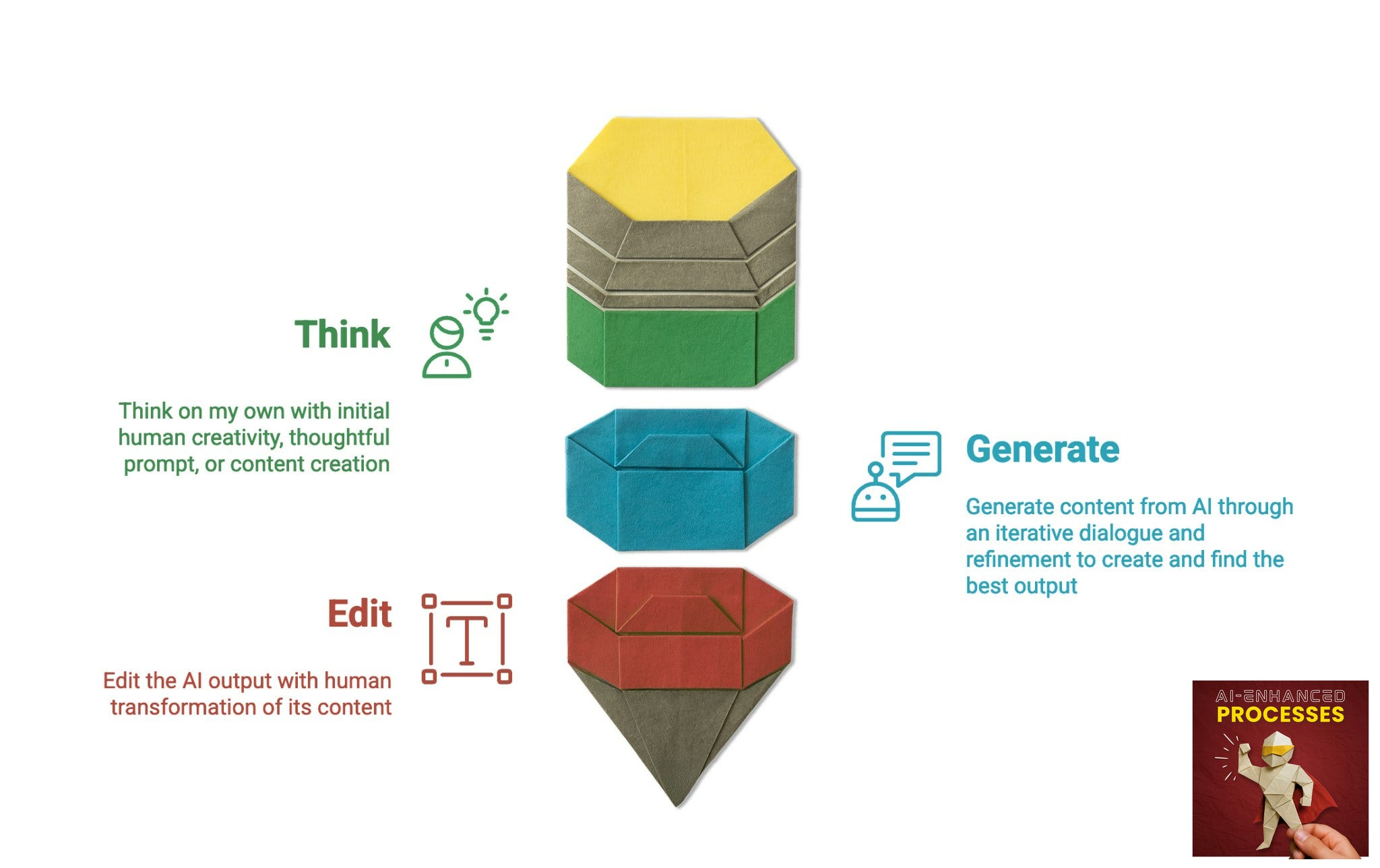
One of the core AI-enhanced processes in the book is Think, Generate, Edit. The sequence is deliberate: students start with their own thinking before AI enters the room, collaborate with AI to extend and explore possibilities, then return to their own judgment to shape and own the result. Human input anchors the beginning. Human decision-making drives the end.
That sequence reflects a broader argument about what it means to be a creative learner who uses AI. Creativity isn’t just output. It’s a combination of identity, values, and actions, and the “Traits of Creative Learners Who Use AI” framework in this chapter maps those traits concretely: synthesizing, analyzing, collaborating, upskilling. Think, Generate, Edit makes those moves visible by clarifying who is doing the thinking at each step, what kind of thinking is required, and how AI can push ideas further without taking the wheel.
Think
Before AI enters the room, you work. This is where independent human creativity does its job: drafting an essay in your own voice, composing a song around a specific musical idea, or making a photograph that reflects your deliberate choices about light, composition, and what the image is actually trying to say. The thinking that happens here isn’t a warm-up. It’s the foundation. Without it, the Generate stage has nothing worth building on.
Generate
Now AI enters as a synthetic guest. Through prompting, iteration, and experimentation, you work toward output that extends your original idea rather than replaces it. This stage takes patience. It also takes judgment: knowing when a generated result is worth keeping, when to push further, and when to scrap the prompt and start over. The goal is collaboration, not delegation.
Edit
This is where you take back the work. Using your expertise, your eye, and your creative judgment, you shape the AI-generated material into something that is unmistakably yours. AI contributed to the process. You own the result.
Download a Preview
Want a taste before the second edition drops? Download a free preview of the introduction and first chapter below. The full second edition will be available in print soon via Amazon and other retailers.

The second edition is coming. More content, a new chapter, and a foreword by Katie Novak. Available on Amazon and at booksellers near you. Subscribe below to be the first to know.