


This is one of a growing collection of AI-enhanced processes I’ve designed to support different types of thinking in the classroom. You can find the full collection at aienhancedprocesses.com/t/processes. I’ll keep adding to it as I build more. The content below is a preview; the full collection of processes will be available in my book.
At a Glance
Students often arrive at AI-assisted research with an assumption: that AI is all-knowing, omniscient, and accurate. I call this AI Omniscience Bias, and it’s the trap Generate, Verify, Reflect is designed to address. Students use AI to find or synthesize information, verify what they find against other sources, then reflect on their own assumptions about accuracy. That last step is the one that builds AI literacy; it turns research into a metacognitive habit.
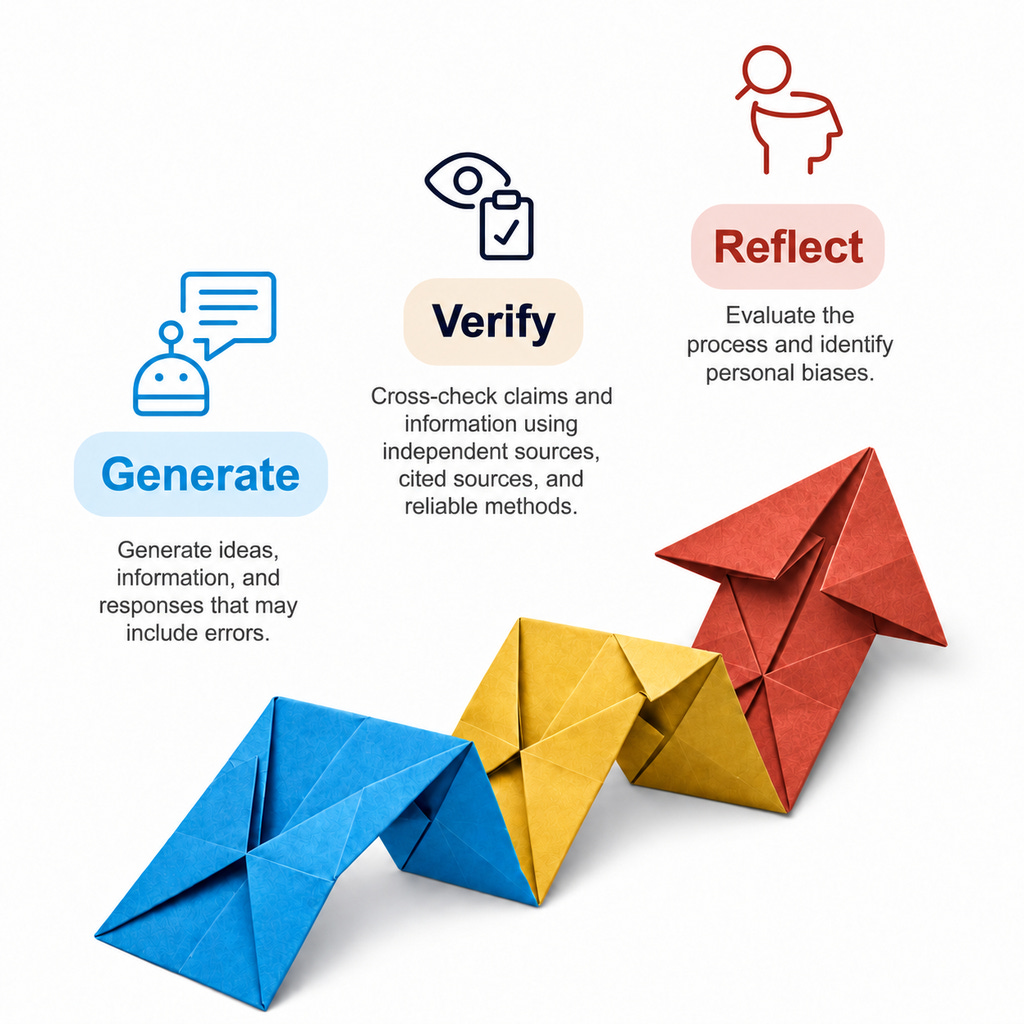
Generate

Overall, what we want to see students doing at this stage is being critical of information and AI models in the moment; this step is not for us to look at other sources, which will be completed in the second step of the process. Here, AI is the source, and students are learning to treat it like one.
Use the ROBOT Test to evaluate the AI tools themselves.
We do not always assume everything we read is true; we keep in mind that it might represent a biased opinion, and we utilize our common sense: Does it feel right?
We push back against the AI when it affirms our responses and ask it to help us understand and not to please us. Furthermore, students can interrogate the AI: when was it last trained? Does it cite sources? Could the phrasing include a hallucination?
See more steps we can take during the generate stage in my upcoming book!
Verify

Now that we have encountered information that seems to be reliable, we find its claim, references, or data points and look for an alternative source of information and verify it. Additional things that we do during this step include:
We deliberately slow by pausing to consider the information we are encountering, rather than trying to efficiently complete a task.
We analyze what we have read by using the CRAAP Test.
See more ways to verify information in my upcoming book!
Reflect

As a final step, we want to ensure that we are avoiding cognitive biases and echo chambers; the essential thing is that time is allocated and the conditions for reflective thought are right (i.e. students are not rushed at the end of class just before the bell rings, they are calm, alert). When we reflect on the overall process, we encourage metacognition which can be an extremely powerful move.
Example questions teachers can share with students to encourage reflection on biases include:
Default-to-Truth: What evidence or source did I find that could have made me doubt or disprove this claim?
AI Omniscience Bias: What might this AI not have known or been unable to do, and how did I check the information with a non-AI source?
See more biases in my book!