

Hindsight, Oversight, Foresight (HOF)
Three processes to support metacognition

HOF represents three categories of metacognition that can be used with or without AI. What you will notice in the coming pages is that several teachers look at using AI throughout the process, while others prefer to use it at one key stage, then ask students to return to their own thinking and close their computers.
Unlike a single reflective moment at the end of learning, HOF positions metacognition across the entire learning experience, meaning students can enter at any point, revisit steps, and cycle through them as needed. These three categories of metacognition are powerful when used together, but they also stand on their own when taught explicitly. A lesson, project, or even a brief task may involve only one of the forms of metacognition if that is what the moment calls for. Over time, students learn to recognize when each move is useful and begin to internalize it.
HOF represents three categories of metacognition rather than a set of steps in a process, as shown in the other examples in this book. Because of that, you’ll first see an overview graphic (below) and then the subsequent sample approaches for each stage. The following pages then break down each part of HOF into verb-based processes that teachers can use with students. As with all processes in this book, these are examples you can use in your classes, but teachers should also feel free to design their own that set clear expectations around who is thinking, what type of thinking they are doing, how AI is used to support that thinking, and how to document student thinking in a way that isn’t cumbersome, but helps the students to notice their own growth.
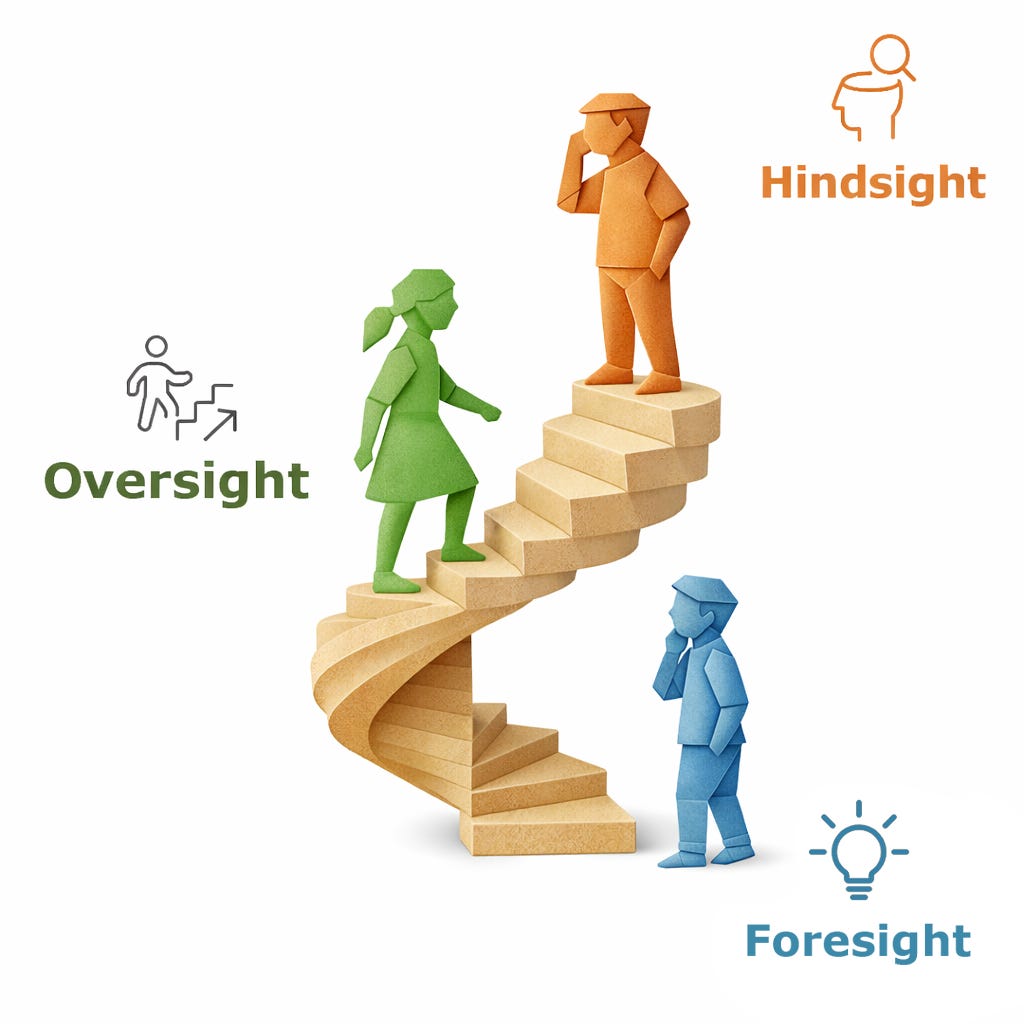
Hindsight: Reflecting on Events
After learning, we look back to understand what happened. Hindsight helps us notice what worked, what didn’t, and what to change next time. It’s also when we connect outcomes to the choices or strategies that caused them, so learning can transfer.
Highlight. Students identify what stood out, including what worked, what was difficult, where things went off track, and surprises they encountered. AI could be used by asking kids about the event and drawing out their thoughts.
Hypothesize. Students think about why events happened. They consider causes, choices, misunderstandings, strategies, or conditions that contributed to the outcomes of the experience. AI could support by asking questions to see cause and effect relationships.
Act. Students capture what they want to take away from this experience. It could be an insight, a strategy note, a checklist, or a reminder on how to work with a team member, etc. AI could help summarize, label takeaways, or suggest transferability. It could also prompt learners to consider their new learning and how it could be applied in the future.
Oversight: In The Moment Awareness
In Elevating Educational Design with AI, Catlin Ricker and Katie Novak explain that formative assessment begins with teachers asking, “What will I learn about my students in this lesson?” They point out that this same move becomes metacognitive when students turn the question inward and ask, “What will I learn about myself in this work?” Oversight is that internal version of formative assessment. It is noticing when we are stuck, distracted, guessing, or meeting our goals, and identifying what we might need next. It creates the pause to ask whether our current approach is working and whether a shift in strategy, pace, or resources could help.
Observe. Students pause during a task to scan their thinking and emotional state. They identify signs of confusion, distraction, guessing, confidence, or progress. AI could be used to ask students to check in, notice, and draw their attention to what is happening internally and externally.
Organize. Students make sense of what they noticed by sorting, interpreting, or connecting their observations. AI can help them clarify patterns, name what might be happening, or rephrase their thinking without solving the problem.
Act. Students choose the next step and what to adjust. AI could help them weigh options, break down steps, and so on; however, decisions ultimately stay with the students.
Foresight: Planning for Success
Find. Students scan the task, prompt, or situation and identify key elements like requirements, keywords, constraints, or prior connections. AI could be used to ask students about the task, helping them to break down assignments into the above parts.
Focus. Students surface questions, possibilities, or uncertainties about the elements in Find. AI could be used to support their curiosity and reveal what thinking or clarifications may be needed before action.
Act. Students choose a direction, where to start, what strategies to try, or what support resources to use. AI could be used in this step to support thinking through questions and paraphrasing; again, students should make all decisions and AI supports their thinking to do so.