


Hi everyone! I’m switching my posts to Thursdays each week. In this post, I’m going to continue building on my work for this school around metacognition. I'll cover how AI can help us be metacognitive, how metacognition can support our meaningful use of AI, and how metacognition can support student independence. Let’s jump into today’s resource!
—Alex
Introduction
Students want to use AI responsibly and do the right thing. But “use it responsibly” leaves them with a lot to figure out on their own due to the fact that that language is so broadly interpretable. These six metaphors and guided reflection scripts help students to be intentional before they use AI.
Through Think, Pair, Share, students consider their own choices, explore them with a partner, and hear how classmates approach the same decisions. This is a form of metacognition: thinking about how they learn, what they value, and gaining a level of self-awareness as they plan their approaches to learning: What am I trying to learn, how could AI help, and what thinking do I need to do myself?
Each metaphor includes a classroom slide and a discussion script to guide that conversation. At the end of the post is a PDF will all six of the slides you can download together.
Metaphor 1 - P.E. Teacher
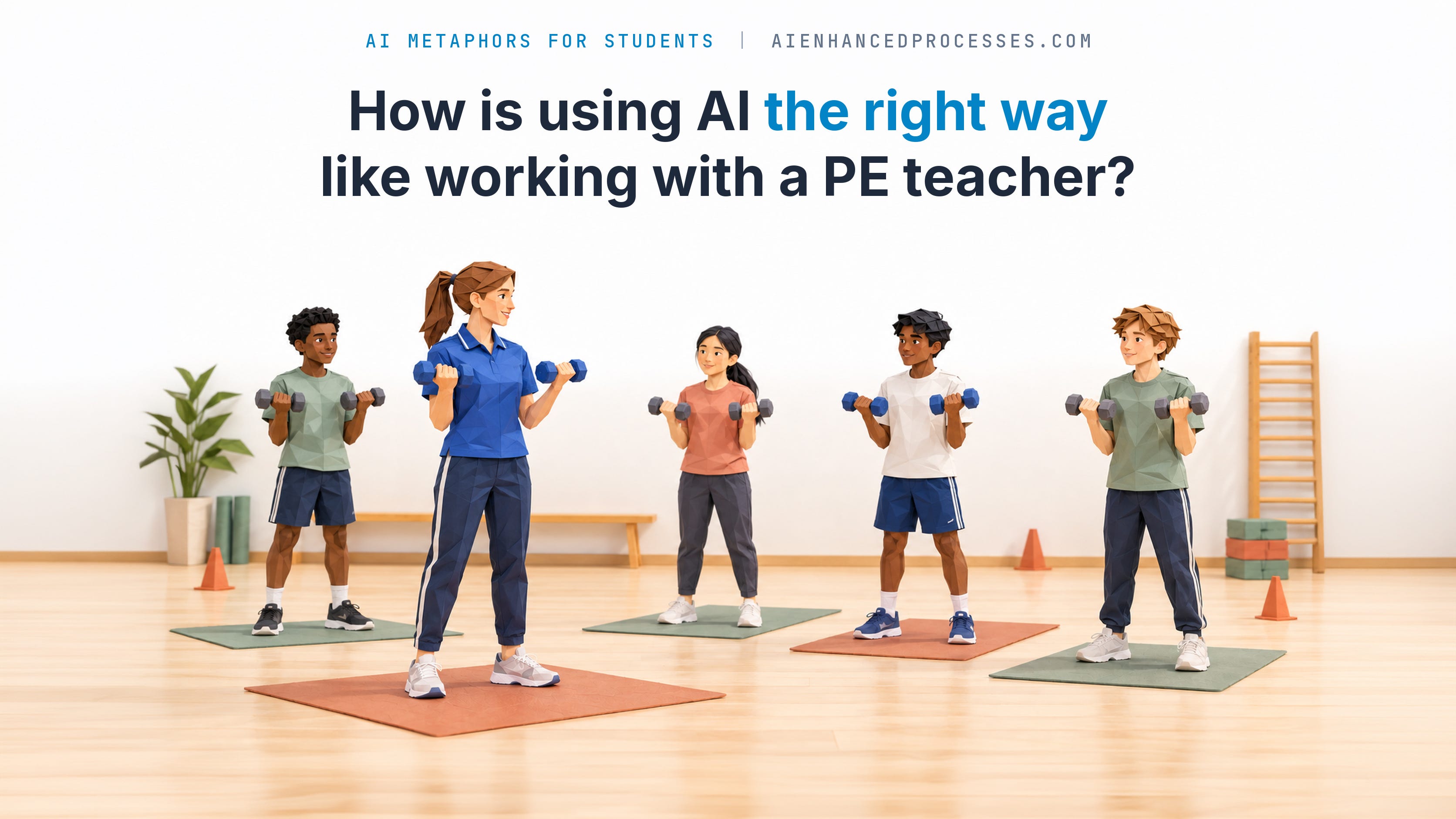
With this metaphor, we can support a meaningful conversation about preserving the practice and effort that builds capability.
On the screen Image
(Show the slide below in class)
Script
As you look at the picture on the screen, think about the best PE teacher you’ve ever had. How did they make you feel when you walked into the gym? How did they get you to try something you were nervous about? Maybe they held the rope, stood close at the vault, encouraged you, or just told you they’d catch you? How did they make sure you actually got stronger, more flexible, faster? (Pause.)
Did they model something first? Remember watching them do it perfectly and thinking, “Easy.” Now remember trying it yourself. Did they know when to step in and when to step back? Did they ever work out for you? (Pause.)
Go ahead and turn to your partner(s) and have that conversation.
(After a few minutes) Let’s share. What were some of the things you thought about? How might using AI appropriately be like working out with a PE teacher? (Chart the answers on the board.)
Metaphor 2 - Calculators
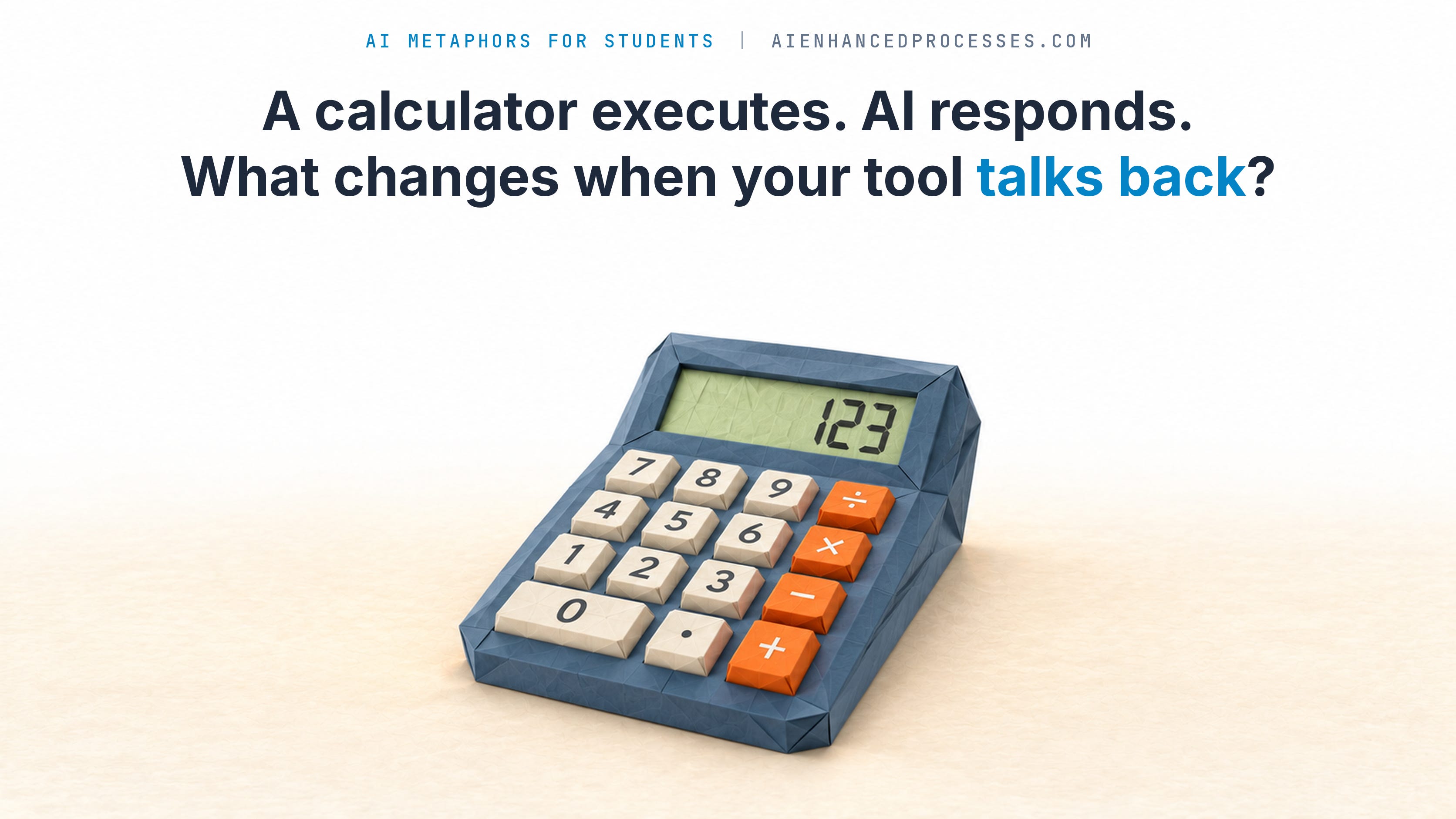
With this metaphor, we can support a meaningful conversation about deciding which parts of a task to delegate to AI and how we can check its answers.
On the screen Slide/Image
(Show the slide below in class)
Script
Think about the first time you were allowed to use a calculator in Math class. How did it feel? What could you suddenly do faster? Were there tests where your teacher said, “Calculators away”? Why do you think they did that? (Pause.)
Now think about AI. Like a calculator, it can do in seconds what would take you much longer. But a calculator gives the same right answer every time you type 38 × 12. AI can give a different answer each time you ask, sounds just as sure when it’s wrong, and can do much more than just math. It can do word problems and write out the reasoning, the part a calculator can’t do. (Pause.)
When you look at AI’s reasoning, it can feel a lot like understanding it. (Pause.)
Go ahead and turn to your partner(s) and have that conversation.
(After a few minutes) Let’s share. What were some of the things you thought about? How is AI like a calculator? How is it different? When should AI do the working, and when is the working the whole point? (Chart the answers on the board.)
Metaphor 3 - Electricity
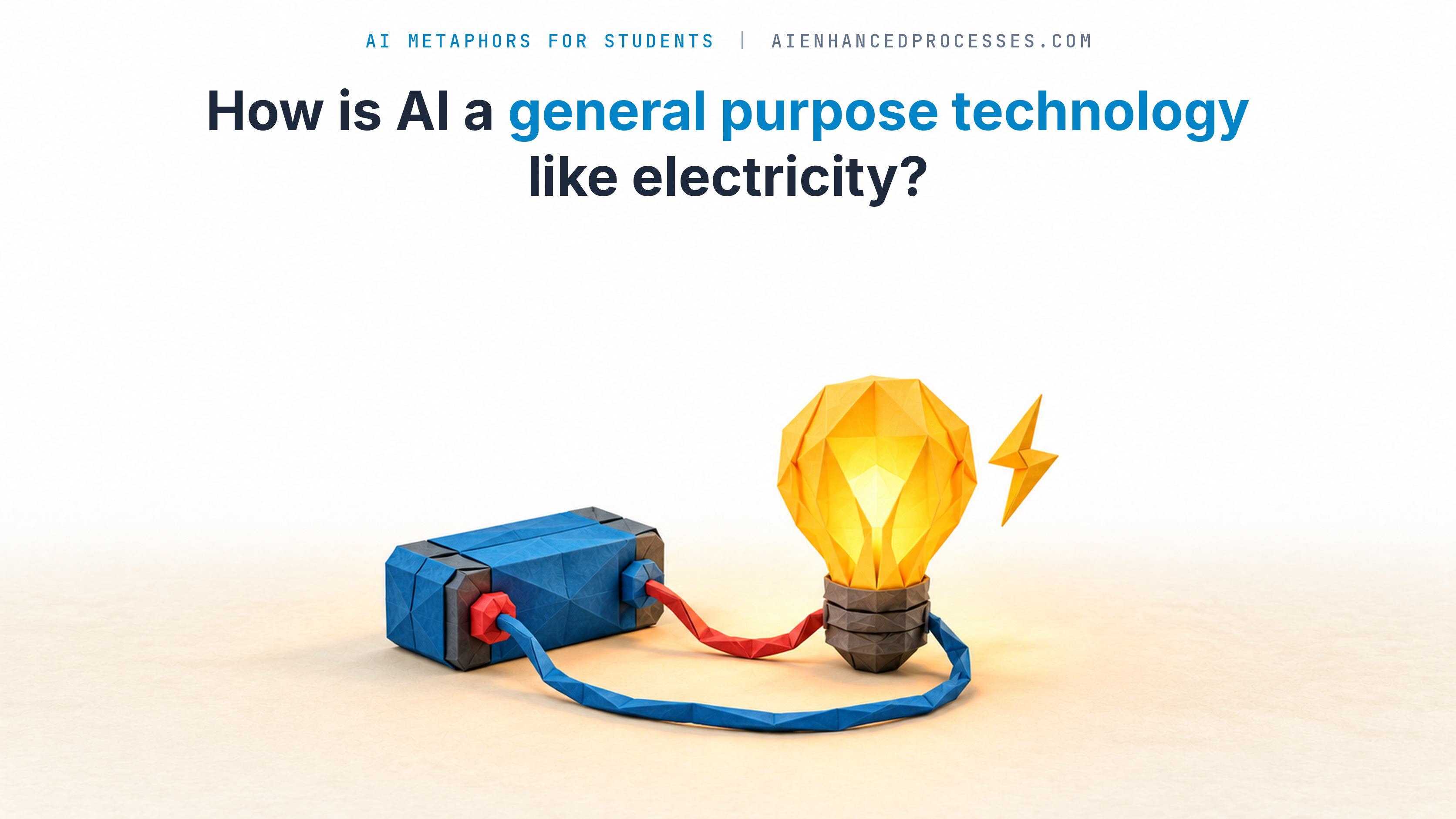
With this metaphor, we can support a meaningful conversation about noticing where AI is already present and choosing intentionally when to use it.
On the screen Slide/Image
(Show the slide below in class)
Script
Look around the room. How many things are running on electricity right now? When did you last think about it? What would your day look like without it? Try to name every job electricity does in this room. (Pause.)
Now think about AI. Most of us picture a chat window, but that’s like thinking electricity is a light bulb. AI unlocks your phone with your face. It picks the next video in your feed, blurs the background in your photos, and finds the song you can only hum. It can translate a sign through your camera, forecast tomorrow’s weather, and help a doctor spot a tumor in an X-ray. Like electricity, it’s powerful; it’s useful; it can be used very widely. (Pause.)
Go ahead and turn to your partner(s) and have that conversation.
(After a few minutes) Let’s share. What were some of the things you thought about? What things do electricity and AI have in common? What’s something AI does that has nothing to do with chat? Where is AI already switched on in the apps you use, and when should you switch it off? (Chart the answers on the board.)
Metaphor 4 - A Guest in Our Classroom
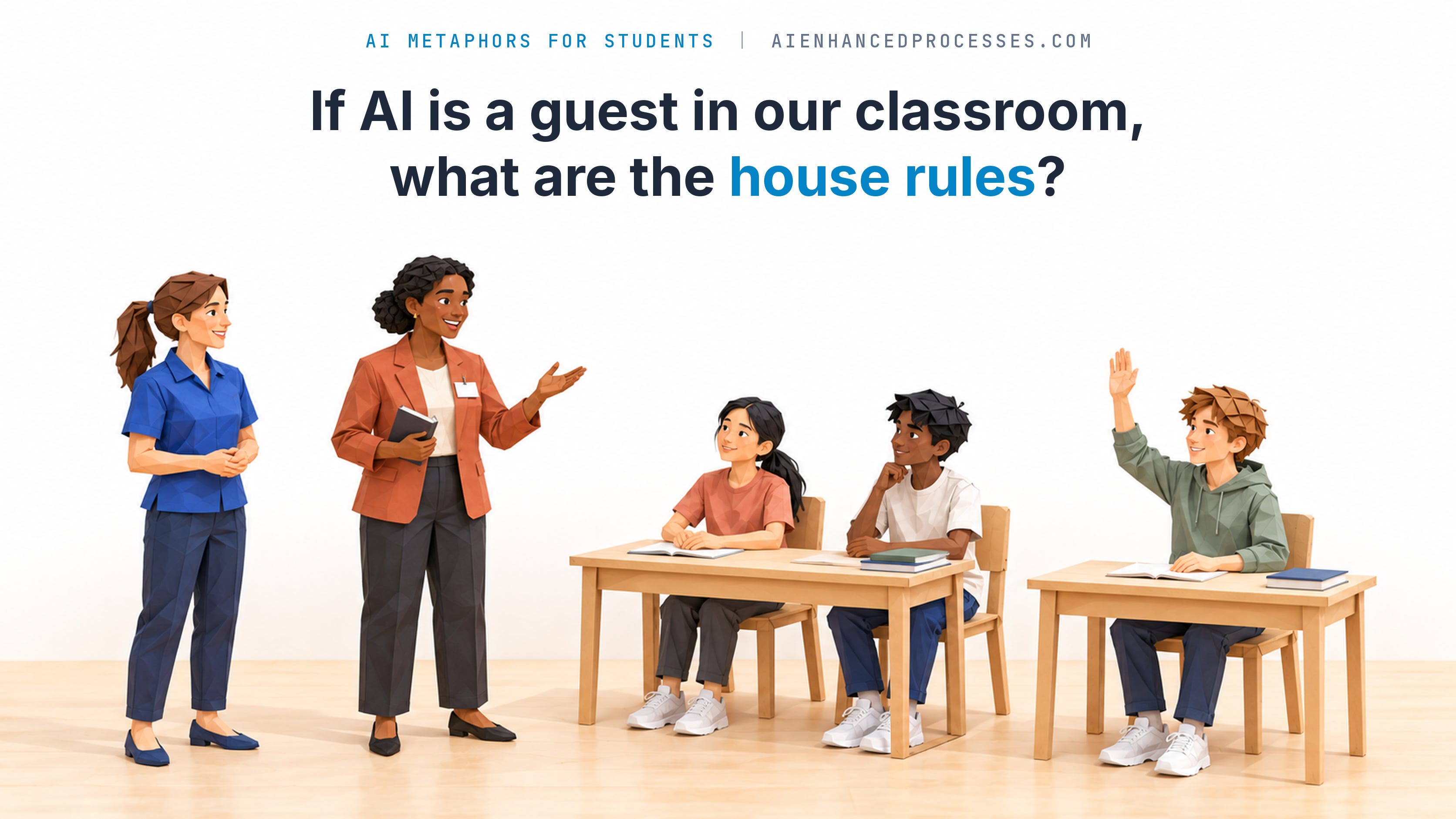
With this metaphor, we can support a meaningful conversation about setting expectations for AI’s role while keeping ownership of our thinking and decisions.
On the screen Slide/Image
(Show the slide below in class)
Script
Think about a time your family had a guest over for dinner. What did you do to get ready? Who decided who was invited, where everyone would sit, and what got served? What made someone a good guest? (Pause.)
Think about the host, too. What things did you need to do when the guest arrived?How did you participate in the conversation and listen to your guest? Who have you seen in your family do a great job as a host? What things made them a great host? (Pause.)
Now think about AI as a guest in our classroom. If it were a living person we invited into our classroom with all our norms, agreements, and culture, how would we host him or her? Instead of having dinner together, maybe we are collaborating, so what things would you do as a host to make sure the guest is fitting in with how we work? (Pause.)
Go ahead and turn to your partner(s) and have that conversation.
(After a few minutes) Let’s share. What were some of the things you thought about? How might using AI the right way be like hosting a guest? What should a good host tell this guest before the conversation starts? (Chart the answers on the board.)
Metaphor 5 - A GPS
With this metaphor, we can support a meaningful conversation about the difference between jumping to an answer and understanding how to get there on our own.
On the screen Slide/Image
(Show the slide below in class)
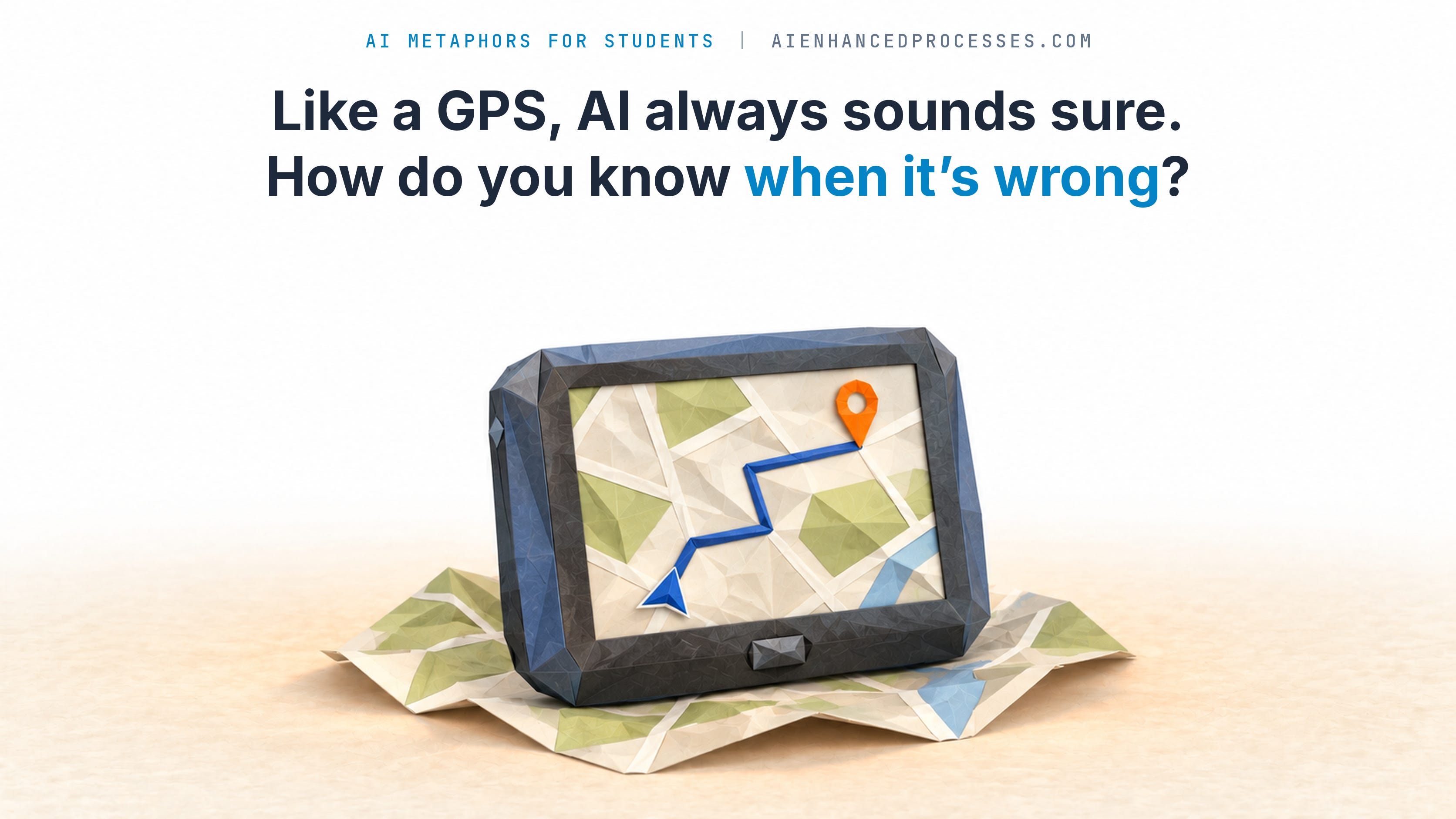
Script
Think about a trip where someone in your family used GPS to get somewhere new. It might have been in a car, it might have been on their phone, or another device. Sometimes it’s an app like Google Maps.
How did the technology help? Did it ever send you the wrong way, or try to route you through a parking lot? How did you know when to ignore it? (Pause.)
Next, picture somewhere you’ve been driven many times with the GPS on, like a friend’s house or a favorite restaurant. Could you give someone directions to get there? Could you draw the route? Lots of us arrive at the same places for years without ever learning the way. (Pause.)
Now think about AI. It can get you to the destination fast by creating just about anything like words, pictures, music, and summaries. Have you ever used AI and arrived with no idea how you got there? (Pause.)
Go ahead and turn to your partner(s) and have that conversation.
(After a few minutes) Let’s share. What were some of the things you thought about? How might using AI the right way be like following a GPS? Which of our tasks are one-time trips, and which are daily commutes? (Chart the answers on the board.)
Metaphor 6 - Fire
With this metaphor, we can support a meaningful conversation about establishing shared boundaries that help us use a powerful tool thoughtfully and responsibly.
On the screen Slide/Image
(Show the slide below in class)
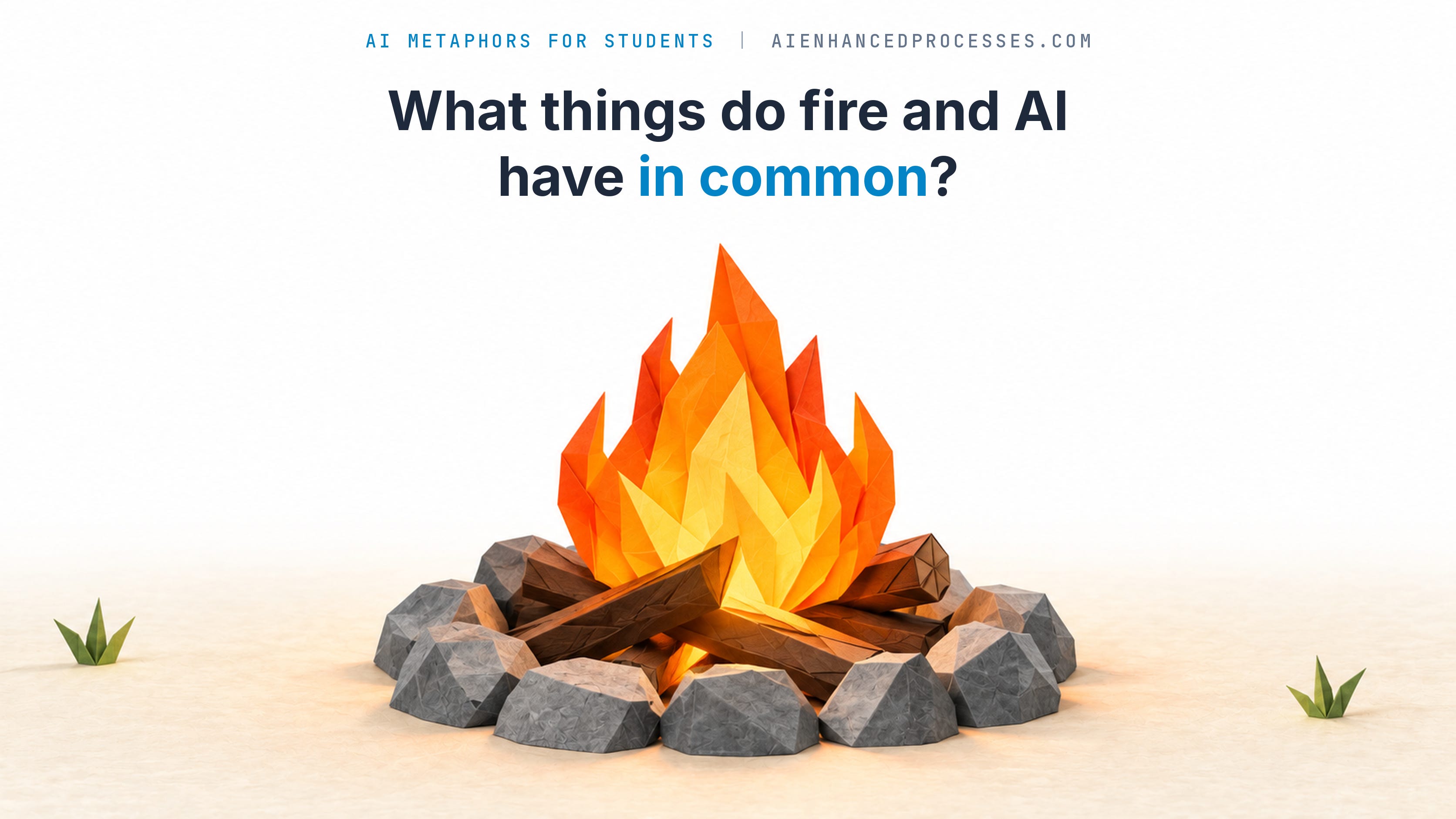
Script
Think about a time you’ve been around fire: a campfire, birthday candles, a Bunsen burner in science, the stove at home. What things did it let you do? How did it feel to be near it? Who taught you how to be around it, and what were the rules? Did anyone ever hand you the match and let you light it yourself? (Pause.)
Now think about AI. Like fire, it’s here to stay; nobody is going to uninvent it. It can keep us warm, cook things we couldn’t cook before, and bring people together around it. It can also get out of control. (Pause.)
Go ahead and turn to your partner(s) and share your thinking.
(After a few minutes.) Let’s share. What were some of the things you thought about? What things do fire and AI have in common? Where are they different? What rules would you want around our classroom campfire? (Chart the answers on the board.)
Download All
Here is a download with all six metaphors on them. Feel free to download and print them for your students.

Conclusion
You don’t need all six metaphors at once. Pick the ones that will spark the best discussion in your room, or invent your own that fit your culture and your class’s shared values. Show your school mascot, a picture from the yearbook, a feature of your city, a landmark in your school, a student’s artwork, a plant from your garden, a world event, a cloud in the sky. You can literally show anything and ask students to see connections, and they will. The human brain is amazing at seeing connections between novel things. Give them time and the conditions, and they will see the connections. Promise.
As students share their connections they are seeing, chart their words and look for patterns. What do they say about effort, fairness, and responsibility, and where did those ideas come from? Then bring those ideas into tomorrow’s lesson. Before students open an AI tool, ask three questions: What am I trying to learn? What help do I want? What thinking has to be mine? Afterwards, ask whether those choices helped.
Come back to the metaphors later in the year. Which still fit? Which don’t? What would students add? And remember, students want to do the right thing. Time and language help them figure out what that looks like and to recognize when their behavior is and isn’t consistent with those beliefs.
Related Posts
The Metaphors We Use for AI. This is a post aimed at adults and asks us to think about the context in which we talk about AI and how different metaphors can be apt at different times.
Shared AI Values Poster. A poster and explanation of four values: curiosity, intentionality, responsibility, and transparency. All of which connect directly to these classroom conversations shown above. Use the poster to help students connect their reflections to shared values and make intentional choices about how they use AI.