


Introduction
I like to think of values as a compass. They are important to tell you where to go, but they do not take you on a journey. Your legs do!
Just about everyone is talking about how our values should be what guide us in this uncertain time with rapid AI adoption. I totally agree. However, the next step to help our students is to figure out, well, what actually is the next step? How do we walk the path of our values? In this post I hope to explore that question.
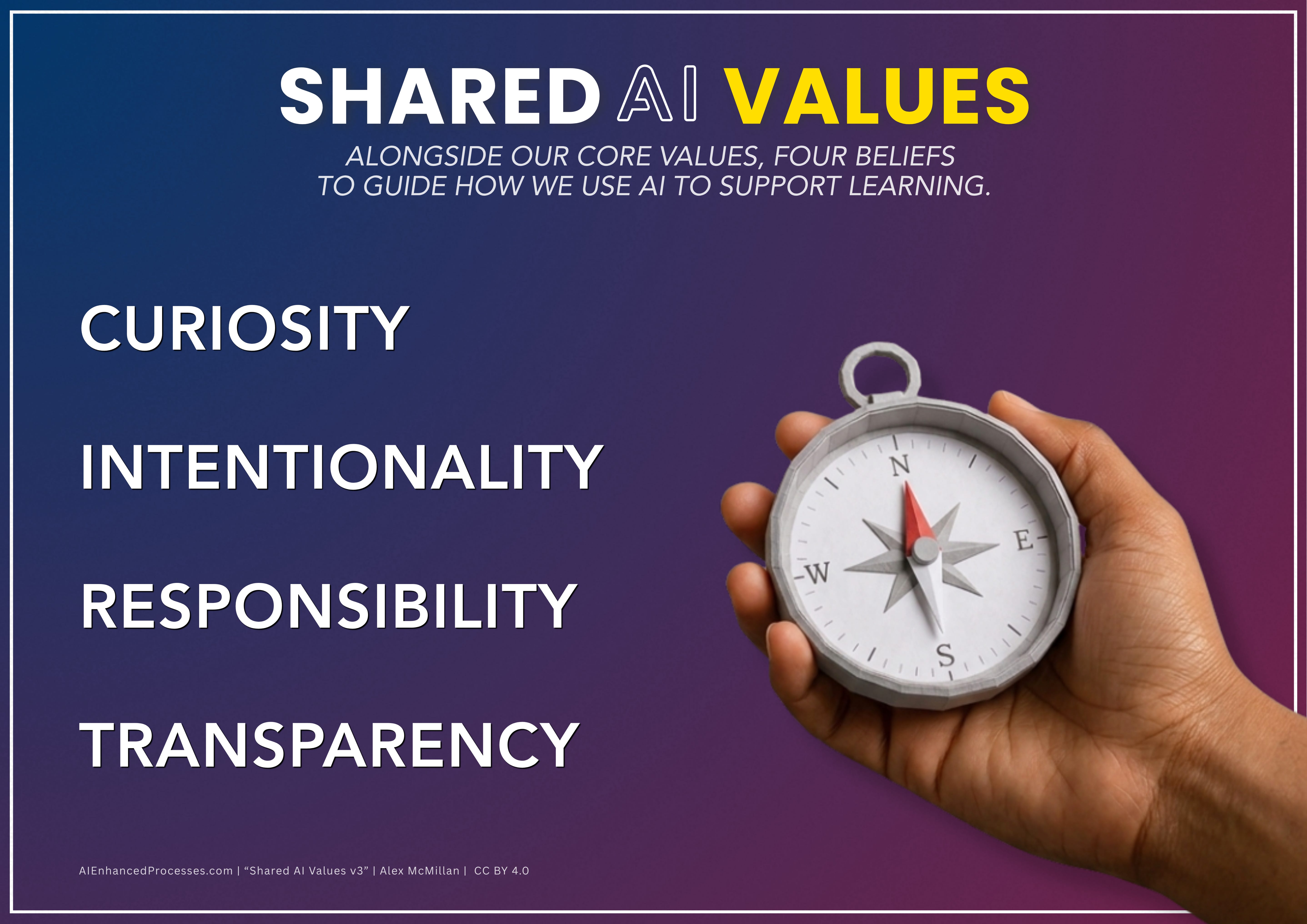
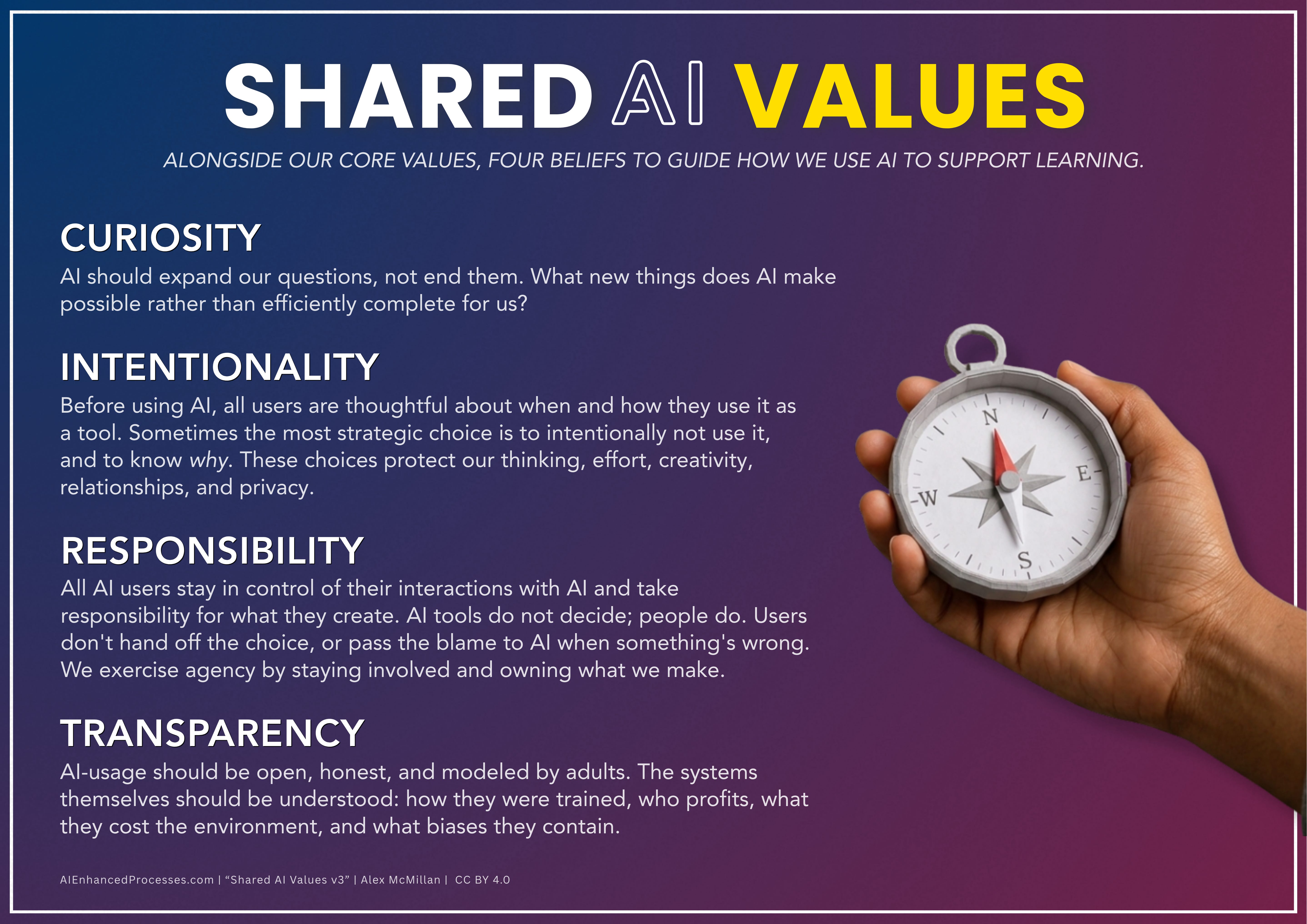
This download is about closing the gap between the values we state and the behaviors we actually reward, and how a process turns a value on the wall into a move a student can practice. The image is high resolution, so print it as big as you need, A4, A3, or A0, or just share it digitally. Download by clicking the image, then pressing the download button. Read on if you’d like ways you can use it in your classroom, the history of the graphic, and how it came to be, along with an AI disclosure about my process at the very end.
Four Values, and What They Ask of Us
A quick note before the history of this work: here are the four values from the poster, and what each one asks of a student. They don’t replace your school’s core values. Think of them as an AI-specific corner of whatever your community already believes about being a good person, learner, and community member.
Curiosity
What it means. AI should expand our questions, not end them. When students enter prompts and receive confident-sounding answers, they are tempted to accept it at a surface level, which often reflects a novice’s understanding of a topic. Expertise helps us catch inaccuracies and to be more critical. Curiosity is the value and mindset that addresses this challenge in students, in that it treats the first answer as a starting point.
How it could be practiced. Instead of asking AI to answer the question, a student asks it to generate three better questions about the topic, then chooses which one is worth exploring and explains why.
Avoiding accidental pitfalls. If the grade mostly rewards the polished final answer, we may be cognitively paying for closure, the fast, complete, confident output. We may be rewarding the absence of the very curiosity we’re hoping for. So, what’s one task where you’d rather your students leave with sharper questions than with finished answers, and how could AI help them get there?
Intentionality
What it means. Before using AI, a student is deliberate about when and how they reach for it, and sometimes the most strategic choice is to not use it at all, and to know why. Intentionality protects the parts of thinking, effort, and creativity that a student needs to keep for themselves.
How it could be practiced. Before a task, students practice metacognition by deciding where AI is in and where it’s off-limits, and name the reason. “I’ll use it to check my logic at the end, but the argument is mine, because that’s the part I’m here to get better at.” For this value to be practiced, the decision comes before the work, not after.
Avoiding accidental pitfalls. If we rarely ask students where AI was intentionally part of our process, the task may end up rewarding the finished product alone, however it got made. A student who deliberately chose not to use AI, and lost time to the struggle, might earn the same mark as the one who outsourced the whole thing. So, where in your students’ learning is the struggle the point or the part you’d protect even if AI could shortcut it, and how would you help them notice that for themselves?
Responsibility
What it means. Students stay in control of their interactions with AI and own what they create. AI tools don’t decide; people do. The temptation is to hand off the choice and, when something goes wrong, pass the blame to the tool. Responsibility is staying involved as a human in the loop and believing that the work, thinking, effort, and output should be genuinely yours.
How it could be practiced. Responsibility is what happens after we use AI. For example, on a writing task, students document a process, showing where they decided to use or not to use AI, what they took from AI, and what they overrode.
Avoiding accidental pitfalls. If we grade only the artifact and never even discuss the decisions behind them, we could be rewarding a result we can’t actually trace to a person. We should ask students to be responsible for making an appropriate number of decisions within their thought processes and to be metacognitively aware of why they did so. So, what’s a decision in your students’ work that you never want AI to make for them, and how could you build the task so they’re the ones making it?
Transparency
What it means. AI use should be open, honest, and modeled by the adults first. Part of this is the student being honest about where AI showed up in their work. The second part to this value is understanding the systems themselves: how they were trained, who profits, what they cost the environment, and what biases they carry.
How it could be practiced. The work ends with a short disclosure about how they used AI (see the end of this post for an example), what the student kept, and what they pushed back on. Writing it forces a student to actually account for what they did, which is its own kind of thinking.
Avoiding accidental pitfalls. If honesty about AI use ever lowers a grade, we may be teaching students that disclosure is a confession rather than a habit. The one who hides it scores clean; the one who’s open gets flagged. So, what would it look like for you to model your own AI use in front of your students this week, before you ask it of them?
From Value to Move: The Process
My work is centered on a simple idea: a process for how we use AI is essential. I’ve been calling this an AI-enhanced process, where we name the thinking, set expectations, and decide what we’d consider a compelling artifact of learning. These are often repeatable strategies students can run again and again, and the purpose is to protect student thinking and effort where it matters most. My hope is that they also become lifelong habits on how students can use AI responsibly into adulthood.
I wrote a full guide to designing your own here, and there’s a free tool that will help you build one and hand you a ready-to-use bot prompt. The Shared AI Values poster names the direction we’re heading. The processes, the ones we hand students or ask them to build themselves, are how they practice getting there.
The Story Behind The Posters
In 2023, I was at Apple’s Future of Learning conference (FOLHK) at Chinese International School (CIS) in Hong Kong, where Holly Clark had gathered a group of school leaders on a Sunday to wrestle with one question: what on earth are we going to do with this technology, and how do we support our teachers and students through it? I listened, paraphrased what I heard in the room, and scribbled down four words: Transparency, Accuracy, Process, Expectations (or TAPE as an acronym). I turned it into a quick graphic and shared it with our community. It was my attempt at an answer because AI was already in our schools and in our students’ hands. TAPE was a first attempt at a response, built fast, from one Sunday’s conversation. The technology has kept evolving since, but more than that, so has our understanding of what it even is and what it can do. I think my mindset about all the work, downloads, articles, heck, even my book, is that refining and updating are the point and what it means to be an innovator.
Looking back, those four words were a series of practices mixed with beliefs, sitting at slightly different levels, and pretending to be the same thing. But they gave teachers something concrete, and for a couple of years, that was enough. Those four words still matter, and I’m still holding onto the practices underneath them. What changed is that I can now name the values they were sitting inside of all along.
Then I read Robert Dilts, who in the 1980s described what he called the logical levels: a stack that runs from environment at the bottom, up through behavior, capabilities, beliefs/values, and identity at the top. He considered these concepts levels because each one sits above and impacts the concept below. The reason it matters for us is the direction of influence: if you want to change a lower level, you work on the one above it. So if you want to change how people actually behave with AI, you don’t start with the behavior. You explore the beliefs and values driving it. Talk about what we believe AI is for, and the behavior starts to follow. I’ve made a visual below for everyone to see his concepts and how he saw the levels impact one another.
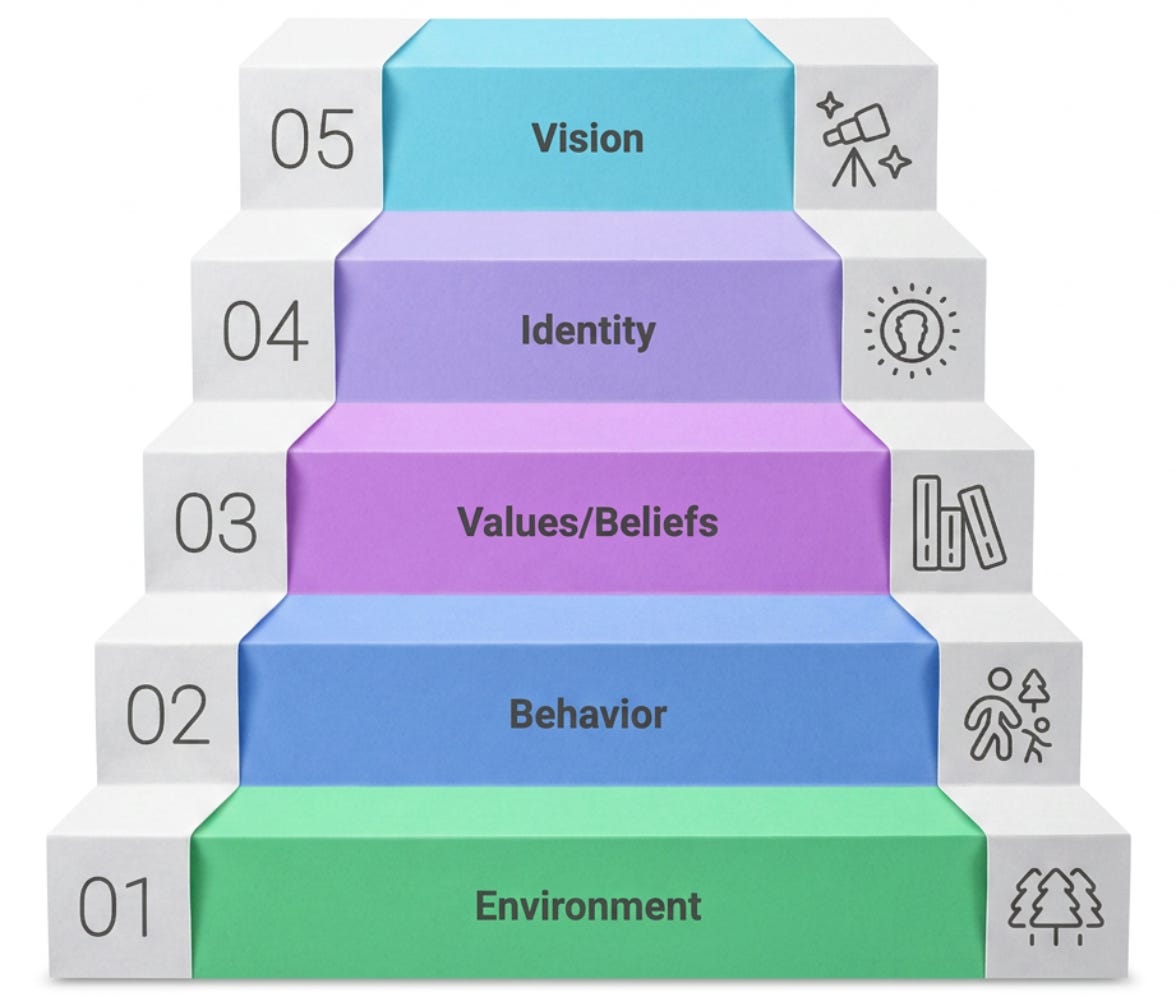
The latest version of the Shared Values Poster (v3) does the first job: it names the values clearly, at the level where they can actually steer something. The behavior is the second conversation, and that’s most of what the rest of this writeup is about.
To be honest, I think I was really holding onto the idea that I needed a word-as-acronym, which was trendy two or three years ago. I don’t need anyone to memorize these words as if the letters are the center of truth. So this year I pivoted.
We are running an experiment on our students with this tech to see how it shapes their thinking. We really don’t know how it’s going to impact them long term (channeling Jonathan Haidt's latest TED Talk). And I would say that it’s a reason that our thinking has to stay adaptive and flexible now more than ever. The last three or four years have been one long revision, and the tech keeps developing, so I plan to make versions four, five, and so on. Naming this mindset, I might call it flexible refinement: open to new ideas and tightening impactful practices, and letting go of those that didn’t quite land.
Practicing flexible refinement, that meant moving the poster up Dilts’s ladder to where values actually live, and adapting the words to match what teachers were already saying. Curiosity. Intentionality. Responsibility. Transparency. I had the pleasure of running the language past several educators I deeply respect, and their feedback is in the version you see today. This poster could not have been made alone. My job, in the end, was to paraphrase a lot of incredible thinkers and design it into something a class can share. That’s why it’s version three. And it’s why “shared” is the word on it that matters most. It’s for teachers, students, parents, admin, and the community alike.
AI Disclosure
Images. The compass image in the poster was generated with ChatGPT and Gemini, then refined into the final graphic. Claude served as a thought partner in refining the words across several drafts, but in the end the words are my own. The graphic of Dilts’s Pyramid was created by Napkin.ai using its origami art style.
Poster Content. Shout to Nick Soentgerath and the other educators who acted as my thought partners in shaping this content. Thank you all for pushing back on earlier drafts and being the editors behind the scenes.
Writing. I spent 11-12 hours on this post. The biggest time commitment was actually on word smithing. I had a lot of debates with Claude 4.8 Opus-High on this one. I’m not sure that I used the right model, but I wanted the soundest reasoning possible. It was fun to argue with AI, which helped me to articulate my thinking and where I wanted to see the poster go, as well as the ways the earlier drafts were unclear.
Claude helped me take my earlier posts, drafts, and verbal notes and make them into a cohesive story. I edited all final versions, regenerated them, edited them again, and finally read them aloud to make sure my voice and ideas were present.