


New Here?
Hey, it’s a new school year, and I have new followers. In case you are new here, I write about how K-12 educators can design learning experiences in which AI supports student thinking instead of replacing it by naming the thinking, setting concrete expectations for AI’s role, and making learning visible along the way. For the full rundown of my approach, please visit Start Here.
Intro.
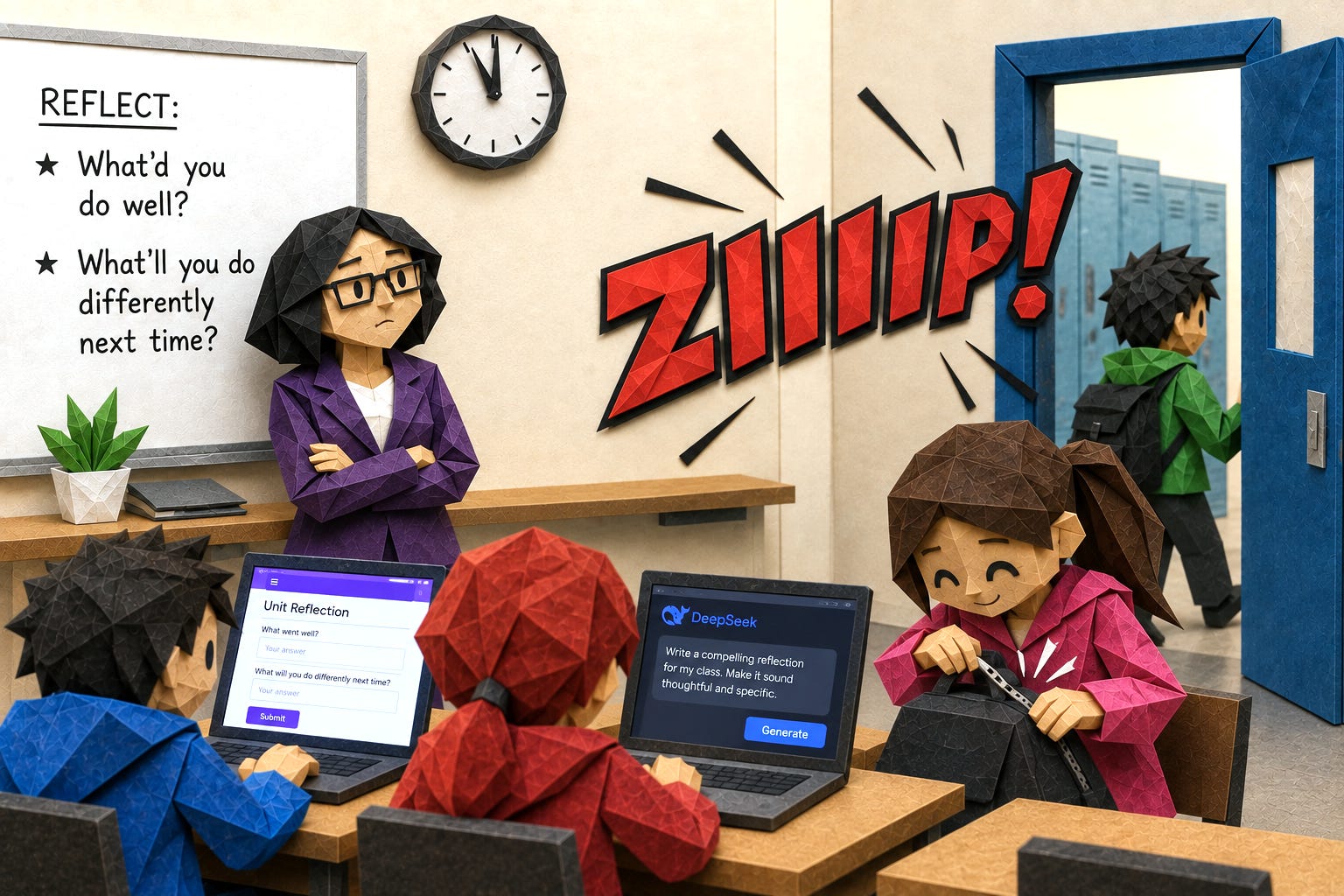
It’s often two minutes before the bell, and your students are doing that thing where you, their teacher, are still making one last proclamation in the name of essential last-minute learning, and you hear the room popcorn with backpacks going “ZIP, ZIPPPP, ZIPPPPPPPP.” The kids all know what they’re doing as they indicate the time to you nonverbally: not only is the class almost over, but their window to learn is closing fast.
Then you put on your best teacher voice and proclaim that they need to complete a reflection before they go. Your tone betrays how much you actually believe in this final countdown of metacognition. “Ok class, let’s just quickly reflect to close this unit up: What went well and what’ll you do differently next time?” They produce something to satisfy you and get out of there. They type “I like my team; next time I’ll manage my time better!!!!!!1” into that oh-so-default-aubergine Google Form you made only moments ago. Or maybe they fire up DeepSeek, ask it to make a compelling-sounding reflection, only to copy and paste it into your form. They make their way out of the room only to forget what they wrote as their friend shows them an Instagram video of a dancing cat.
Aaand scene. There were several familiar challenges going on there, weren’t there?
We as teachers often assume we know how to reflect. One of the most common mistakes is that we rush it, and that rushing teaches students exactly how much we think it matters, as well as the depth of thinking they will actually reach. In that rushing, we make the reflection for us when the point should be for students to build a level of self-awareness they can use in the next task. That self-awareness and application is what we might think of as self-regulation.
If rushing is the norm, imagine what happens with AI as a part of the learning experience. Students who never learn to manage themselves will happily let a chatbot do the thinking for them because they won't notice their thinking has been usurped. In fact, that cognitive outsourcing feels good in many ways because the task is complete, the teacher is satisfied, and their grades remain parent-pleasing. My point is that metacognition in the contemporary classroom is less about task completion and more about learning from our experiences, recovering from mistakes, using AI responsibly, and relying less and less on the teacher to rescue students as things get challenging.
Shifting into genuinely reflective thinking and using it to guide actions is as much an art as it is a science; it takes time, structure, and students who aren't distracted. The worst time to try is when students are in a rush for any reason. So in this article, I’m advocating that students not follow my processes, or necessarily your processes, teachers, but design their own intentional use of AI, deciding where it belongs in their work, where it doesn’t, and how they’ll know the thinking was theirs. Independence is something we all seek: students who can set goals, choose strategies, work with AI tools in deliberate and constructive ways, and notice when the AI is serving their goals and when it has started doing the thinking for them. Students who manage themselves are learners who will use AI wisely long after they leave our classrooms, and I believe metacognition is a key strategy for getting them there.
What Does The Research Say about Student Independence?
Disclosure: I used Consensus to help me compile relevant and helpful research. This article was written by me, but this portion was supported more by AI. See my AI disclosure at the end for a summary of my process.
Bureau and colleagues (2022) pooled 144 studies and more than 79,000 students and found competence to be the strongest predictor of self-determined motivation, ahead of autonomy. Hold the phone, that’s almost counter-intuitive.
Before students choose how to work, they need a level of understanding. One way that could happen is by seeing exemplars and learning the associated skills to produce something similar. Focusing on choice and process without understanding what good work looks like and must include can only go so far in supporting independence. On top of that, how can students judge AI output if they aren’t even sure what good looks like in the first place?
Warshauer (2015) found that productive struggle (also often referred to as desirable difficulty, effort, etc.) stays productive and meaningful when teachers probe and question rather than tell. Teachers who rescue kids when they have the opportunity to struggle productively also remove the learning that could have taken place as a result of that challenge. I have two interpretations. First, rescue often feels like care, so in that sense, it might make the teacher feel good rather than helping the students to grow, so in that sense, it’s tempting to want to rescue them when they’re stuck. Second, AI is the ultimate rescuer! When a kid is stuck, there is an always-on, eager rescuer that can happily take away friction. But in that case, it’s up to the students to manage themselves from wanting to be rescued. I would again argue that metacognition and taking a beat to consider when and how AI supports their thought process will help them to avoid accidentally using AI in unhelpful ways. For example, while you are working, how will you know you are growing? Given that you’re at school to learn, what things should AI do and not do to support you? What signs will you look for?
Teaching students to regulate their own learning shows one of the most reliable effects in the research; Dignath and Büttner (2008) found an average effect of 0.69 across 84 intervention studies, and the programs that explicitly taught planning, monitoring, and evaluating were among the strongest. Students who monitor mid-task catch problems while there’s still time to fix them. That’s the difference between the rushed Google Form and actual self-regulation. The Education Endowment Foundation's 2018 guidance report on metacognition and self-regulated learning recommends that teachers explicitly teach metacognitive strategies, model their own thinking out loud, and gradually withdraw support as students gain proficiency. And when it comes to AI, self-monitoring is what can help students notice when AI is taking over the learning.
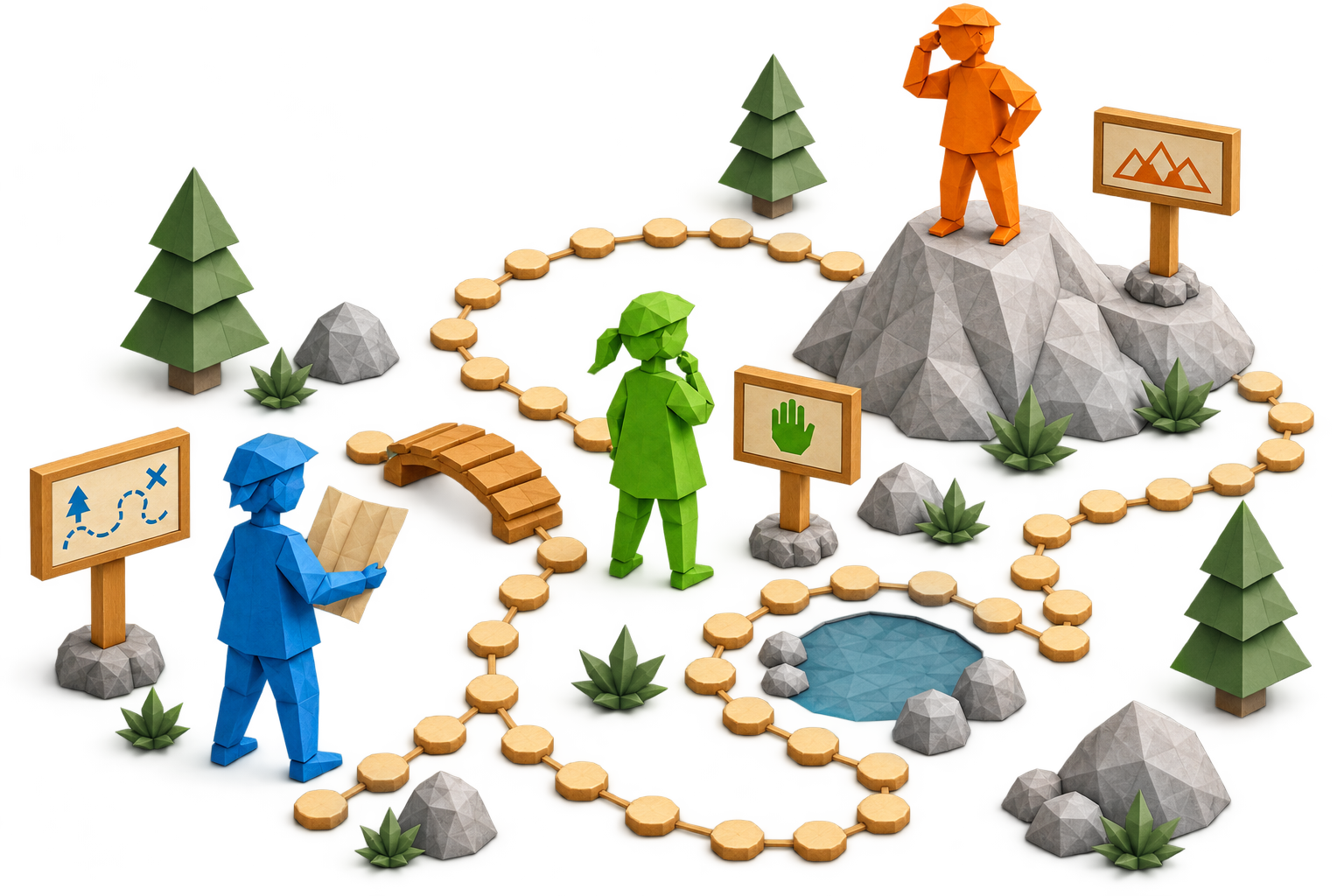
Alongside the research, it’s worth noting that there is a dispositional shift that many of us have to make in our minds as teachers. When students plan a learning process to meet the learning goals, the teacher’s role is less about controlling a deterministic outcome with one expected product at the end; more about establishing a goal with kids and helping them build their own paths toward it. Common moves you can make include circulating, asking what strategy they’ve chosen and why, and helping them notice when their efforts are paying off and when they’re not. This is what we mean when we talk about designing learning experiences rather than assigning work. Across a learning experience, metacognition comes into play at three points: before, during, and after learning. Let’s look at three metacognitive processes that I made for your consideration that I call Foresight, Oversight, and Hindsight that can be used to support students in both creating their own processes and practicing independence.
Three Processes.
1. Foresight: Metacognition Before Learning
Before the work begins, students plan. They align their actions with the objective, anticipate their strategies, and decide up front what role AI will play so they lead the interaction instead of drifting into it. They also decide how they’ll see their own thinking as it unfolds; that is, how they’ll document the learning.
2. Oversight: Metacognition During Learning
Mid-task, students pause and check. Is the strategy working? Am I still true to my plan? Am I in control of the interaction with AI, or is it in control of me? Am I still cognitively engaged, or am I watching text scroll by? An accountability buddy strengthens this move: a peer or a teacher who asks the check-in questions students haven’t yet learned to ask themselves.
3. Hindsight: Metacognition After Learning
Afterward, students look back at actual work samples, examine what they did, consider why things turned out the way they did, and how, if, and when AI actually helped them with their intentions. Sometimes the honest answer is that it didn’t, and that answer is also powerful data in its own way.
Teachers can absolutely define and create their own reflection processes; my processes are examples that work along with a growing collection of processes built for different kinds of thinking. What matters is that metacognition gets time, structure, and enough repetitions to become a practice instead of a mindless algorithm. Check out my full article on Foresight, Oversight, and Hindsight for more details.
Monday-Ready Moves/Resources.
Ready to try these ideas in your classroom? Here are a few strategies and resources you can use to support student independence with AI and metacognition.
Flip the reflection slot. Open class with reflection on yesterday’s work instead of squeezing it into the last two minutes before lunch. Same practice, fresh brains, and the reflection feeds directly into today’s plan, serving as a meaningful grounding.
Build the verb bank together. Put three questions on the board: What verbs or actions might lead us to this goal? What thinking moves will we need along the way? Who might be part of the process? If you’re an IB teacher, you have the command terms. Write the answers and keep the bank posted; it’s the class’s shared language of thinking from here on.
Follow a Process Together. Take a task you already teach and walk students through a process you designed, naming each verb as you move. You’re modeling what a designed learning experience feels like from the inside, so they can build their own later. You could also use one of my processes, generate one with the support of AI, or create your own with this how-to article!
Assign accountability buddies. Pair students and give the pairs two mid-task questions: Is your strategy working and helping with your goals? Are you still leading the AI, or is it leading you? Two minutes, once per work session. That’s metacognition in the form of Oversight.
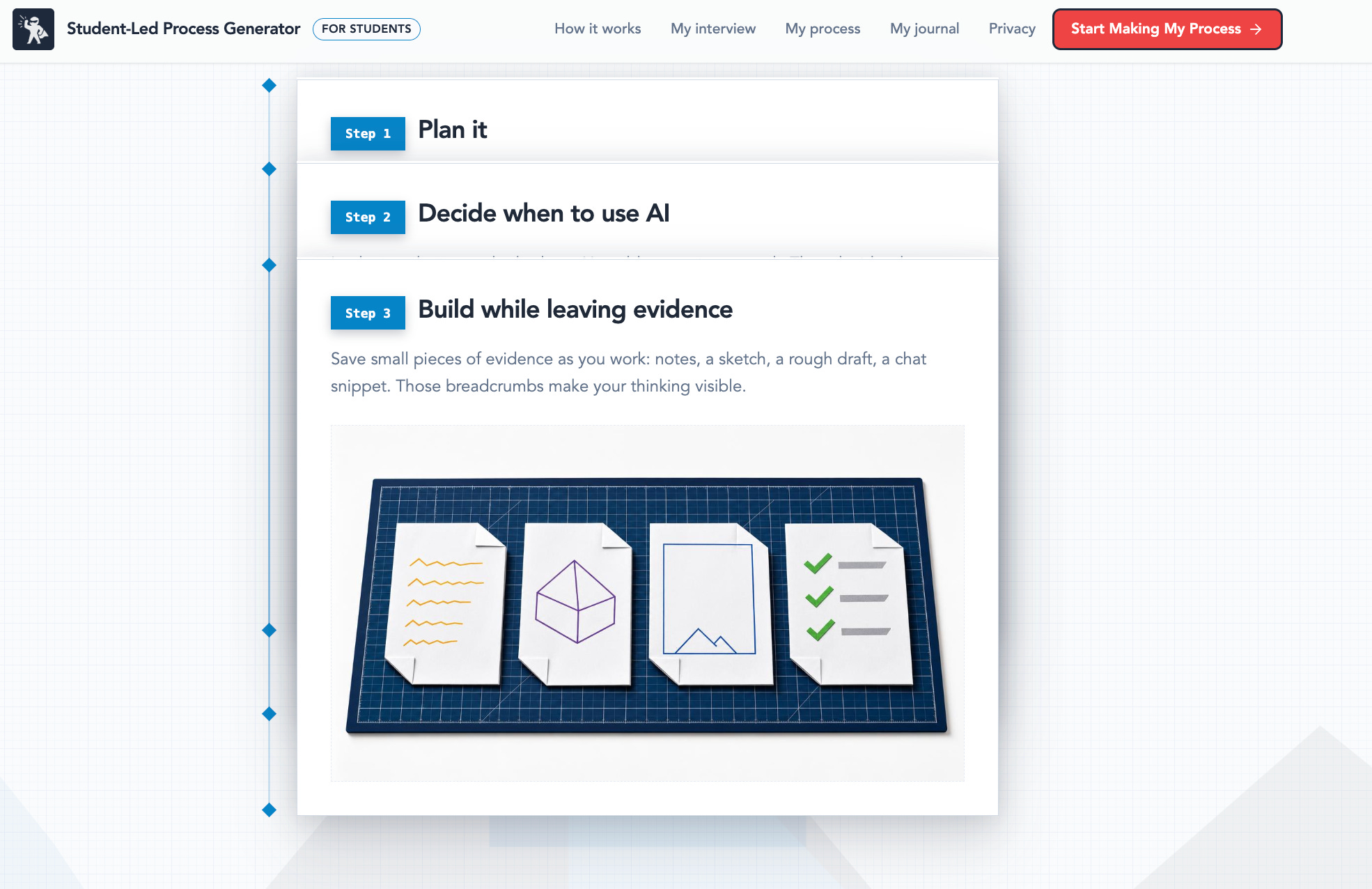
Start a process journal on day one. A doc, a notebook, or the exported deck from The Student-Led Process Generator; the format matters less than the habit and the ability to look back at the artifacts for and of reflection. Plan at the top, check-ins in the middle, Hindsight at the end. The purpose is for the kids to see their growth and consider what happened, why it happened, and what they learned from the experience about themselves as learners, the subject matter, and their use of AI as a powerful tool.
Reading.
Here is some great reading if you’d like to learn more about metacognition, self-regulation, and the teacher’s role as someone who guides the process and scaffolds students into independence, and not their intellectual savior.
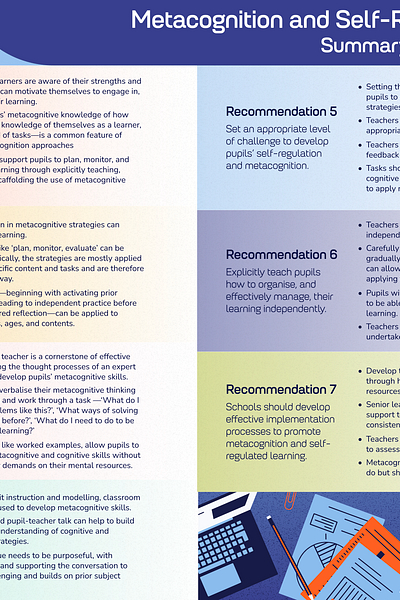
Education Endowment Foundation. Metacognition and Self-Regulated Learning: Guidance Report. 2018. Free and short report with recommendations to implement immediately. Below I have a one-pager with a summary of their findings. Link to the report below in Works Cited.
Wilson, Donna, and Marcus Conyers. Teaching Students to Drive Their Brains. ASCD, 2016. A short book about practical strategies to help students gain independence. Check it out on Amazon.
Ritchhart, Ron. Creating Cultures of Thinking. Wiley, 2015. A powerful book about designing a classroom that values deep thinking. Check it out on Amazon.
Stanier, Michael Bungay. The Advice Trap. Page Two Books, 2020. A funny and light-hearted reality check on our need to rescue others as coaches, but I think applies to teachers fostering student independence as well. Check it out on Amazon.
Works Cited.
Bureau, Julien S., et al. “Pathways to Student Motivation: A Meta-Analysis of Antecedents of Autonomous and Controlled Motivations.” Review of Educational Research, vol. 92, no. 1, 2022, pp. 46-72. https://doi.org/10.3102/00346543211042426.
Dignath, Charlotte, and Gerhard Büttner. “Components of Fostering Self-Regulated Learning among Students. A Meta-Analysis on Intervention Studies at Primary and Secondary School Level.” Metacognition and Learning, vol. 3, no. 3, 2008, pp. 231-264. https://doi.org/10.1007/s11409-008-9029-x.
Education Endowment Foundation. Metacognition and Self-Regulated Learning: Guidance Report. Education Endowment Foundation, 2018. https://educationendowmentfoundation.org.uk/education-evidence/guidance-reports/metacognition
Warshauer, Hiroko Kawaguchi. “Productive Struggle in Middle School Mathematics Classrooms.” Journal of Mathematics Teacher Education, vol. 18, no. 4, 2015, pp. 375-400. https://doi.org/10.1007/s10857-014-9286-3.
AI Disclosure.
This piece began as my own brainstorm of the year’s focus. I used Claude to structure the argument and draft prose in my voice, then revised and edited the draft myself.
The research portion was generated initially by Consensus.app then refined through several conversations with Claude to distill it down into the key points that are relevant to you, dear reader, and then edited by me for factualness, readability, and voice.
The three processes, the classroom moves, and the opinions are mine.
The recording of this episode is me, at home speaking out each and every word. I enhanced the audio with Adobe Podcast to give it polish. The intro music was generated by Suno.
I love the "reflect on last class's content at the beginning of the class" instead of the end. So good!