


This is one of a growing collection of AI-enhanced processes I’ve designed to support different types of thinking in the classroom. You can find the full collection at aienhancedprocesses.com/t/processes. I’ll keep adding to it as I build more. The content below is a preview; the full collection of processes will be available in my book.
At a Glance
This is one of my most popular processes that can be used quite widely. I have found it to be the most helpful for classes practicing creative thinking which I define below in a graphic titled “Traits of Creative Learners Who Use AI”. The core of this process is that we start and stop with human thought, creativity, and analysis, and when we use AI, we have an iterative dialogue, rather than simply taking the first output with little consideration.
The Think, Generate, Edit process (below) has specific verb-based actions that you or your students can use when being creative. The intention is that we begin and end with our own efforts, and in the middle, we collaborate with AI, rather than letting it do the work for us.
General verbs were used in this process so that you can define them for your own creative context. For example, the word “think” could be made more specific by saying, “think creatively by brainstorming a range of possible story ideas.” The second step could be “generate by expanding on one idea, using a text-based AI to explore alternative openings, settings, or tones”, or “edit by curating and refining the strongest pieces, weaving them into a coherent draft that reflects your own vision.”
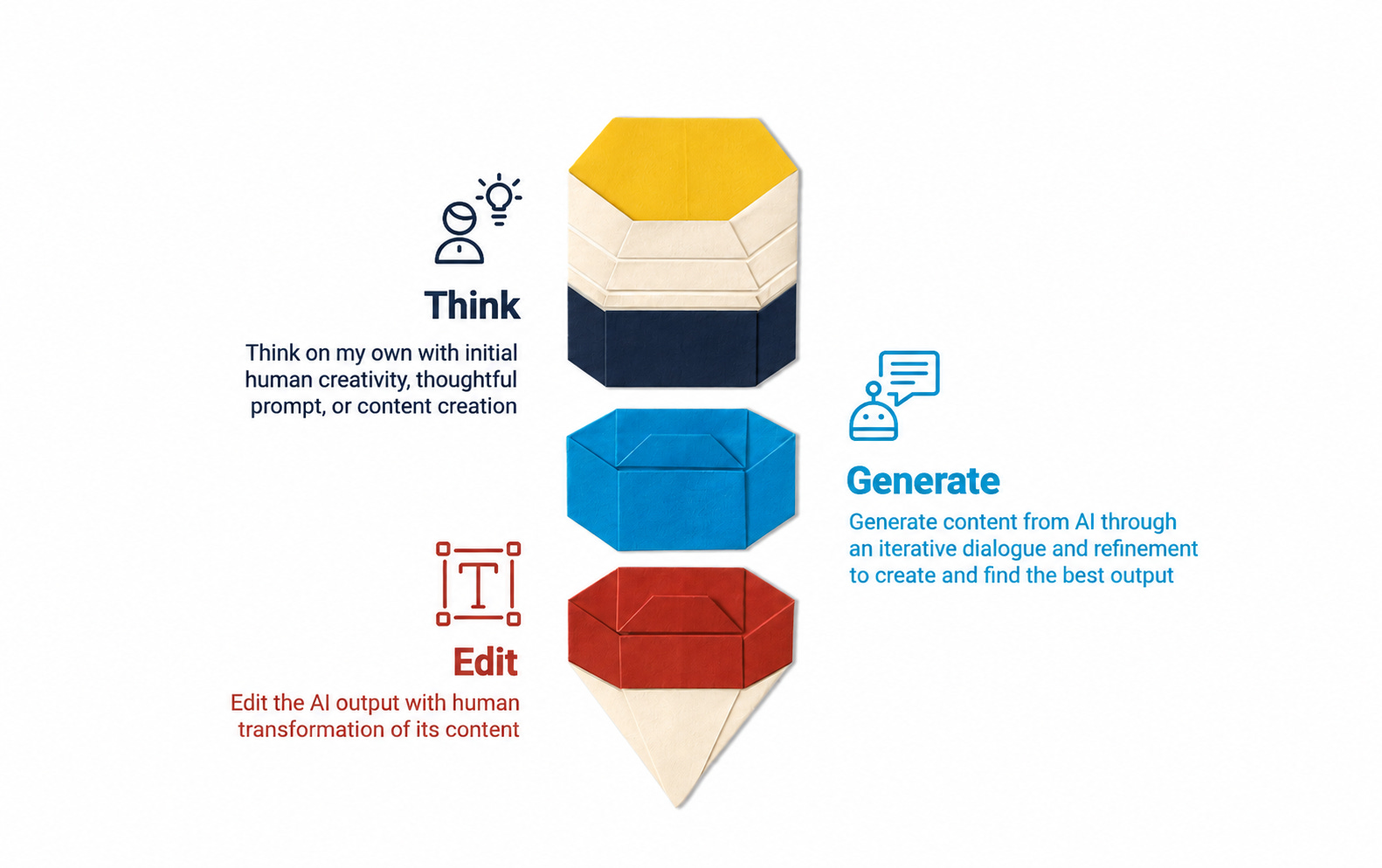
Think

For the purposes of this process, the word “think” is intentionally vague. I wanted to use a term that could encompass both creative and critical thinking.
Before engaging with AI, we should develop high-quality content that reflects our intent. This might take various forms: crafting an essay that captures our distinctive voice and perspective, composing a song that expresses our musical ideas, or creating a photograph that demonstrates our understanding of lighting, composition, color, and visual storytelling. It could even be in the form of a well-thought-out prompt. Whatever the thinking might be, it serves as the foundation for the AI interactions in Step 2.
Thinking with AI could look like creating a pencil sketch, a song, a prompt, having a chat, a photograph you took, a whiteboard mind map, and so much more. With multi-modal AI models, we can input just about anything that expresses our thoughts.
Generate

Output involves an iterative dialogue with AI tools. Through careful prompting, refinement of inputs, experimentation with different AI models, and continuous adjustment, we work toward obtaining results that complement and enhance our creative vision or intent. This stage requires patience and strategic interaction to achieve the desired outcome. Furthermore, you are engaging in both creative and critical thinking throughout this step: what did you create? Does it meet your needs? If not, how can you adjust and do it again to get precisely what you want to express your vision?
Edit

This step is crucial because it’s where we critically examine AI output and make it our own. Through human judgment, expertise, and creativity, we transform what the AI generates into something that aligns with our original intent.
Although it appears as the third step, editing is rarely the end of the process. Creative work is iterative, and we often move back and forth between thinking, generating, and editing as ideas evolve.
At this stage, I intentionally recommend stepping away from AI. Editing is our opportunity to slow down, apply analytical and creative thinking, and ensure the final work reflects a distinctly human voice.
So simple, so clear, so helpful. As usual!
Thank you for this! I recently came across an interesting TED Talk about AI. I'm sure you know, but here it is. https://www.ted.com/talks/priya_lakhani_this_is_how_kids_should_be_learning_with_ai