

Who Should Be Efficient with AI in Schools? Part 2: The How.
How to design learning-first processes that keep kids as active learners.


Summary: From Part 1 to 2
In Part 1 of this series, we explored the risk of our students sliding into “the humans of Wall-E” habits in which they use AI for efficiency. In this follow up, we will look at how to operationalize a K-12 classroom that leverages AI to support meaningful work as a “superpower” while still requiring a final product.
A False Dichotomy
I’ve been mentioning the idea of a polished product quite a bit in this article, so it’d probably be helpful to acknowledge that I am not suggesting that we only focus on processes in our classrooms. It’s sort of an age-old argument and it is really a false dichotomy. We cannot have a process without a product, evidence of learning, or artifacts. And we cannot have a product without a process that leads us to creating something worth sharing.
I find that often with kids, the product becomes the why, but they lack the patience or skills to utilize a process to get to a polished product. That is one impactful way teachers can facilitate learning, the co-construction of meaningful processes to support effort, creation, collaboration, and polished products.
Since generative AI is fabulous at creating products, we cannot emphasize only the product, even inadvertently (for example, “here’s a prompt, go home and write on your own, then share your finished work with me for a grade”). A clear process allows the teacher to set expectations and ensures that the student remains the pilot. It breaks something massive into digestible steps. This is what I mean by processes turning into strategies. They help kids practice to think with AI and when we release them to the world after high school, they will have specific ways to use this technology in their utility belts. Wow, so many superhero references, but you get the point.
Solely focusing on a product, without insight into how students arrived at their thinking, can turn into AI helping kids “do school” by efficiently generating a product to satisfy a grade. However, simply adding “process” to an assignment is not a panacea, and should not replace other forms of good teaching.
Furthermore, if we are not careful, process-based education can easily turn into policing where students are overburdened with endless mini-products to demonstrate learning (read this great article by university professor, Jason Gulya, about this idea). In the age of AI, many are turning to process-based education so each step can be documented to prove a student did not “cheat.” This is an autopsy of work, not evidence of learning. When a process is used primarily for surveillance, it becomes compliance rather than a mechanism for thinking. And thinking is the whole point!
In the upcoming second edition of my book, I argue for a shift from documentation autopsies to breadcrumbs, which are contextually natural ways to trace thinking.
Their purpose is to:
Help students notice their own cognitive moves and support metacognitive awareness of growth. This is a huge one and the priority because it will actually lead to students being increasingly willing to exert effort by seeing that they are learning and growing and noticing that it’s paying off.
Support teachers in monitoring student learning as it progresses.
A breadcrumb is a form of mini-product that could be a quick voice note, a chat screenshot, a rough concept map, or a sketch. The goal is for students to capture their thought process in a way that supports their learning during and after the experience and to increase willingness to continue to try hard and think deeply. There are so many ways to create breadcrumbs that show a trail of thought. Below are a few ideas, and definitely check out the second edition of my book to see more real-world examples:
Screenshots Disagreement (A zero-prep approach): Ask kids to capture a screenshot of their chat that contains something from AI they disagreed with and to share their own stance on why it was wrong.
Screenshot Before and After: Ask the kids the take a screenshot before they worked with AI and then again after they worked with AI and to explain their changes.
Visual Timelines: Create a Padlet timeline that tracks the steps students took.
Integrated Journals: Use a process journal with specific spots to draft ideas and interact with a teacher’s bot.
Frameworks: Follow an established process (like the Stanford d.school Design Thinking cycle) and log ideas in a slide deck.
Persistent Chats: Have an ongoing conversation with a bot about the process, return to the same chat later, and eventually share the link with the teacher.
A well-designed process that constrains ways to naturally collect artifacts of learning, or breadcrumbs, is my overall recommendation. I would avoid documentation of student thinking that does not ultimately serve the student in reflecting on their learning, or serve the teacher in meaningfully coaching students to do so. Oversight into the thought process as a form of academic integrity is the byproduct and not the purpose.
To make a powerful process, it should explicitly name the thinking required at each stage (for example, “now we are testing assumptions” or “now we are synthesizing viewpoints”) and introduce AI to support that specific cognitive move. The risk of not naming a thinking move and failing to set expectations through dialogue is that students are left guessing about when and how they can use AI. They might overuse AI, or use it in a way that is inconsistent with your goals and be perceived as “cheating.” Naming the thinking moves clarifies expectations for both you and your learners, preventing misunderstandings.
Another overarching goal of K-12 education is to scaffold and support them until they have the agency to design their own workflows and processes. Teachers can provide structures so students can develop the discernment to manage their own thinking later and that likely will emerge as they have more experience in AI as a meaningful collaborator in high school or university.
I want to close this section by emphasizing that breadcrumbs do not have to be a burden. Not every breadcrumb needs to be evaluated. If we treat these artifacts as natural snapshots of thinking that serve the student first, it releases the pressure to grade every single step. A powerful, time-saving move is to have students reflect on their own breadcrumbs at the end, and then simply assess that reflection rather than the piles of rough work. Furthermore, breadcrumbs of thinking act as a safety net in that teachers can dip into them specifically when they notice gaps in a process or work that doesn’t sound like the student’s voice.
Classroom dialogue ideas
What would be possible ways to make your thinking visible during our process? How might you know if you grew during this experience? What would be a reasonable use of your time to document your thinking breadcrumbs along the way? What things would you like to be mindful of when using AI in each step?
Monday Ready Tools
If this has felt a bit theoretical, here’s a practical move you can use in class on Monday.
Goal: design a simple process that (1) names the thinking, (2) sets clear AI expectations, and (3) leaves small breadcrumbs of learning.
Steps
Name the thinking move (process). Alone, with your class, or in groups, list the thinking needed to succeed on the task. Use as many steps as you need.
Examples: generate ideas, plan, draft, check evidence, revise for clarity, reflect.
Set AI Expectations (AI-enhancement). For every thinking move, decide how AI can be used, or where it cannot. This is where “AI literacy” becomes practical: What tools do we have access to, and how do we use them so that they support (not replace) the thinking?
Collect breadcrumbs of evidence (formative assessment). Pick a small, natural artifact that helps students notice growth and helps you spot when AI did too much. Examples: a before/after sentence, a screenshot of disagreement with AI, a quick voice note (“what I changed and why”), a draft, a sketch, a brainstorm mindmap.
Option 1 to Make an AI-Enhanced Process
Access material I’ve made for you on AIEnhancedProcesses.com > Downloads has a series of posts with things you can use in your classroom to create a process as a teacher or collaboratively with your students. Below is one tool you can use that focuses on writing processes. The image below shows purple cards that are process word. Underneath them are expectation cards that show to what extent AI can be used in that step of the process.
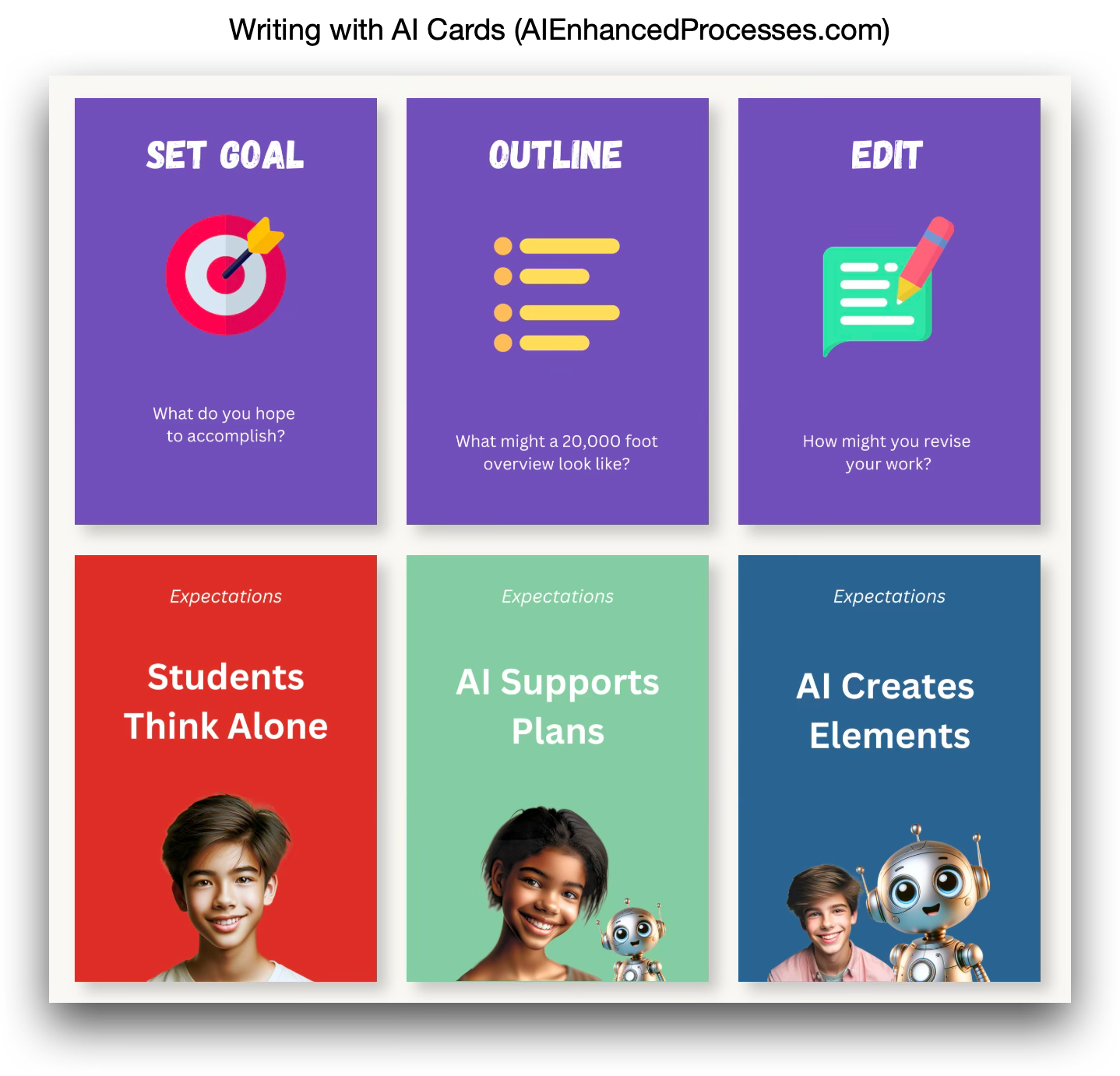
This tool is but one of many in the downloads section of my site. I’ve also got a Padlet template that does the same thing as physical cards, but it’s all virtual and free, making it easy to distribute. But what if you can’t print my materials or perhaps they’re not suitable for your classroom. I’ve got you.
Option 2 to Make an AI-Enhanced Process without Cards
If you can’t print cards, simply make your own with sticky notes. I’ve done this in a pinch many times when coaching teachers, and it worked.
Row 1: thinking moves
Row 2: AI expectations (Allowed / Limited / Not allowed + one sentence why)
Row 3: breadcrumb choice
The main point is the habit: involve students in the process, and encourage them to adapt it with rationale. That’s how we build self-directed learners who make wise decisions about AI, problem-solving, and learning.
Classroom dialogue ideas
Let’s make a bank of words that show thinking; what should go in it? Given our learning task at hand, what thinking moves should we use to create our shared process? If you’re ready, what thinking moves could you sequence to create your own process? What existing processes are out there that could work in this situation or be adapted to meet our needs (e.g. Design Cycle)?
Classroom Example
In Anita Vanessa Chou’s MYP 5 science class at Yokohama International School, AI bookends a scientific investigation with Foresight and Hindsight as two forms of metacognition. Before the lab, a Flint chatbot helped students clarify the purpose of the learning task, restate expectations connected to Criterion B, break the objective into variables and constraints, surface questions and uncertainties, and plan a safe investigation with intentional procedures.
Below is an excerpt from my book, AI-Enhanced Processes, in which I do two things: I label the steps in which AI was used within a deliberate process with a little robot. Second, I name the “superpower” that AI supported in the learning with a hero. Let’s take a look.
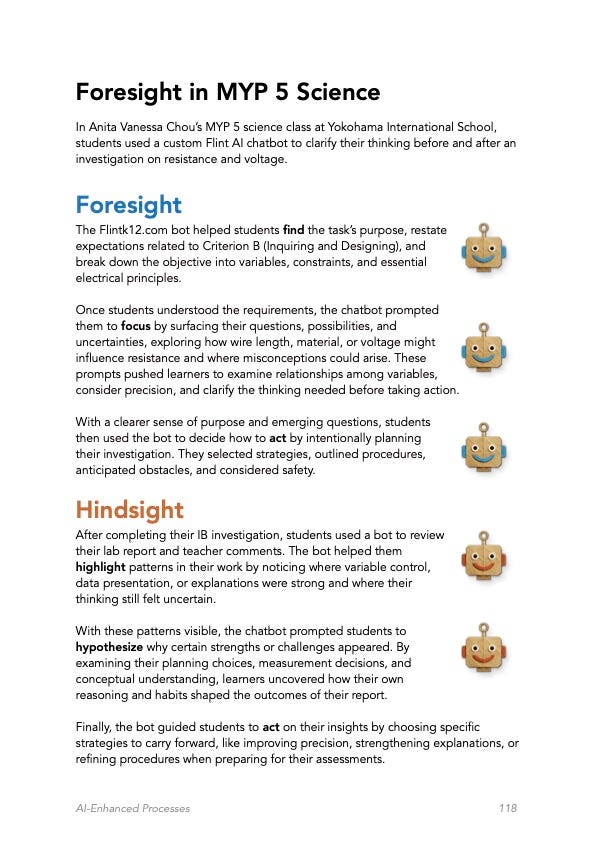
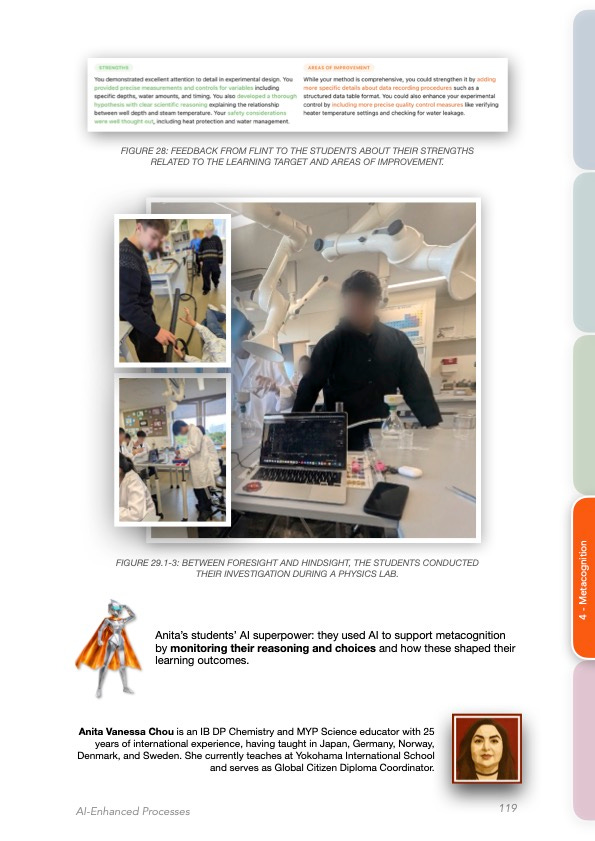
After the pre-task foresight, the students conducted the lab. The point is that the thinking stayed with them. They still had to make decisions, interpret what they were seeing, and deal with the messiness of real science. AI did not do that part for them. It was also highly collaborative between students, which matters because collaboration is one of the easiest things to accidentally erase when AI becomes a default shortcut.
After the lab, the same tool supported metacognition by helping students review their report and feedback, notice patterns in variable control and explanations, hypothesize why those patterns occurred, and choose concrete strategies to improve next time. The AI did not do the thinking for them. It scaffolded the thinking they were meant to practice as scientists, mostly through Socratic questioning that encouraged metacognition before and after the learning task.
It sounds counterintuitive, but using AI probably made the whole experience slower. But hey, that is a very good thing. That lazy and critical-thinking part of our brains I mentioned earlier, in Kahneman’s book, needs time and friction to actually do its job. In this case, AI did not accelerate the work; it increased the fidelity of the thinking.
Classroom dialogue ideas
What did you see happening in this classroom that shows AI was a collaborator with the students and not an assistant completing things for the learners?
Conclusion
If there is one thing I want to leave you with, it is this: efficiency is not the goal of students who are learning to use AI. The habits we practice with kids today will become the habits they practice as adults. So the question isn’t whether students will use AI. The question is what kind of habits we are building? Wall-E habits, or Iron Man habits?
Now what do we do with that? We stop treating AI like a blanket permission or a blanket ban, and start treating it like a design choice inside a learning-first process. In every assignment, we can name where the thinking workout needs to stay with the learner (productive struggle), and where AI can remove barriers that don’t actually create learning (unproductive struggle). We ask students to keep breadcrumbs to serve themselves and their learning first, and second to check whether AI is supporting the thinking or creating cognitive debt; the quick diagnostic shared above can help determine if students engaged in the learning. The breadcrumbs should be small, natural traces that help students notice their own cognitive moves and help teachers coach learning as it progresses. Not to police kids.
We don’t just want polished products, we want AI to be a collaborator that strengthens judgment, confidence, and independence, the stuff that actually transfers when students are on their own.
Classroom dialogue ideas
What superpowers does AI make possible for us when it comes to animals, science, medicine, transportation, knowledge? If you were to imagine an ideal world, how would you like to see AI become a superpower for you as a learner?
Great Reads Related to This Article
These are some of the works I reference, allude to, or was inspired by while writing this article. All of them look at the ideas presented here from a different angle and are recommended reading in the form of articles or books.
“Problems with ‘Process Over Product’ (Part 1)” by Jason Gulya
“Why Does Thinking Feel So Hard?” by Carl Hendrick
“Gotcha Culture” by Colleen Ferguson
AI Disclosure
Part 2 of this article was created through an iterative Think, Generate, Edit process, repeated multiple times. The initial draft was written by me and informed by my work on AI-Enhanced Processes, Second Edition. I then used multiple AI models: ChatGPT, Google Gemini, Claude Sonnet, and ChatGPT Deep Research. They were used to refine, challenge, and extend my thinking. Visual elements were generated with ChatGPT. All writing and final decisions were reviewed and edited by me, a real human, to ensure coherence, intent, and accuracy.
It’s also worth disclosing how long it took me to write this article. I would estimate 8-10 hours were spent writing, thinking, rewriting, generating, etc. I would not say that was a particularly fast way of working, rather AI was my collaborator.