


In my last two posts, I explored ideas related to efficiency in K-12 classrooms. We looked at how to move from thinking of AI as a tool to help kids save time to seeing it as a collaborator that pushes their thinking and makes new things possible. In this week’s post, I want to explore another much-discussed, still-troubling area of our lives impacted by generative AI: creativity.
Graphic designers, musicians, photographers, and copywriters have found their crafts threatened by low-quality “AI slop”: AI-generated content that lacks the human touch but gets forgiven because it amuses us, or because of the hype surrounding the technology, that we accept what would normally be unacceptable.
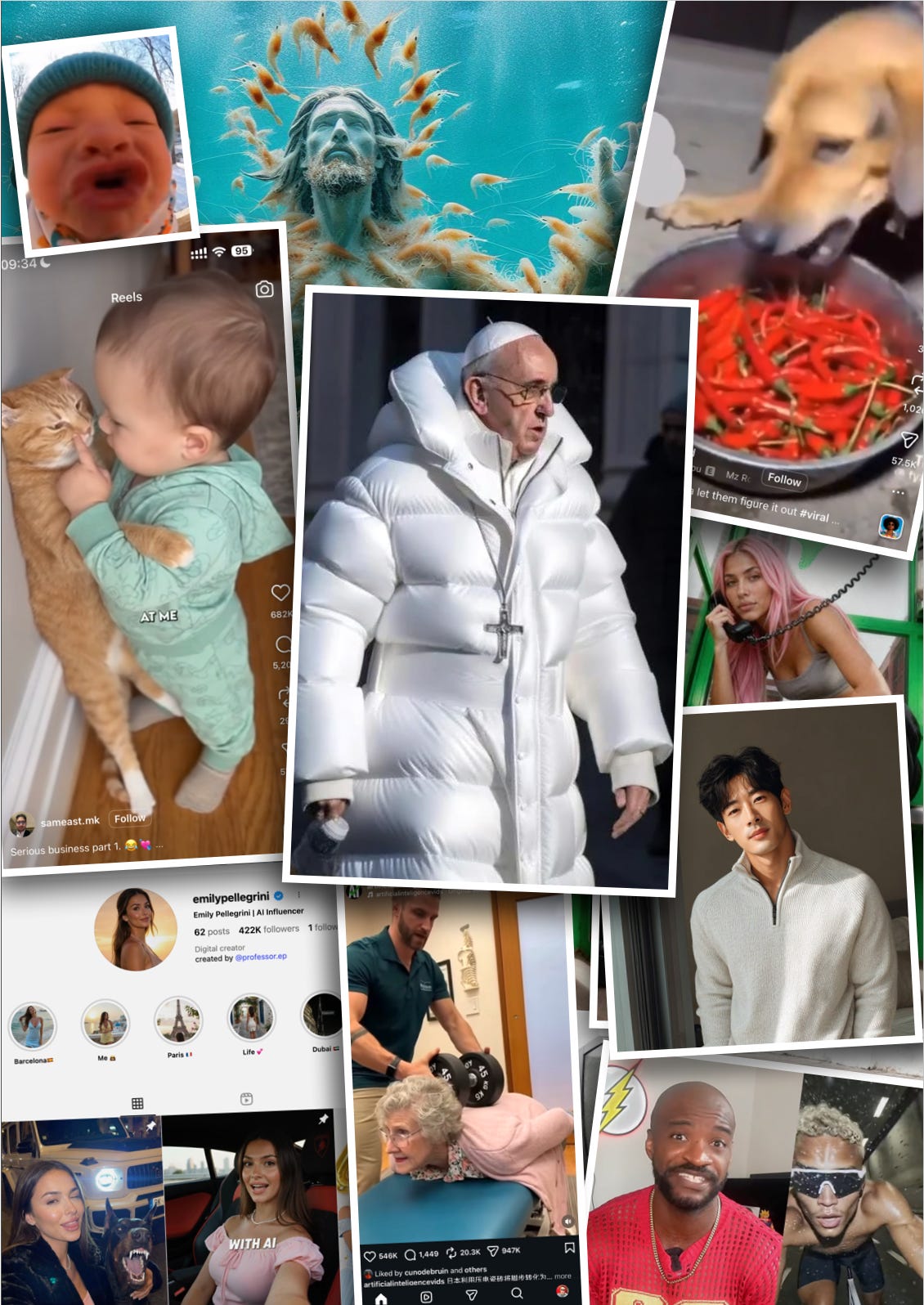
Ok, if you can get the image of Shrimp Jesus out of your head, let’s go back to creativity, efficiency, and process.
An efficiency-first mindset becomes risky when applied to creativity, because creativity is not just “making something”, and it is especially not whipping something together and calling it a day. The type of creativity we want students to engage in is actually a challenging mental task. I’ll speak to this more in a moment with a graphic below, but creativity is highly personal and expressive; it’s originality and collaboration; it is analysis and technical skills.
Some phrases you might hear that would indicate this sort of efficiency-first mindset is at play are below. Also in the conclusion, I have these look-fors with alternatives that we want to hear instead. Some preview samples include:
“I just need to get this done.”
“What’s the minimum to get an A?”
“Do we have to show our process?”
“ChatGPT, write this essay for me, here’s the prompt.”
“I’m stuck, can you just tell me the answer?”
“Why do we have to do multiple drafts?”
“Let’s have the students all do the same type of project.”
If the priority is simply finishing a task, AI starts to stand in for the creator instead of supporting the human work of expression. The path of least resistance will always win, and if the goal is task completion rather than meaningful thinking, then in the age of AI, we end up with “school slop.” In schools, that often means assignments no one feels invested in: students generate the work with AI, teachers respond with AI, and a grade gets passed back and forth. It is fast, it looks finished, and it drains the human presence that makes creative learning worth doing. It’s compliance, not creativity, and while this existed before AI, AI is certainly shining a light on this problematic mindset.
In this dystopian premonition of AI taking over creative thinking and relationships, we get into a cycle in which teachers assign work that doesn’t merit effort, so students stop believing effort matters. Students then stop trusting the teacher’s expertise because the feedback feels automated, too. That human connection, the part that was so important, gets diminished due to innovation for innovation’s sake. School slop becomes normalized thanks to AI and a curriculum that might not have kept pace with the rapid changes in our world.
In the upcoming second edition of my book, AI-Enhanced Processes, I dive deeply into AI superpowers. Here is a preview of three concepts from the new book that frame how we might protect creativity and avoid school slop.
Classroom dialogue ideas
Can AI be creative, or is that something only people can do? How can we still express ourselves and invite AI into the space without sliding into “school slop”?
Concept 1: The “Steak Dinner” Theory
I am incredibly fortunate that the second edition of my book features a foreword by Katie Novak, a leader in Universal Design for Learning (UDL). In her foreword, Katie shares a brilliant analogy about product versus process. She compares education to hosting a dinner party. It doesn’t matter how good the steak or the wine is (the product) if your guests are vegetarian or sober. The goal isn’t the food itself. The goal is the gathering and each person being nourished (the process and the outcomes).
This analogy frames what I am trying to do in the second edition. We are moving away from looking at the shiny AI tool or the product as output (the steak) to designing the experience (the dinner party). When we apply an efficiency mindset to a dinner party, it fails us. We don’t want to efficiently consume calories; we want a meaningful experience. Learning, in this case, is less about gobbling down information and more about savoring, discussing, connecting, and noticing what students prepared.
School slop happens when we confuse the steak for the party. We get obsessed with output and forget that the point was the experience and nourishment.
Concept 2: Creativity with AI is a “Sandwich”
This post really is leaning on food metaphors. We’ve got “slop,” dinner parties, and now a sandwich. I know, I know. But this one is worth keeping.
If good teaching is nourishing, it should be experiential and cognitively stimulating. The question is: how do we structure lessons so students want to spend effort on thinking, not on decoding confusing instructions, or bypassing learning to complete tasks efficiently and using AI to create slop?
One option I use in the book is Think, Generate, Edit (TGE). The idea with this process is that you should name the thinking moves that matter in your context and build a process around them. Better yet, help students design their own processes once they’re ready. But if you want a simple starting point, try this sandwich.
Think (Human)
We start with a human thinking independently. This step is AI-free to protect productive struggle and asks students to think deeply about something. Thinking in this case could be a drawing, a prompt, a storyboard, a photo, a song, an outline, a draft, etc. For example, in an art class, this might look like: think by creating a sketch of your idea.
Generate (AI + Human)
We use AI through a back-and-forth conversation. We are not doing this to save time. You aren’t using AI as a vending machine; you are using it as a collaborative partner. In an art, this could look like: upload your sketch, generate several interpretations in different styles, refine prompts in detail based on what you notice, then choose the best ones you would like to use in your next step.
Edit (Human)
We end with a human touch by editing, refining, and curating. We never just take AI output and submit it. In an art, this could look like: load the image into an iPad and add your own edits through illustration and effects. This is where school slop gets defeated, because the student is making taste-based decisions and doing real craft.
To illustrate TGE, I share a story in the book about remixing a song I wrote back in 1997.
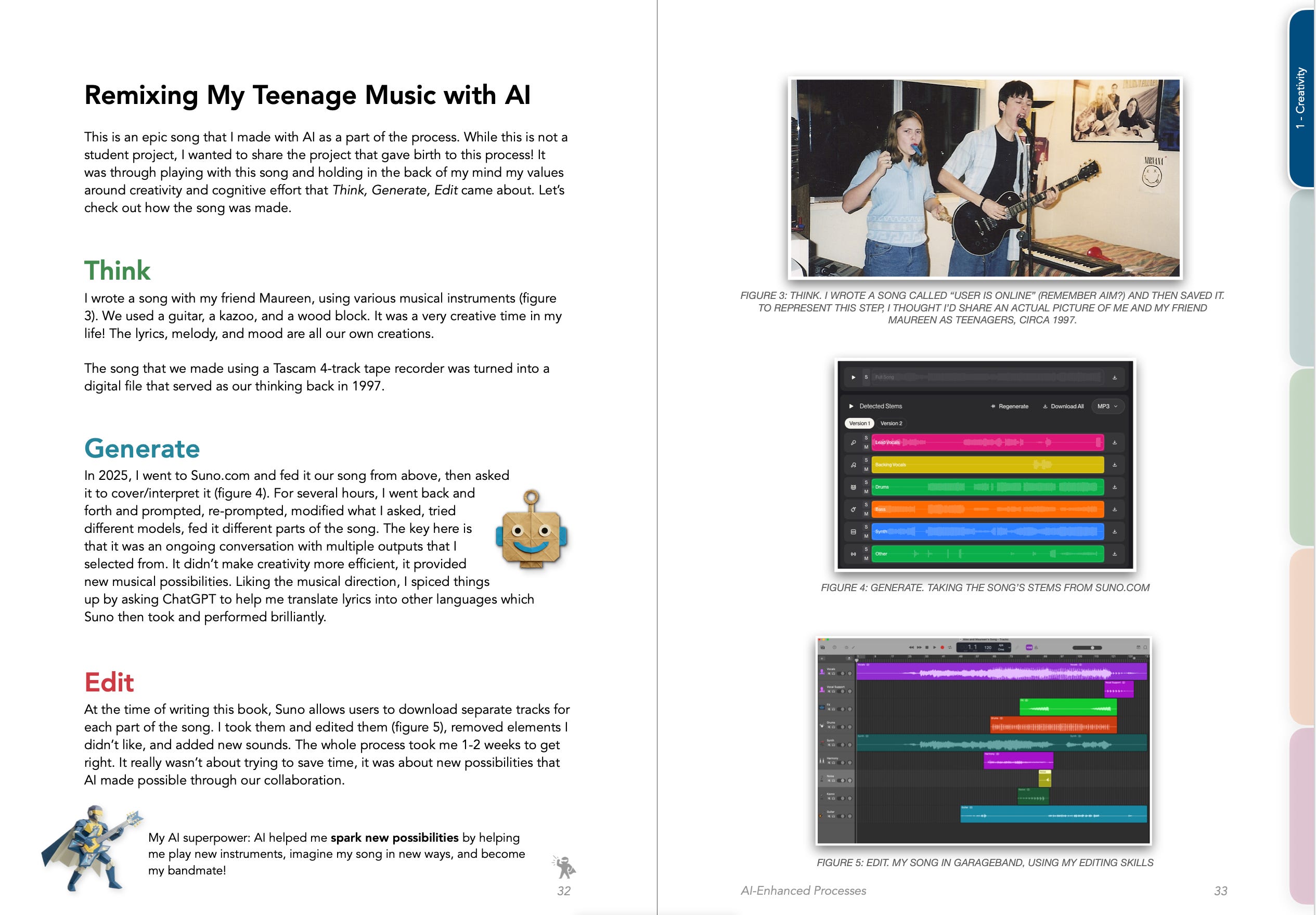
As shown above, I took a collaborative approach. In this case, a collaborative approach looked like both AI and I contributing to a new and unique song. I uploaded a song that I made as a kid (think), then had a conversation with AI and generated several covers that were more refined with additional instruments (generate). Finally, I edited the song using GarageBand, added effects, and removed sounds (edit). If I had used generative AI to quickly make a song without engaging in any effortful thinking, I might have written a half-hearted prompt in Suno (AI platform that makes music) and called it a day. I’ve seen kids do the same thing, basically telling it to “make a song” without much thought, effort, or process to support their thinking and effort. Without the process, the amusing output from Suno would probably have been meaningless slop that had stopped at entertainment.
Making a song with TGE was so inspiring that it led me to create several other songs, including ones in other languages, featuring instruments I can’t play (keyboard and guitar player here), and vocals I could never produce.
Classroom dialogue ideas
Can AI support your creativity? How should or shouldn’t we use AI in a given learning task? What process could we construct to deliberately use AI in a specific way in our work?
Concept 3: Defining the Creative Learner
Finally, we have to look at who the learner is in this equation. In Chapter 1 of my book, I share a graphic called “Traits of Creative Learners Who Use AI.”
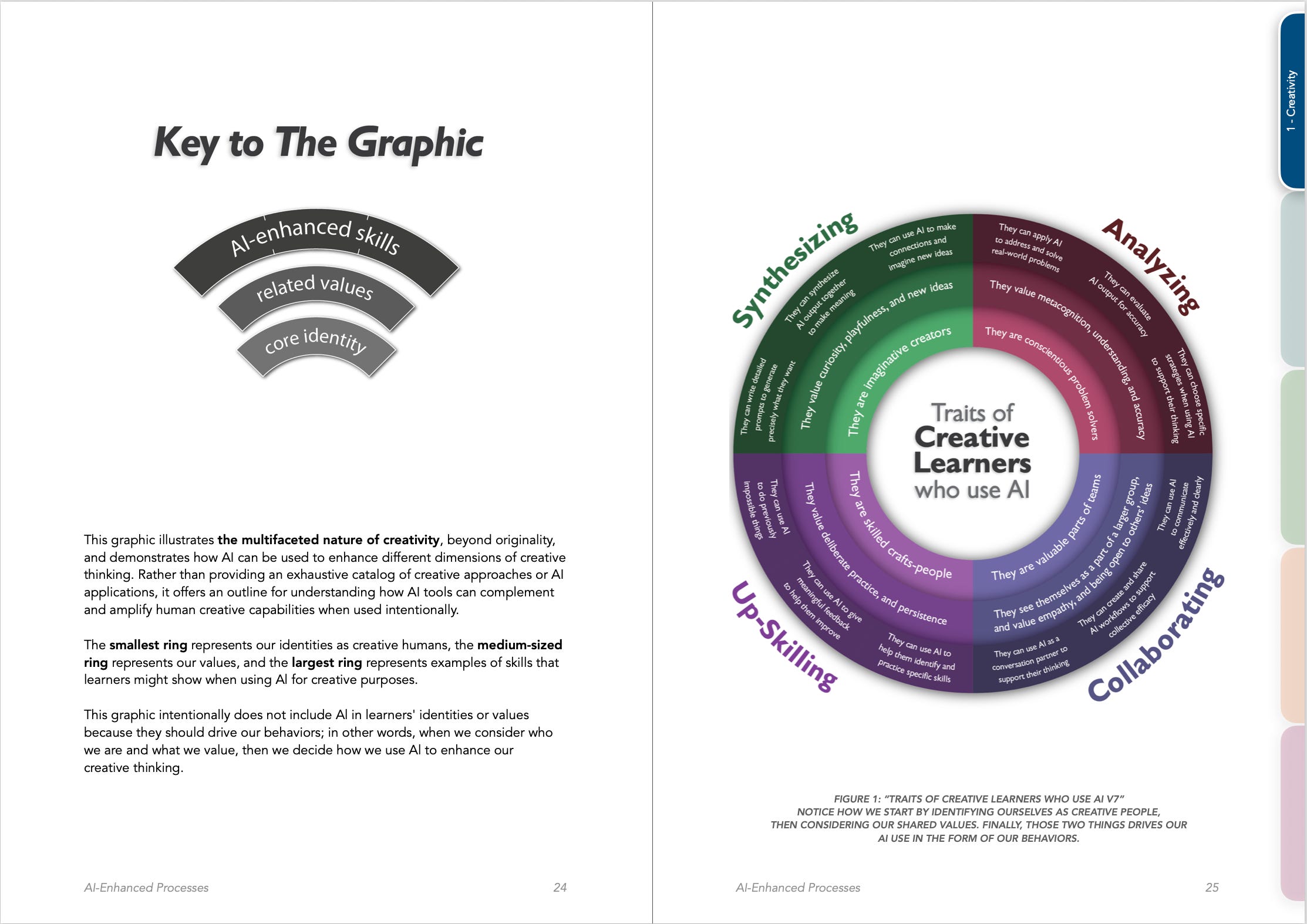
The graphic visualizes three rings:
The Center: Our identities, who we are.
The Second Ring: Our values.
The Outer Ring: Behaviors, and how we use AI when driven by our identities and values.
The point of all of this is that we have a definition of how we use AI (our behavior) when it is driven by our values and identities. The graphic also defines creativity in four domains: synthesizing, analyzing, collaborating, and upskilling. I thought that it was worthwhile to look at how creative thinking is actually quite broad and that it’s not just thinking about making something original.
A second point that is implicit in this graphic and chapter is that creativity isn’t an innate gift (I’m channeling my inner Carol Dweck). Creativity is a rigorous way of thinking that takes effort and discipline, two things the efficiency mindset encourages us to avoid. School slop is what happens when we treat creativity like it’s something we’re born with instead of something that requires real work and effort that is actually fun and rewarding.
And if we aren’t careful, lazy AI-use can bypass the traits in the graphic:
We bypass synthesizing by prompting and sharing raw output from AI models. School slop loves unedited output.
We bypass analyzing by accepting outputs without critique. School slop hates critical thinking.
We bypass collaborating by focusing on the chatbot instead of teamwork and teacher mentorship. School slop is lonely work.
We bypass upskilling by letting AI do the heavy lifting and skipping the practice that builds craft. School slop is allergic to practice and effort.
So far, we’ve looked at what students need to avoid, but I want to take a moment to mention some of the important things that students do when being creative. First, students need the right physiological state. They have to be calm and alert. If they are stressed, distracted, or tired, then they are not going to access those creative parts of their brains. They need to be physically taken care of first before they can exert meaningful effort.
Second, they need the right mindset: they have to be willing to spend energy because the purpose feels valuable. All humans are hardwired to want to avoid effort and conserve energy, and thinking deeply spends that precious energy. So when students have voice, choice, personal investment in what they express, a tie to their community and culture, an authentic audience to celebrate their work, or any other clear reason why they are creating the work, they will be willing to exert effort instead of looking to efficiency.
Mindset and our physical state are essential to get right before we look at ways we can use AI in our creative processes.
Classroom dialogue ideas
How do you define creativity? What do you value when it comes to creativity? How might the way we use AI be consistent with those values? Maybe that means not using AI at all when we are creative! How are you feeling today; are you calm, alert, and rested? Are you ready to be creative?
Monday Ready Tools
Tool 1: Checklist
Efficiency has its place (admin tasks for those who have already gained expertise, sparking ideas, cognitive sparring partner). But the process is where the magic happens, especially for cognitively demanding tasks like creativity. Clear processes with clear expectations are also how you combat school slop. And teachers, you can design these processes tomorrow. Start by naming the thinking you want students to do, then decide clearly how AI does (or doesn’t) support those moves. Talk to your students about expectations. If you don’t name the thinking, school slop will start to fill the vacuum.
Here is a simple student-facing checklist you can steal and use on Monday:
Think, Generate, Edit Checklist
Think (Human): I created an original starting point (sketch, outline, plan, storyboard).
Generate (Human + AI): I explored multiple iterations and can explain what changed and why.
Edit (Human): I made meaningful revisions and can point to my decisions.
Documentation of Learning and Process: I can show evidence of my thinking evolving (drafts, screenshots, notes, version history, reflection) and can use them to have a conversation with others about how I grew.
Tool 2: Creative Mindset Look-fors
In the introduction, you saw me write about efficiency-mindset vs. a creative-mindset. Here is an expanded list of phrases you can share with your class when practicing creative thinking.
Instead of “I just need to get this done” or “Can we just finish”
“I want this to sound like me. What is MY goal for quality and craft?”
Instead of “What’s the minimum to get an A” or “How long does it need to be”
“What does strong work look like to me, and what are the success criteria?”
Instead of “Do we have to show our process?”
“What evidence of thinking would best show my creative effort?”
Instead of “Can we just use the Canva template?”
“Can I use a template as a starting point, then make original choices and edits that show taste and intention?”
Instead of “ChatGPT, write this essay for me.”
“ChatGPT, help me generate options, challenge my thinking, and improve structure. I will write the final draft.”
Instead of “I’m stuck, can you just tell me the answer?”
“I’m stuck, but I know I can handle this challenge. Can you ask me questions to provoke my thinking?”
Instead of “Why do we have to do multiple drafts?”
“What is the focus of each draft, and what should improve each round?”
Teachers: Instead of “Let’s have students all do the same type of project.”
“Can we keep the criteria consistent, but let students choose the format that best fits their idea?”
Teachers: Instead of “Can’t beat them, join them. We’re all using AI anyway.”
“Let’s define what good AI use looks like, model it rather than keeping our use of AI secret as adults, and make expectations clear in each step of the process.”
Where to Learn More
I will be diving much deeper into AI-Enhanced Processes and creative moves at several upcoming conferences in Asia. I keep my speaking engagements up to date on the Conferences page on this site. I’ll be speaking in the 2025-2026 school year at:
And finally, watch out for the second edition of my book! After all the great feedback from readers and conference attendees, the book has taken on a life of its own. It is a huge leap forward, and I can’t wait for you to read it, coming soon, so stay tuned.