


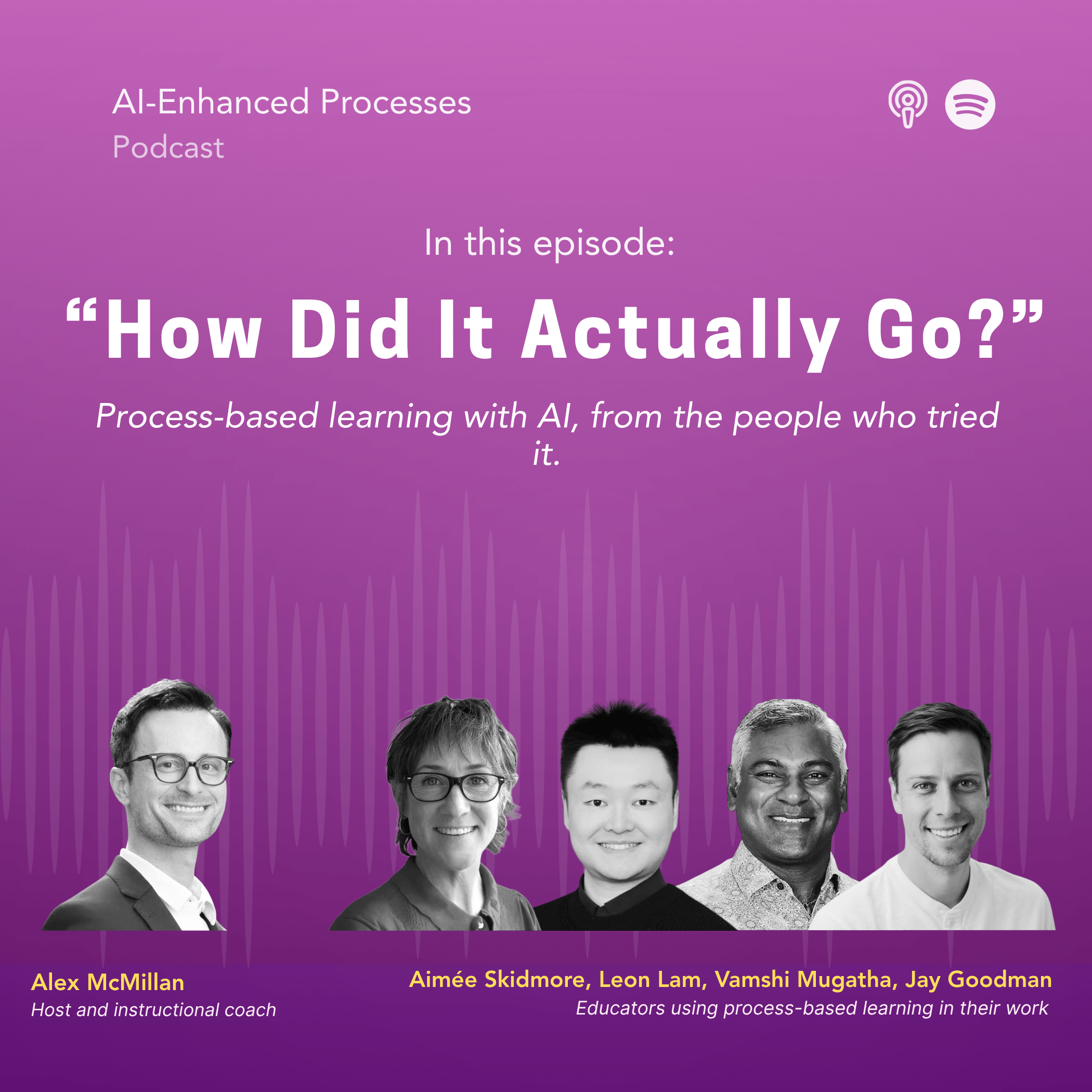
It's time to finish up the year with one last podcast episode. I decided that I wanted to have a reflection and talk to people about how process-based learning has been going inside their schools or classrooms. I talked to a range of educators and asked them several different questions, and this episode is a series of highlights from those conversations. So, over these 20 minutes, you're going to hear a series of short recordings in which we look at process-based learning with AI from several angles. Below are notes about each of the guests with links to their websites and social media. Thank you all for contributing to this episode!
Aimée Skidmore | Teaching and Learning Coach | Geneva
Aimée works with experienced teachers who are tired of being the engine in the room. Her focus is student ownership: structures where students start, think, revise, and take responsibility without the teacher carrying it all. She appears twice in this episode. First, she describes what process-based AI use looks like from inside her classroom. In her second segment, she explains how deliberate checkpoint gates changed the outcome of a chatbot-building project.
Aimée offers a six-week Student Ownership Sprint for secondary teachers. She also hosts the International Teacher Staffroom podcast.
Aimée wrote a companion piece to go along with this episode. After you listen, make sure to read her more in-depth write up about “gates” below.
GenAI Didn’t Break the Project. Speed Almost Did.

Intro I’m closing out the school year by slowing down to actually look back and make sense of what happened. It’s a metacognitive act that I, for one, could certainly do more of.
Jay Goodman, Ed.D. | PBL Consultant | Canada
Jay has spent nearly two decades designing problem-based learning programs. His Ed.D. focused on PBL program design. He co-developed the Innovation Institute, an award-winning interdisciplinary PBL program in Shanghai.
In this episode, he describes mentor bots: teacher-designed AI personas built around specific domains of expertise. Students identify a knowledge gap, do initial research, and then bring that thinking into a structured conversation with a field-specific model. It solves a real PBL logistics problem without replacing the thinking students need to do first.
LinkedIn | Goodman Learning Partners
Vamshi Mugatha | Director of Technology | American School of Brasilia
Vamshi brings in a leadership perspective as an admin. Vamshi describes a familiar challenge for many schools around the implementation side of a policy. What he realized was that the missing piece was expectations. When teachers weren’t setting them, students were using AI without disclosing it. The gap between the two created tension that the policy alone couldn’t resolve.
Leon Lam | A-Level Head of Humanities | Beijing National Day School
Leon teaches A-Level economics and leads Humanities at Beijing National Day School. Last year, he vibe-coded a Socratic essay coaching chatbot designed to slow students down and move them through idea generation, outlining, and drafting as distinct stages. He’s candid about what happened. Some students engaged deeply. Others focused entirely on getting the chatbot to advance to the next stage, treating compliance as the goal. He reflects on what he’d do differently next time. His biggest takeaway is that co-designing a process with students can be a powerful way to make the process less performative and more purposeful in supporting their work.
Leon wrote a companion piece to this podcast episode. Check it out below.
Transparency in the Process

I’m closing out the school year by slowing down to actually look back and make sense of what happened. It’s a metacognitive act that I, for one, could certainly do more of.


