


Inviting AI into your classroom and simply saying, “Use it responsibly,” is like inviting a wacky stranger to your dinner party and saying, “Just don’t make it weird.”
Nobody knows what that means. You turn your back for five minutes to grab the wine, and you come back to find the stranger reorganizing your spice rack by scent and trying to sous-vide the family cat. Everyone is staring at you, and you’re left scratching your head, trying to reverse-engineer the chaos from the mess.

That’s the problem with vague instructions: they invite interpretation. As Katie Novak points out in the foreword to the forthcoming second edition of my book, AI-Enhanced Processes, being a host isn’t just about opening the front door; it’s an intentional design. In a classroom, we’re hosting a digital guest in a room full of humans. If we don’t facilitate the introduction, the humans don’t know how to engage, and the guest, with all its enthusiasm and desire to please, takes over the party learning experiences.
That’s basically the current state of AI school policies. Often, they're labels that sound decisive but rely on conceptual language. Many teachers are still unsure how to put that language into practice. Don't get me wrong, schools need a policy that establishes a shared language for how stakeholders will engage with AI in classrooms. However, action plans, practice, professional development, and coaching are the necessary next steps. Without the practical implementation plan, we likely will encounter selective interpretation: a teacher thinks “use AI only for brainstorming” when indicating AI is allowed. A student hears “drafting with AI is fine.” A school leader hears “future-ready learning.”
We need a better way to host AI as a guest in our classrooms, and that means practicing our shared agreements, not just writing them.
That’s where an AI-enhanced process (AIEP) comes in as one meaningful strategy to operationalize good practices. AIEPs are short, repeatable sequences of thinking moves that make expectations concrete. They keep the effort with the learner and give AI a clear role without letting it take over. Instead of “AI allowed,” we get shared language for action: here are the thinking moves, here’s how AI can collaborate on each one, and here’s what stays human.
A strong AI-enhanced process includes these facets by design:
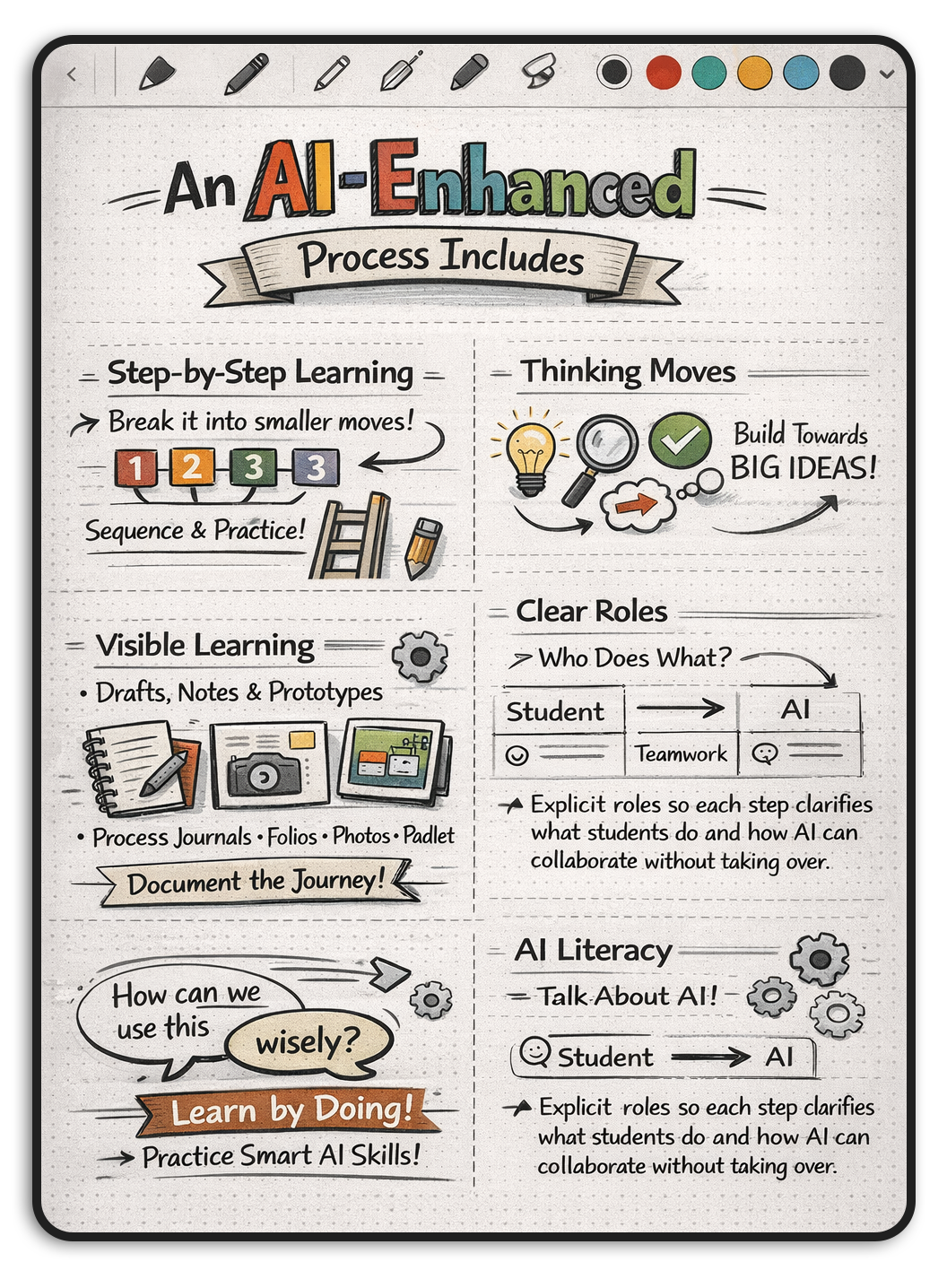
Multiple steps that break a complex task into smaller moves, so learning happens through a sequence.
A variety of action-oriented thinking moves (generate, analyze, evaluate, reflect) that build toward a larger outcome.
Visible thinking through drafts, notes, prototypes, and reflections so the work can be coached while it’s still happening. Process journals, folios, photos, Padlets, to name a few, are great ways to document student learning. It’s most powerful when it’s for the students first, and adults second. I will share more about this below, but I also have a two-article series you might enjoy. They touch on big ideas like efficiency and effort. Links below.
Explicit roles so each step clarifies what students do and how AI can collaborate without taking over like our wacky guest at the dinner party.
Embedded AI literacy happens through classroom dialogue and intentionally designed learning experiences, where AI shows up in ways that actually enhance learning. Students learn by doing. They build meaningful habits with AI when lessons use it to strengthen thinking, not replace it. Reflection helps students notice how the process actually flowed for them: where AI supported their growth, where it got in the way, and what they want to adjust next time. Over time, that cycle of practice and reflection becomes a lifelong strategy that students can carry into adulthood.


In summary, AI-enhanced processes are strategies we intentionally design in conjunction with meaningful classroom dialogue about how we use AI with our students, which can lead to powerful learning experiences and lifelong strategies.
Ok. Now that we have shared language for what an AIEP is, we can actually host AI in our classrooms. In the next sections, we’ll look at three powerful moves to build your own processes that take the above ideas into account and operationalize them.
Powerful Move 1: Name The Thinking
Powerful Move 2: Set Expectations around Student-AI Collaboration
Powerful Move 3: Make Learning Visible
Powerful Move 1: Name The Thinking
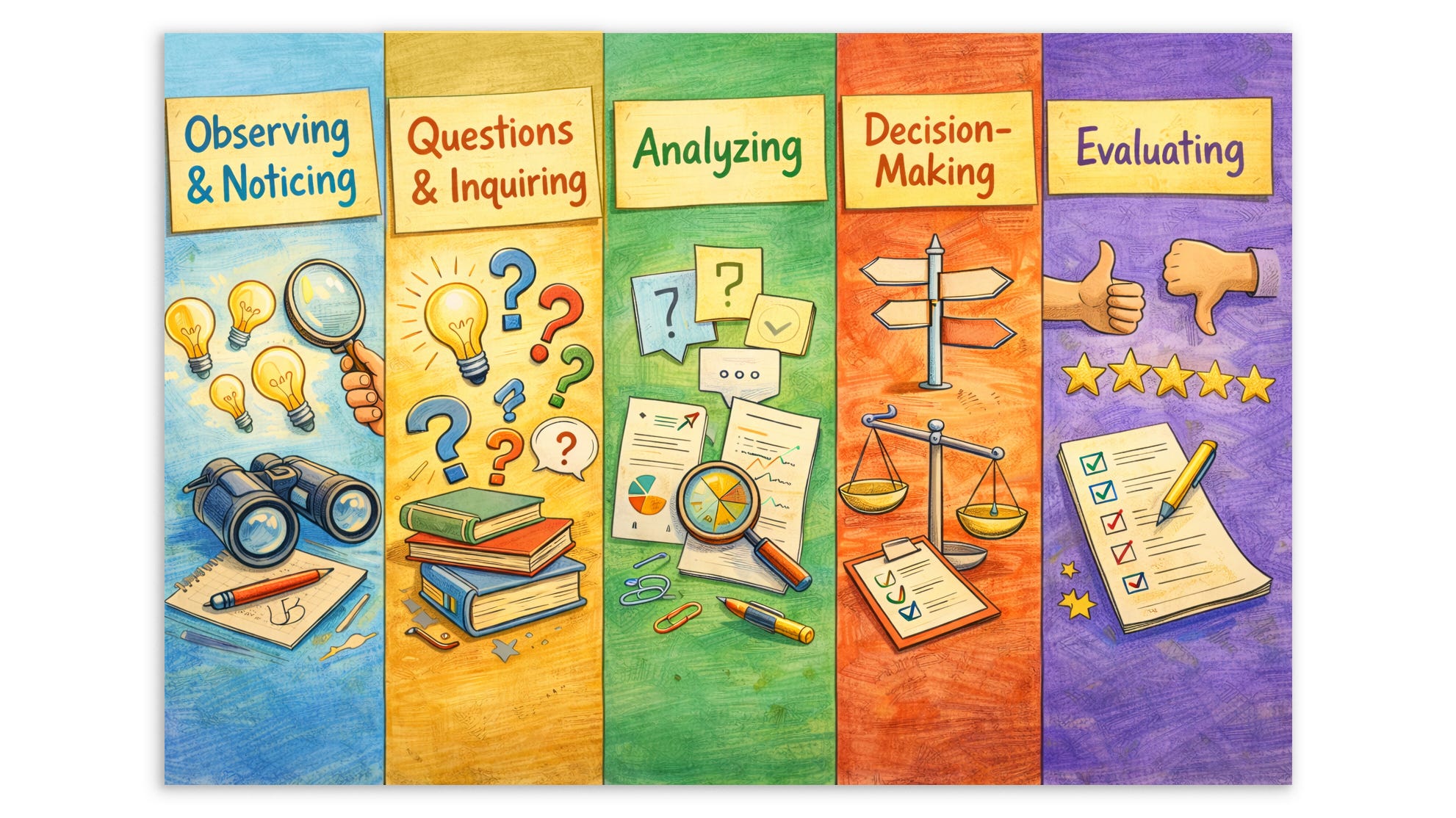
Naming the thinking in a process is an idea borrowed from Project Zero’s work around making thinking visible. And in that sense, this is not really a new idea; it’s the notion that we consider the category of thinking, and then name the verb we want students to practice. For example, the category might be to think critically, and the verb might be to evaluate. Project Zero suggests that if you care about thinking, you have to design for it. You have to name it, value it, and make it observable, because what a classroom repeatedly reinforces and rewards is what students learn to do. And with AI, if we don’t name the thinking, the easiest path of the least resistance wins: creating a polished product automatically. It’s tempting for students to skip the messy process that requires effort and to focus on task completion. If we do name it, we can build the habits of mind we actually want to instill in our students.
Another important thing to note when naming the thinking is that each thinking move is not an “activity” to keep kids busy, nor are they compliance checklists. They’re steps that make thinking visible enough to practice another powerful move: metacognition, in which we can talk about the thinking, coach for improvement, encourage students to notice their own growth, and plan their own independent next steps.
In addition to Harvard Project Zero’s Thinking Routines, there are other processes that follow very similar patterns, like Stanford D.School’s Design Thinking cycle, writing workshops, lab reports, Socratic seminars, critique protocols, coaching cycles, research, and a hundred other classroom processes that work because they support the thinking that leads to a solid product.
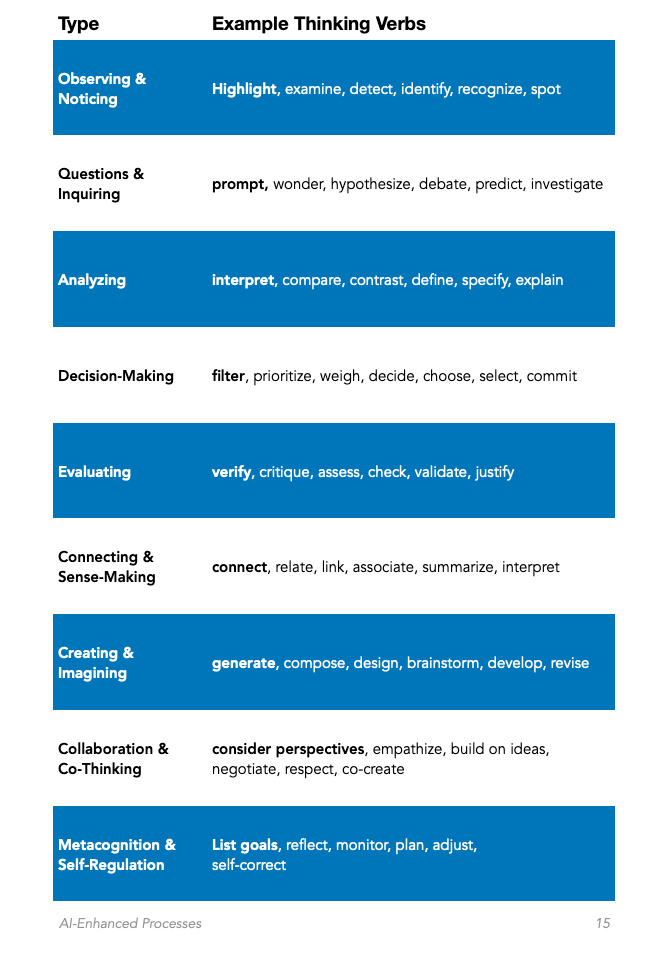
Below is a preview of my book with samples of words that we can draw upon. It’s not an exhaustive list, but it’s a good place to start, helping us think about what we mean by “naming the thinking moves”. Notice the bolded words under the “Example Thinking Verbs” column. Those are things that AIs can currently do quite well on their own or in collaboration with our children.
When planning, ask yourself:
What types of thinking are important in this task?
If I were to name what students should do as verbs, which ones come to mind?
How can I build a shared vocabulary with my learners about what these words mean?
When in the year is it helpful to introduce, practice, and review this language?
In the next section, we will take the named thinking moves and set expectations for when and how AI collaborates with students on each move.
Powerful Move 2: Set Expectations around Student-AI Collaboration
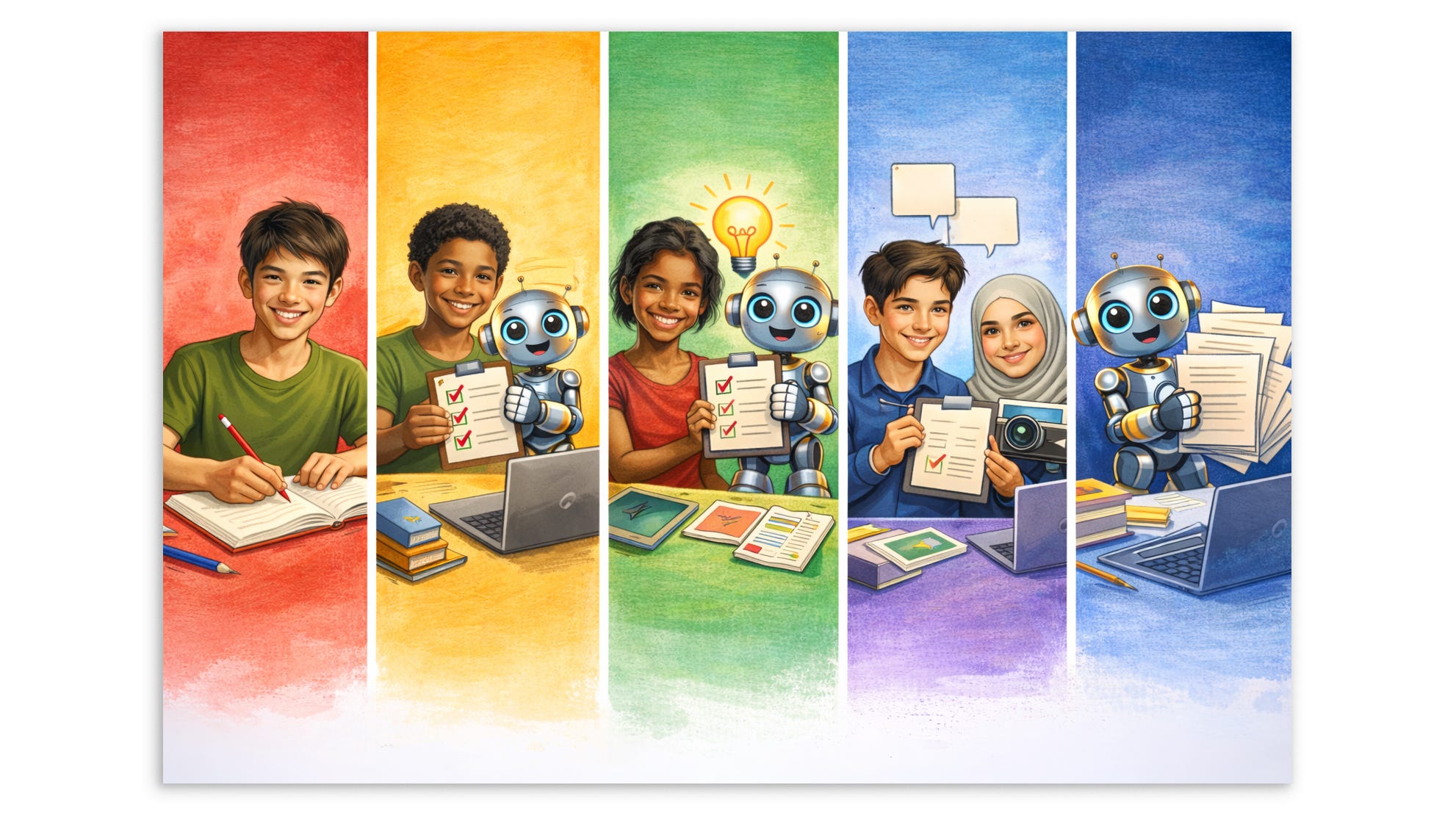
I like to frame AI as not a tool, not a calculator, and certainly not a threat, but a guest collaborator. That framing changes the way we introduce it to students. We’re not handing them a device and saying, “Go use this.” We’re inviting AI into the learning space, and we should be deliberate about the roles it plays.
For example, if the thinking move is brainstorming, you might say: “AI will collaborate by asking Socratic questions that push your creativity. It will not generate ideas or suggestions for you.” Now students know what they’re responsible for, what AI is responsible for, and what’s off-limits.
You can take that one step further by narrowing which AI students use. In class, that might sound like: “I built a bot for you to use that’s aware of our learning objectives. Please use this bot only. It helps me be a better teacher, it allows me to coach you with more precision, and it makes your AI use transparent so we’re both clear on when and how you leveraged AI to support your effortful thinking.”
From there, the planning move is straightforward: decide how AI supports each thinking move based on your knowledge of the learning goal and your students. Caveat: this kind of decision making does require some AI literacy from us as teachers, enough familiarity to predict what the tool will do well and where it might take over the thinking.
If you’re new to it, AI-use scales can make expectations easier to name and share. You can use an existing one or build your own.
One option is the Expectations Scale that Holly Clark and I created. It helps you label what AI can and cannot do within each step of a process. For example: “During empathizing, you may use AI to give feedback on the depth of your interview questions,” or “During outlining, you may use AI to help you structure your plan.”
Another option is the AI Assessment Scale by Perkins et al. It’s widely used and has influenced a lot of school-based scales. The concept overlaps with what you saw above, and to be transparent, our work was influenced by theirs. Their team updates the scale regularly and grounds it in ongoing research, which makes it well worth reviewing as you design expectations for students. Check out more here: https://aiassessmentscale.com/
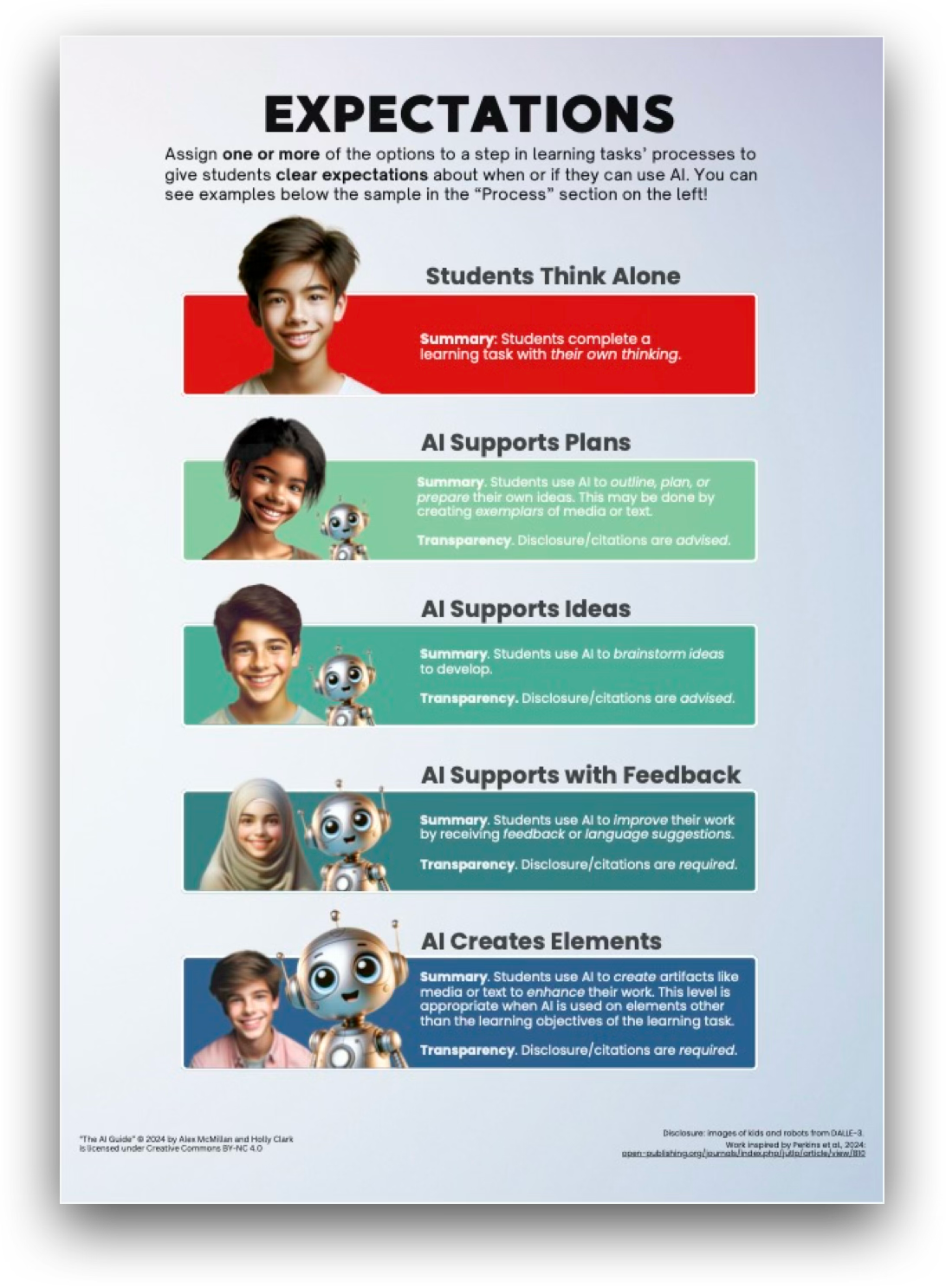
Ok, so now you’ve seen two moves: name the thinking, then decide how AI will collaborate with students, or not, on each step of the process.
In the next section, we will build on those two ideas with a third powerful move. In the next section, I will argue that a process only works if we can actually see it. If the only thing we ever see is the final product, we’re back to guessing how the students arrived at that work and praying that AI didn’t do it all for them.
The third powerful move is making the learning visible through documentation. Let’s take a look.
Powerful Move 3: Make Learning Visible
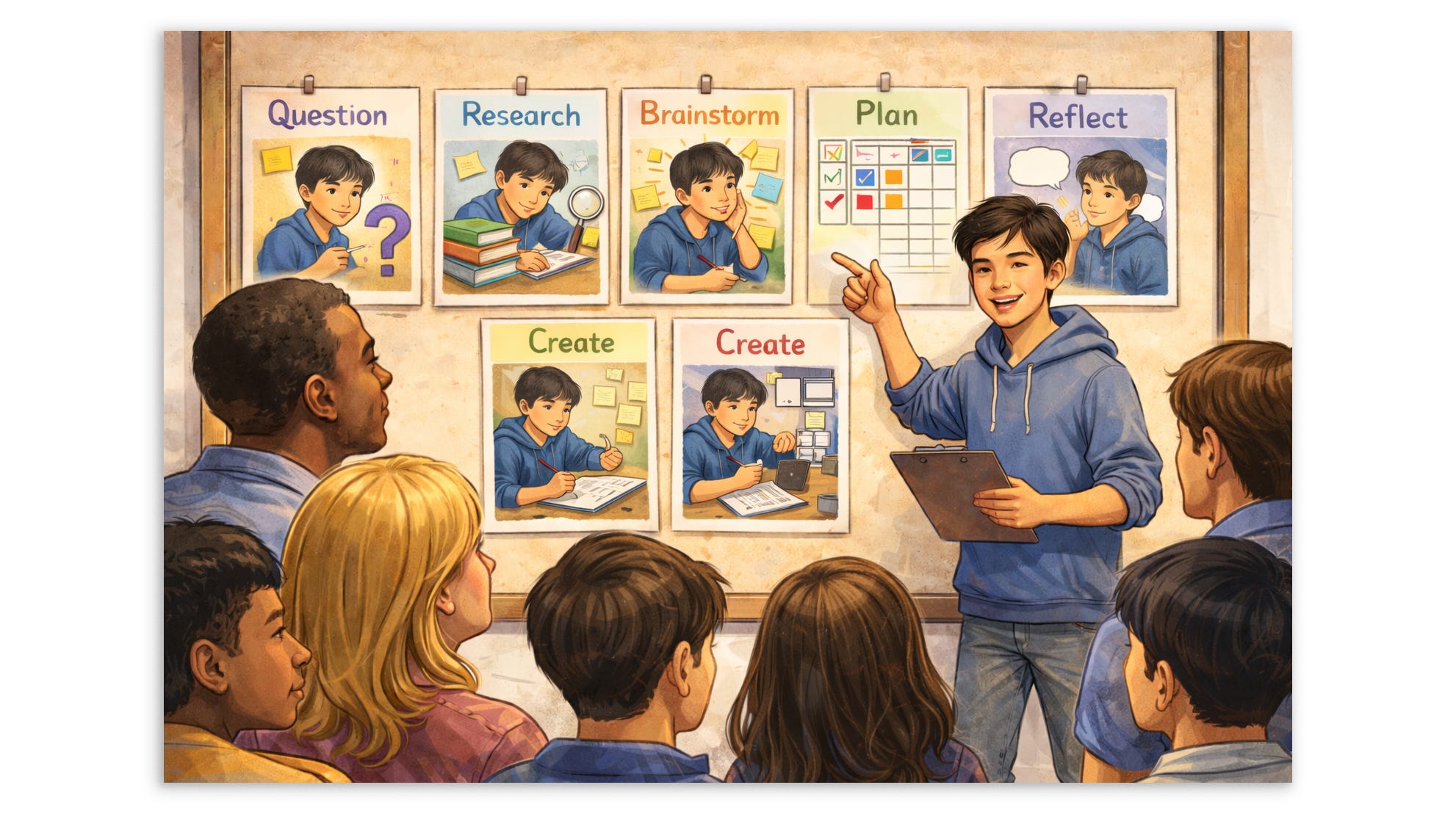
I realize that up until this point it has sounded a lot like I’m placing process over product. Let me be clear: the final product still matters. For most kids, it’s the most motivating part, the destination, the why of it all. But when a compelling product sits on top of visible thinking, it becomes something richer: a story of learning they can actually explain. Look at what I made, and here’s how I got there. I struggled. I persevered. I pivoted. I grew.
The problem is that AI can generate polished work instantly. So a polished product alone is weaker evidence of thinking than it used to be. That’s why making the thought process visible is powerful. Meaningful learning requires both process AND product. Products give purpose. Processes shape the thinking that makes the product worth creating. Drafts, prototypes, revisions, annotations, and reflections are mini-products that capture thinking along the way.
But there’s a trap that teachers should be aware of: documentation can slide into policing. When visibility becomes prove you didn’t cheat, students experience it as compliance, so I use a better frame: breadcrumbs. Breadcrumbs are lightweight traces of thinking captured during learning: a quick reflection, a sketch, a revision note, an outline, a screenshot of a chat plus a short takeaway. Not everything, just enough to make learning visible in context and help students notice their own growth over time.
There are countless ways to document student thinking. Here are two visibility moves that work across subjects, then a list of more possible approaches. If you would like to see more inspiring ideas, make sure to check out my book.
Option 1 - Process journals:
A process journal gives students a single place to capture “breadcrumbs” of their thinking as it evolves, and it gives teachers something coachable while the work is still happening. It also scales cleanly: a simple template in Google Docs, Word, or Pages can be duplicated for every student through an LMS, then adjusted up or down with prompts, feedback boxes, links to vetted tools, and clear expectations. The result is one adaptable tool that holds instruction, links to purpose-built bots, reflection, and evidence of learning together, instead of trying to reverse-engineer what happened from a polished final draft. In fact, final drafts can sit in the process journal! It’s such a powerful move to ask students to submit their process journals to their teachers that include the final draft because it shows that we value the thinking and the work leading up to the final piece.


If you like the idea of using a process journal, I have templates and more ideas that you can get for free from these two articles.


Option 2 - Think Collaboratively on Paper
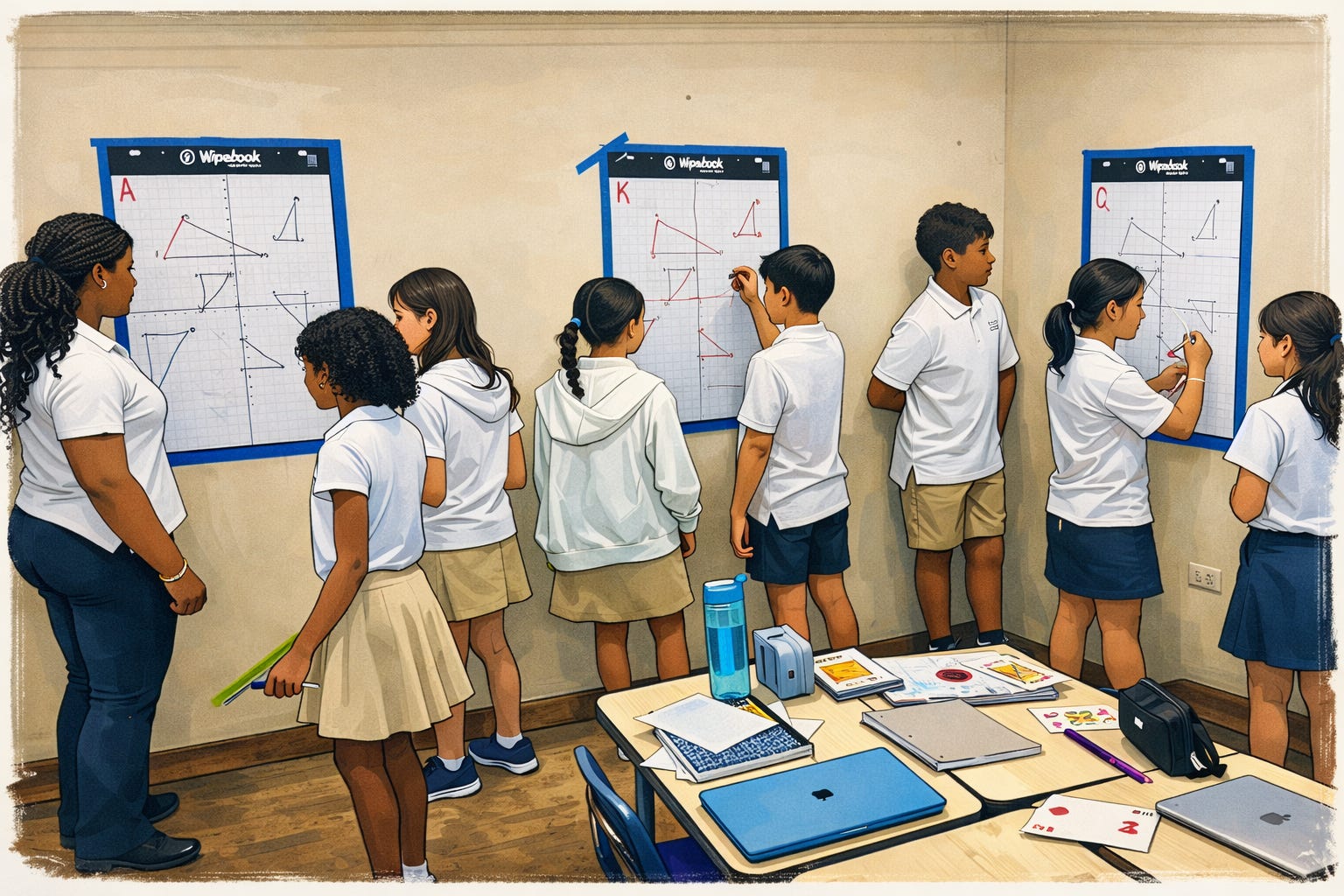
Vertical learning, the Peter Liljedahl move you’re seeing pictured below, is a simple design choice with a huge payoff: get students standing, working in groups, and thinking out loud on visible, shared spaces.
In the age of AI, this technique is powerful because it shifts the class from “who can produce the cleanest final answer” and back to how ideas form, change, collide, and improve while simultaneously building in movement. My goodness, do kids sit a lot during the day! Vertical work makes an active process unavoidable: students get up, and start talking about learning away from distractions like laptops.
If you notice, the laptops are closed in this classroom! Students go from discussing, collaborating, debating, and then perhaps opening their computers to share their findings with an AI bot from their teacher. Such a powerful and intentional use of technology at key times.
More ways to document student learning
I only shared two approaches in this article, but there are plenty of ways to document learning. Below is a list of additional options students can use to capture their thinking as it’s happening. The goal is simple: make learning visible enough that you can coach it, students can learn from it, and AI stays in the role of collaborator. You’ll probably mix and match a few of these rather than rely on just one.
Possible approaches include:
Blank template/drafting space (work-in-progress thinking).
Chat thread (shows thinking changes, not just answers)
Pivot point notes (moments thinking shifted and why)
Metacognition question trails (curiosity evolving into sharper questions)
Idea graveyard (discarded ideas kept as evidence of exploration)
Connection notes (new idea + prior knowledge)
Annotated snapshots (image + one sentence of meaning)
60-second voice memos (messiest parts + next moves)
Evidence selection (best evidence set + short rationale in slides)
Physical notebook entries (kids love these)
Conference/exhibition script (student-led explanation supported by evidence)
How to Design Your Own Process
One of my favorite ways to build an AI-enhanced process is to use intentionally low-tech tools: sticky notes and a pen.
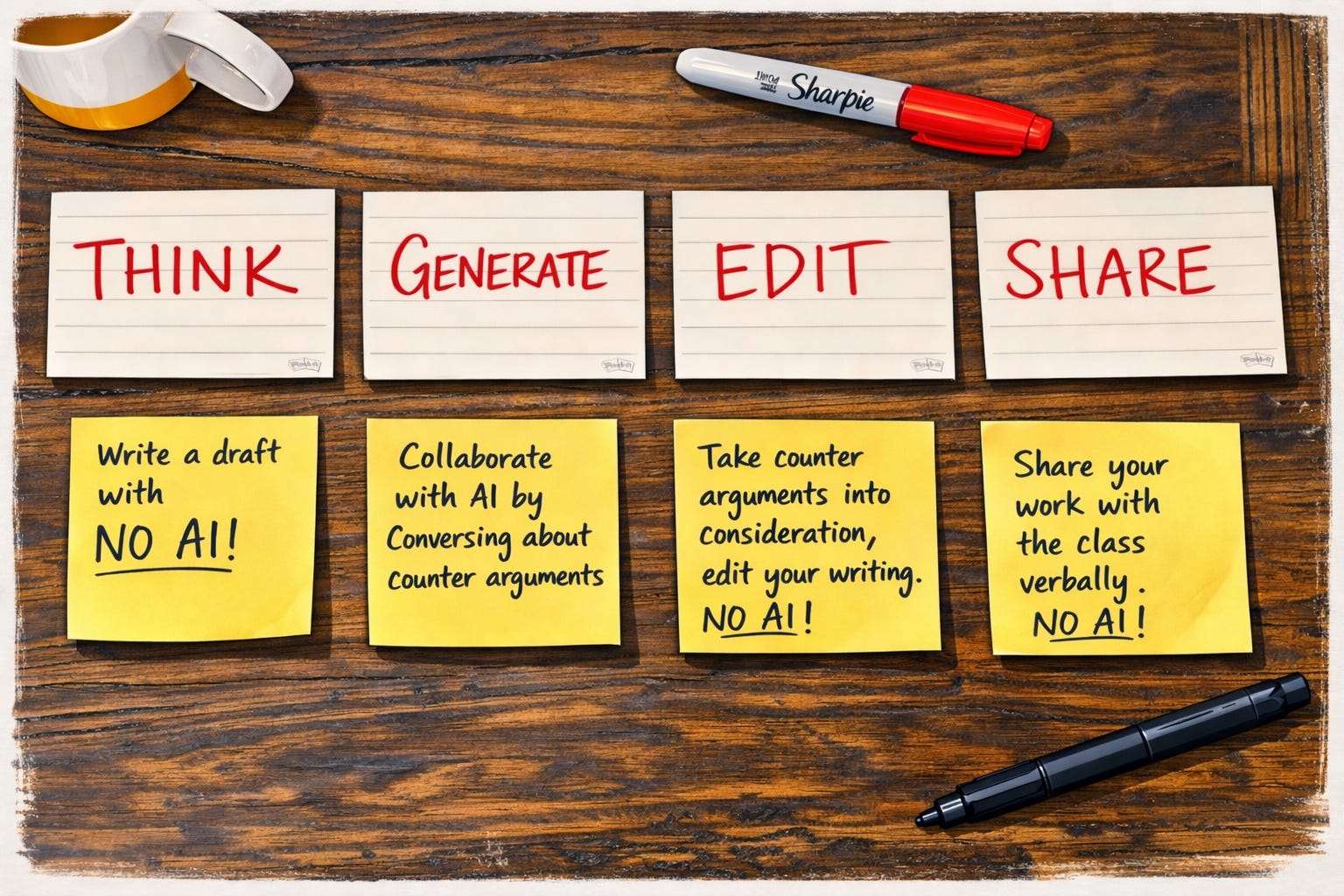
To be clear, the stickies are for planning. They’re a coach’s sketchpad. They’re perfect for teams because you can move them around fast, test different sequences, and talk through how students will flow from thinking move to thinking move without getting stuck in a Google Doc spiral.
When I’m coaching a teacher, I’ll make two rows. Row one is the thinking moves. Row two is how AI collaborates, or doesn’t, on each move. That’s it. You can see a quick example in the photo above from a high school writing task. I made it up for this post, but you get the idea.
Once you’ve got a sequence you like, share it with students in whatever format fits your classroom. Take a picture and project it. Turn it into a slide. Write it on the board. Print it and put it on tables. The format doesn’t matter. The point is simple instructions that keep the focus on the learning and make expectations easy to follow.
Teachers, I gotta say, me included, we talk too much. We frontload instructions like we’re reading the terms and conditions of a credit card. We overexplain the pitfalls, the rules, the exceptions, the “don’t do this,” the “also don’t do that,” and by the time students actually start working, their brains are already tired. That’s cognitive load in the worst place: on the directions instead of the thinking!
A simple process fixes that because it keeps instructions short. A process can enable you to provide just-in-time teaching. You can circulate, coach the move students are actually in, and drop a mini-lesson, a metacognitive guide, or feedback right when it’s useful. Direct teaching is not bad; in fact, it is one of the highest impact approaches to teaching, according to Hattie. But when it’s the predominant teaching move, class can become disengaging and focused on content, compliance, and control.
Here’s the sticky note move I use when coaching teachers to plan their own AI-enhanced process:
Step 1: Write thinking moves across the top row (verbs only).
Step 2: Under each one, write the AI expectation in plain language: “AI can help by… / AI cannot… / Student must…”
Step 3: Share it in class. Read it once. Ask for clarifications. Then start the work. Coach during the process and avoid over-explaining, as tempting as it is!
Pro tip: take it one step further and add a third row for breadcrumbs. Under each thinking move, write what students will capture to document their learning and make the thinking visible, for example: a brainstorm snapshot, a decision point, a revision note, a reflection, or a screenshot of a chat. Whatever it might be, it helps you and your students to align around what thinking will look like.
Monday-Ready Resources and Powerful Moves
There were a lot of ideas in today’s article. What I want to leave with you with are big picture, powerful moves, and further tools you can start using in class immediately.
1) Good reads
The Power of Making Thinking Visible, by Ron Ritchhart and Mark Church. If you want a practical backbone for naming thinking and making it observable, this is a strong place to start.
Mindset, by Carol Dweck, has had a powerful influence on my work with AIEPs. Dweck explores the concept of a growth mindset versus a fixed mindset and how a fixed mindset can limit our growth and potential. This mindset shapes many areas of our lives. What Dweck does so well is help us recognize the language of a growth mindset. With AI in our classrooms, we need to pay close attention to the language of a fixed mindset. I’m seeing many ways a fixed mindset could lead to students leveraging AI to complete tasks rather than seeing that productive struggle is an important and necessary part of the learning experience.
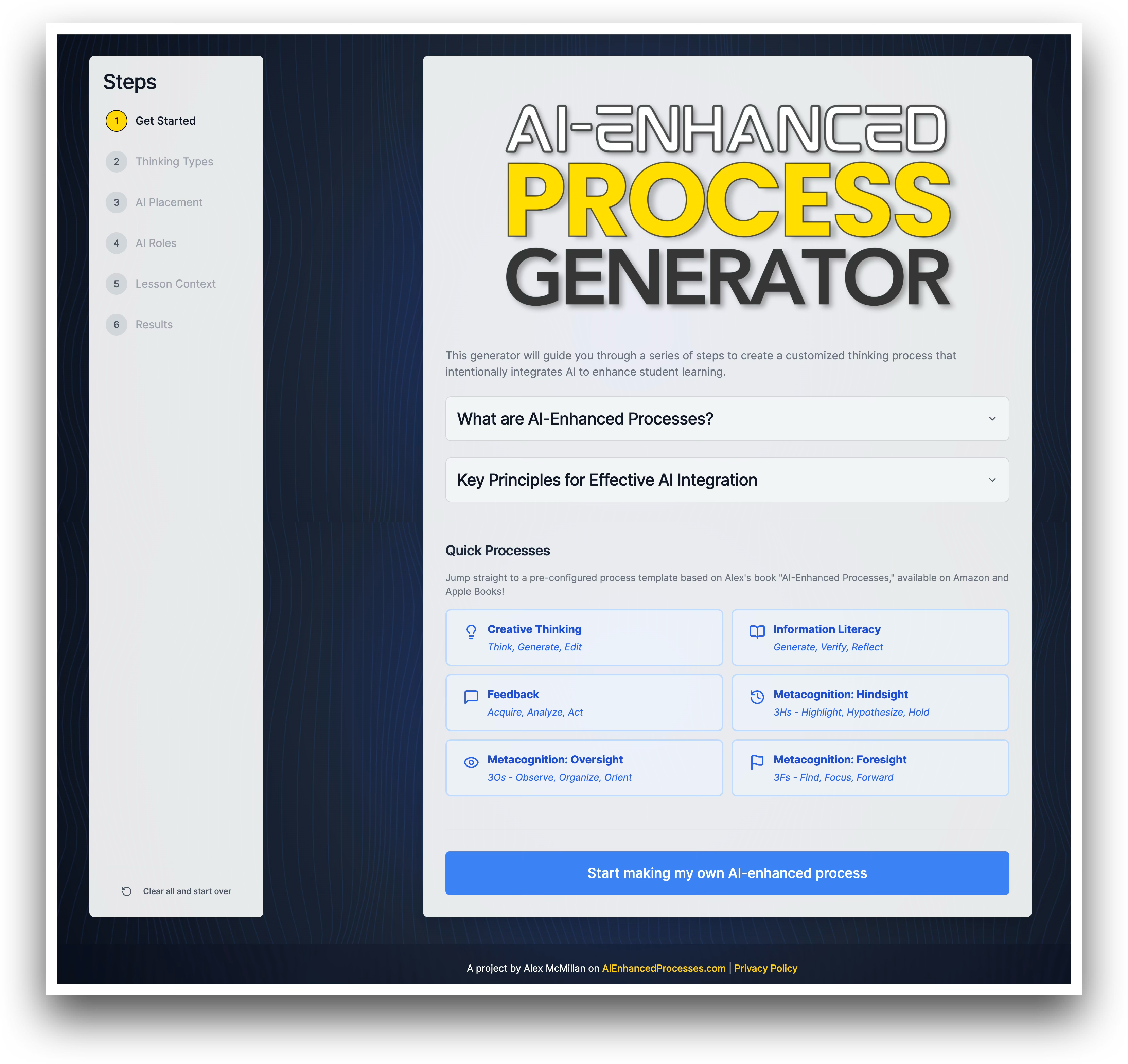
2) My free process builder
You can use my tool to generate an AI-enhanced process and a detailed prompt you can feed into a chatbot so it understands your context, your students, and your documentation approach. It helps you to not only get specific about the learning experience you want to design, but it also helps AI to align with how it will support because you can feed the prompt from this tool straight into School AI, Flint, Magic School, etc., to follow your process. https://processes.lovable.app/
3) The three takeaways from the article.
These are the three things I really want you to walk away with. Immediate and simple steps to support AI use in your classroom with clarity.
Name the thinking.
Set Expectations around student-AI collaboration.
Document student thinking and make it visible.
Conclusion
If you want a starting point, don’t overhaul everything. Redesign one task as a process, and watch what happens when expectations stop being implied and start being practiced. Start small on purpose, and start where you already have momentum. Think about the repeated thinking moves you see all year: brainstorming, outlining, arguing from evidence, checking for bias, revising for clarity, or reflecting on choices. If there’s a strategy you use frequently, that’s your best candidate. Operationalize it. Name the moves, make them teachable, and run the same process again and again until students stop asking, “What do you want?” and start asking, “Which move are we on?” or even better yet, show independence and fluency with their use of the process.
Write a short AI-enhanced process for that task, and keep it simple:
Name the thinking (verbs only).
Set expectations for how AI collaborates or doesn’t.
Add breadcrumbs so the learning is visible while it’s still alive.
And that’s it. You’re not building a system. You’re building a routine that students can actually run without you reading the terms and conditions out loud for 30 minutes.
“AI allowed” is a label that invites interpretation, and interpretation is exactly how you end up with a spice rack sorted by scent and a cat in a sous vide bag.
A process turns shared values into shared behaviors. It protects the parts of learning that can’t be outsourced: judgment, reasoning, taste, decision-making, and reflection. And it gives students something better than “What do you want?” It gives them a map that reinforces your shared values. After frequent practice, the questions shift to the ones you actually want to hear: “Which move are we on?” Or even better, no question at all. They just start, and they run it. The point being that processes need to be regularly reinforced to get to automaticity and internalization. With AI, kids have few internalized processes due to the fact that it’s a relatively new technology, so your efforts to practice meaningful use of AI are essential.
While I believe in the power of process, to be clear, the point is never the process itself. The point is the thinking and the effort that the process makes visible.
Start small on purpose. Run the same process again and again. Tweak one step at a time. Find ways to demonstrate understanding. Keep the focus where it belongs: on student thinking, not on policing, not on overexplaining the steps, and definitely not on cleaning up the mess after your digital guest takes over the party.
AI Disclosure
Supporting artwork in this post was created with the support of ChatGPT and Gemini. All images have AI disclosures to indicate my process with transparency. Other graphics from my book were created by me (e.g. table of words).
The audio accompaniment of this article with me reading was my voice, and then run through Adobe Voice Enhancer to clean it up and make it sound professional.
This article was co-written by ChatGPT 5.2 and Claude 4.6. My process followed several cycles of Think, Generate, Edit. This article is in many ways a summary of the core ideas in my book. I took a PDF of it (and compressed the hell out of it), uploaded it to ChatGPT, and had a conversation with it about my work. We created an outline that followed it and the typical structure of my Substack posts.
My typical flow is to start an outline on a Sunday, think during my workweek, especially while walking to work and talking to my partner (walk-and-talks are the best). Then on the weekend, I refine the work for Monday morning to be delivered to your inboxes.
What I found is that ChatGPT and other LLMs are great at helping me write, as I can get a summary of my existing work/ideas and start laying it out. I’ll wake up early, have coffee, and read where I am in my writing, revise it through a conversation with my synthetic collaborator, and then go about my day. I find new ideas come to me, and I will edit the work later to help it flow, or sometimes even to visualize it better.
I would estimate that, with AIs as my collaborators, I saved a significant amount of time, but I still spent around 10-11 hours completing it.
Finally, I believe we should normalize transparent disclosure of AI use in education. When adults model openness, students are more likely to talk honestly about how they’re using AI rather than hide it. If you are not disclosing your use of AI, you might be unintentionally modeling secrecy.
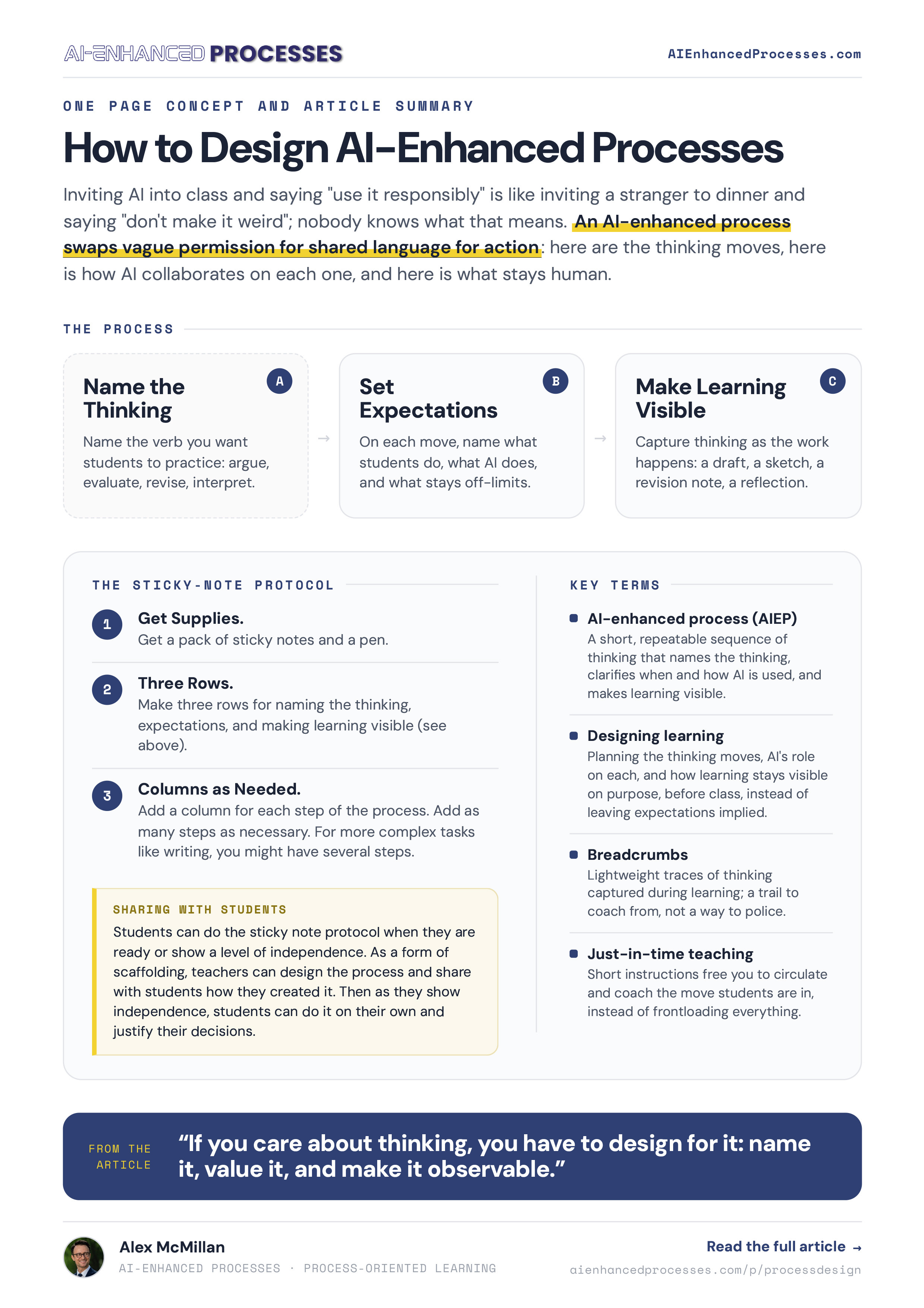
One Pager of This Article
If you enjoyed this article and want to share it with someone else, here is a one-pager summarizing its content. Download it, print it, email it to a friend who you think would appreciate it, or you could directly share the link to it! Thank you for reading!
Sous vide the cat had me hooked in for the weird ride immediately.