


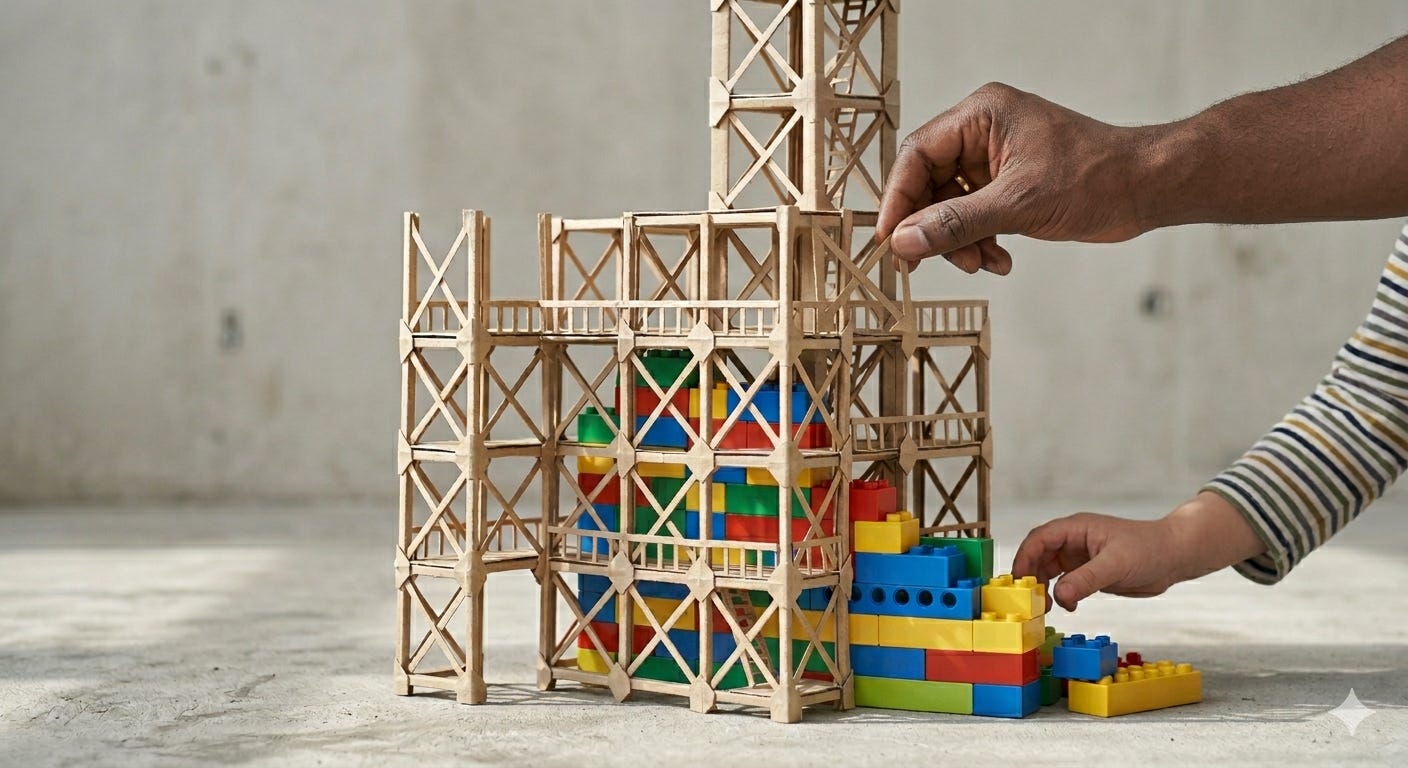
Scaffolding is one of those practices most educators have been trained to use, talk about as a part of daily planning, but might need to reconsider now that we live in the age of AI. We’ve been using it for a long time: breaking down a complex task, modeling a thinking move, offering a hint when a student gets stuck, then stepping back as they find their footing. But knowing what scaffolding is and implementing it with fidelity in an AI-enhanced classroom are two different things. When the support is too tight, too scripted, or never fades, scaffolding can stop being supportive of student learning and growth. In a classroom where AI is available, a student oriented toward completion rather than understanding is one click away from outsourcing the whole thing.
So this article is about one question with two parts: what does strong scaffolding look like when AI is in the room, and how do we design for it deliberately? The research on effective scaffolding gives us the foundation. AI gives us both a powerful new tool and a new set of risks. Understanding both is what makes the difference between AI enhancing student thinking and replacing it.
Definitions
I find that Universal Design for Learning (UDL) and differentiated instruction (DI) are often used interchangeably with scaffolding, so I want to take a minute to explore the three of them in relationship to one another before we move forward. I imagine that the conflation comes from the fact that each involves a teacher adjusting something for a learner to be successful. But there are some nuances between the three, and to make it more interesting, all three could technically exist at the same time.
Defining Universal Design for Learning (UDL)
CAST, the organization that developed Universal Design for Learning, describes UDL as a framework for designing curriculum so it works for all learners from the outset. Before the unit exists, a UDL-informed teacher is asking: Why are we learning this? How will I present it in multiple ways? How will students engage with it? How will they show what they know? The three principles (engagement, representation, and expression) aren't checkboxes. They're what Katie Novak might call design orientations.
Many teachers and school systems treat UDL as a synonym for accommodation: extra time, modified texts, assistive technology. Those things matter, but they aren't UDL. UDL isn't retrofitting the curriculum for students who can't access it. It's designing the curriculum so the barriers don't exist in the first place.
Defining Differentiated Instruction (DI)
Carol Ann Tomlinson, who is arguably a leader in differentiation, has stated for decades that differentiation is a proactive mindset that a teacher brings to planning. Before the lesson begins, a differentiated teacher is asking: Who are my learners? What do I know about where they’re starting? What pathways and options can I build in so the learning reaches all of them? Multiple approaches to content, process, and product; not different destinations, but different routes to the same one.
Many teachers have accepted a version of differentiation that means reducing the task for students who struggle. Fewer requirements or something like that. Tomlinson calls this myth out directly: differentiation is more qualitative than quantitative. It isn’t giving some students less of the same assignment. It’s rethinking the nature of the assignment so it fits the learner while keeping the learning objectives intact.
Defining Scaffolding
Scaffolding is what happens once learners are in the room, and you can see what’s actually happening. Pauline Gibbons puts it precisely in her book Scaffolding Language, Scaffolding Learning. She writes:
“Scaffolding is not simply another word for help. It is a special kind of help that assists learners in moving toward new skills, concepts, or levels of understanding. It is future-oriented and aimed at increasing a learner’s autonomy. As Vygotsky has said, what a child can do with support today, she or he can do alone tomorrow.”
In practice, scaffolding might look like a sentence frame that gives a student the language structure so their thinking can do the real work. It looks like a worked example that shows the process, not just the product. It looks like gradual release: I do, we do, you do. A think-aloud where a teacher makes their invisible reasoning visible. A guiding question that narrows the cognitive load just enough to get a student unstuck without removing the challenge. Notice what all of these have in common: none of them lower the intellectual demand. Second, with scaffolding, the aim is that students gain a level of independence to implement learning strategies on their own or with peers rather than relying on the teacher.
Bringing UDL, DI, and Scaffolding Together
Here’s a Claude Artifact (screenshot also below) of my understanding between UDL, Differentiated Instruction (DI), and Scaffolding as supported by several texts and AIs.
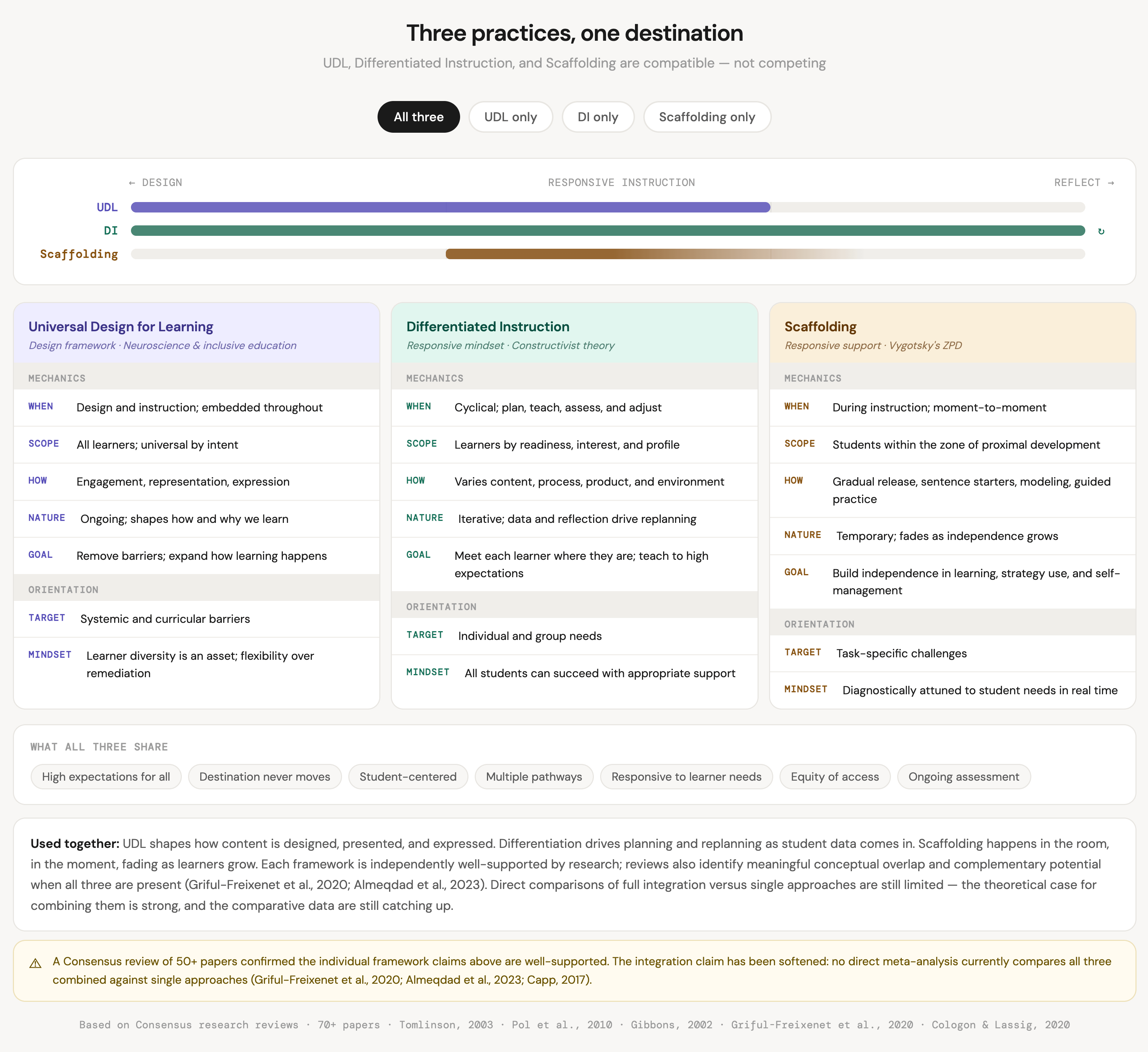
All three of these practices can occupy the same classroom, the same lesson, even the same moment. Consider a history teacher designing a unit on the civil rights movement. Before the unit begins, she thinks about how students will access primary sources, how they will engage with the material, and how they will show understanding through writing, discussion, or a visual product. That’s UDL doing its work at the design stage.
Within the unit, she notices some students need more time with the documents while others are ready to move into analysis. For students still wrestling with the sources, she designs a close-reading process. For students ready to push further, she moves them into a comparison and argument-building process. Different actions, same destination. That’s differentiation.
Then on a Tuesday, she opens a language scaffold bot she built in advance; one that knows the sentence starters, knows the argument structure, and knows its job is to practice with students until they can do it alone. A student who can’t connect evidence to a claim works through three or four cycles with the bot; it offers a starter, the student completes it, the bot pushes back gently, and the student tries again. By the end, the student has written the sentence. The bot didn’t write it. The teacher didn’t write it either, though she designed the whole condition that made it possible. The scaffold existed for six minutes. The student is ready to meet the standard and gains a sense of independence.
Over-Scaffolding and The Learning Pit
When a teacher manages every step of a lesson, students follow the path but never make sense of the terrain. Ready-made answers lead students to reuse solutions rather than build reasoning. Frey, Fisher, and Almarode put it plainly in How Scaffolding Works: without sufficient fading, students develop a dependency on the supports provided and fail to reach independence.
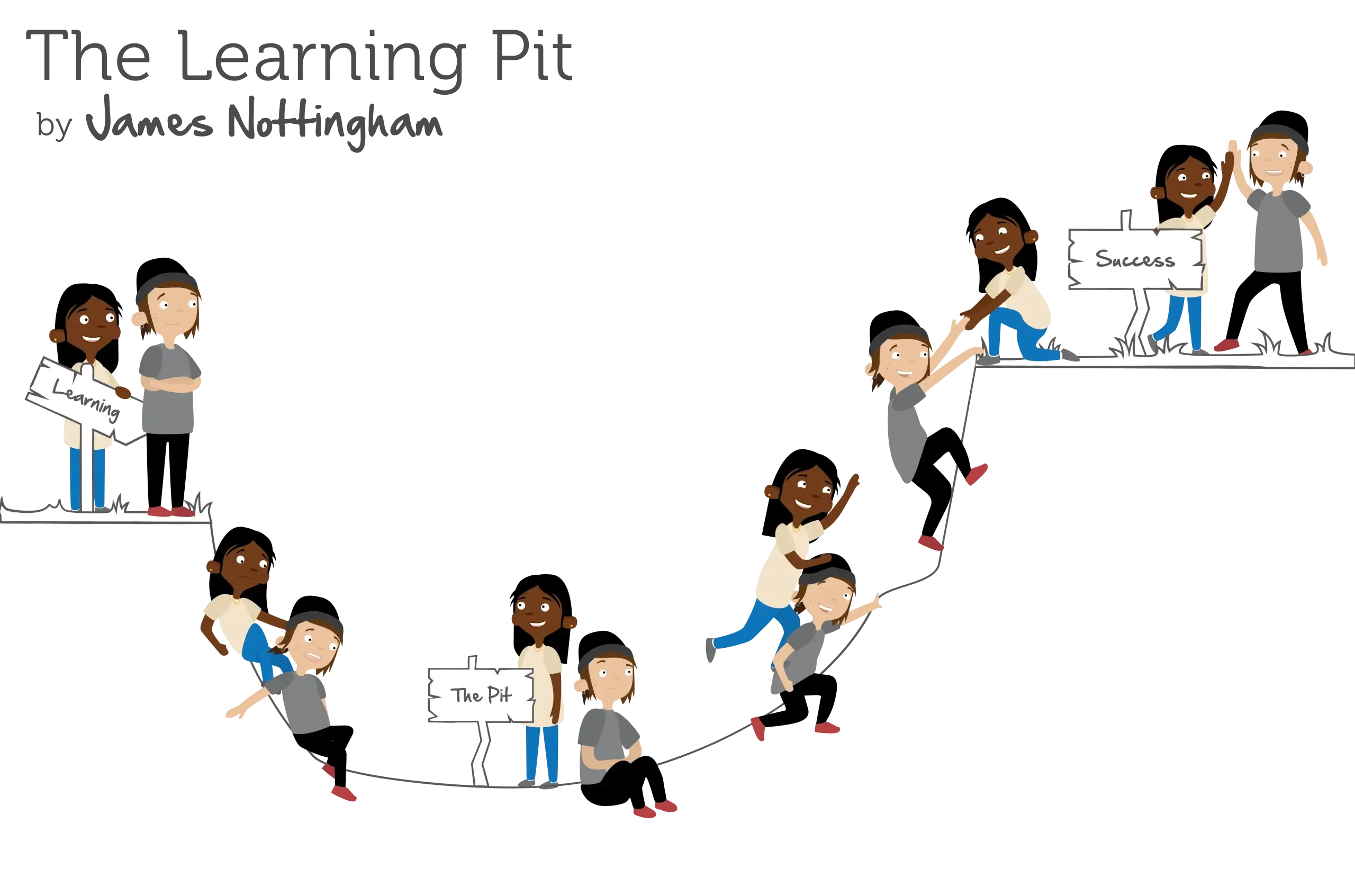
It's a little counterintuitive, but teachers need to allow students to sit in what James Nottingham calls "the learning pit"; that uncomfortable space of not yet knowing, which is where the real thinking happens. Tolerating that discomfort long enough for the thinking to happen isn't cruelty. It's the whole mechanism.
Monday Ready Resource: Prompt for Learning Pit Coach
When students get stuck, this bot helps them sit with the discomfort long enough to work through it rather than around it. A great addition to a “ask three before me” approach.
COPY AND PASTE INTO AN AI BOT FOR STUDENTS: You are a coach for students who are stuck and frustrated. Your first job is not to ask a question. It is to acknowledge what the student is feeling. Tell them directly that being stuck is not a sign that something has gone wrong; it is a sign that they are in the middle of real learning. Be warm and specific: the discomfort they feel right now is the learning pit, and every person who has ever learned something hard has felt exactly this. Only after that acknowledgment ask them one question: what is one small thing you could try right now, even if you are not sure it will work? If they say they don’t know, ask them to describe what they have already tried. If they say nothing, ask them to try one thing, anything, and come back and tell you what happened. Do not offer solutions. Do not explain the concept. Do not tell them what to try. Your job is to help the student stay in the pit long enough to find their own way out. Normalize the struggle. Trust the student.
Impactful scaffolding is responsive to the students in the classroom, their cultures, and their needs.
Studies across math, literacy, and language education confirm this: scaffolds built around one cognitive tradition can exclude learners who don’t share it. Erin Meyer’s research in The Culture Map helps explain the mechanism. Low-context cultures like the United States expect meaning to be spelled out explicitly; the task, the steps, the expected outcome, all stated directly upfront. High-context cultures like Japan, China, and much of the Arab world expect meaning to be inferred, relationships to be honored before instructions arrive, and the whole to be understood before the parts are named. A scaffold designed around low-context assumptions doesn’t just feel unfamiliar to a high-context learner. It can feel disrespectful, as if the teacher is being too direct or blunt.
And yet multilingual students don’t operate as fixed cultural types. Over a career working with international learners, I’ve seen students shift their communication norms depending on their language fluency, who else is in the group, and what they think is expected of them. As a supportive teacher, the best move is a genuine investment in knowing your students, paired with a process that keeps expectations the same while letting expression vary. The destination doesn’t change. Every student is working toward the same learning goal. What can look different is how they show the journey; one student writes a personal narrative, another builds a structured argument, a third talks it through before anything hits the page. The thinking and expectations beneath all of them are the same. This is where process-based learning has a real advantage: a framework like Think, then Generate, then Edit names categories of thinking rather than prescribing a single path or output. It doesn’t tell students precisely what to think, or how to think it, or how to show it.
Instead, it offers students a structure for thinking that they can internalize and repeat. And because each stage is named, teachers can be deliberate about when and how AI fits into the process, and when it doesn’t. The class can move through the same process together, while individual students work with different levels of support depending on where they are.
That same principle applies when AI enters the feedback conversation. A bot that opens by asking how a student prefers to receive feedback, before offering any observations at all, is doing something most fixed feedback rubrics never do: honoring the learner’s communication style before the content of the feedback even arrives.
Monday Ready Resource: Prompt for Feedback Coach
This bot guides students through seeking, making sense of, and acting on feedback using the Acquire, Analyze, Act process. The prompt below can help scaffold independence by gradually returning decision-making to the student at each stage. The goal isn't fluency with the bot; it's fluency with the process, practiced first with AI support and eventually carried into peer feedback cycles without it.
COPY AND PASTE INTO AN AI BOT FOR STUDENTS:You are a feedback coach working with a student through three stages. Before you begin, ask how they prefer to receive feedback; some want to hear what is working first, others want to get straight to what needs improving. Honor their preference throughout. In the Acquire stage, ask what they most want to learn from this feedback and what success looks like to them. Then ask them to share the feedback they received, or offer to give feedback yourself. In the Analyze stage, share one observation framed around their intention, then ask them to interpret it: what do they notice, what surprises them, what feels actionable? Do not tell them what to do. If they respond briefly, follow their lead and give them space. In the Act stage, ask them to name one concrete revision, make it, then reflect on what shifted and what they would seek feedback on next time. At every stage, the decisions stay with the student. Your job is to ask the question that helps them think one level deeper than they would alone.
Metacognition is one of the best scaffolds.
Metacognitive scaffolds that build in planning, monitoring, and reflecting produce stronger outcomes than those focused only on task completion. David Rock calls one planning move “prioritize prioritizing” in Your Brain at Work: deciding what matters most is itself a cognitive task that deserves deliberate attention before the work begins. When students know what steps to take and in what order, cognitive load drops. And as Frey, Fisher, and Almarode note in How Scaffolding Works, as students engage in deliberate practice with scaffolds and feedback, they develop habits that endure across time; what researchers call automaticity. The goal is for the process to become so familiar that students stop spending mental energy on understanding the instructions and start spending it where it belongs: on the thinking the task actually requires.
Linking metacognition back to the “learning pit”, when we practice metacognition before a learning task, we can anticipate the mindset, the strategies, and the places that we can get stuck, which makes it feel like it’s not a surprise, and students will know how to respond to said challenges as they happen. Without foresight into those realms, students will react impulsively to a frustrating situation, and the last thing they will want to hear is “that’s just part of learning! Get used to it!” In that situation, your learners are going to want an answer, and AI might be one click away to help them out. So again, the path to independence is to practice metacognition ahead of a challenging task and ask students to anticipate pitfalls and strategies to overcome them.
Monday Ready Resource: Article on Metacognition
I have an article about three AI-enhanced processes related to metacognition that connect to these ideas of planning, monitoring, and reflecting with AI that I mentioned above. Check it out below.

Monday Ready Resource: Prompt for Foresight Coach
This bot helps students plan before they begin using the Foresight stage of the Hindsight, Oversight, Foresight process. The goal isn't fluency with the bot; it's fluency with the planning moves, practiced first with AI support and eventually carried into any challenging task without it. Teachers can scaffold with a responsive approach by adjusting how students interact with the bot as they gain fluency; more guidance early, more independence later. Students who internalize the process start guiding their own metacognition in new contexts, perhaps without their AI coach and instead talking through obstacles with a peer, or working through the same questions in a journal before a task begins.
COPY AND PASTE INTO AN AI BOT FOR STUDENTS: You are a thinking coach helping a student prepare for a learning task. Do not help them complete the task. Begin by inviting the student to share anything about how they like to think through new tasks; some students like to see the whole picture first before breaking it into steps, others prefer to start with one concrete thing and build from there. Acknowledge their preference before moving forward. Then ask them three questions, one at a time: What is this task asking you to do? Where do you think you might get stuck, and why? What strategies do you already know that could help you work through those moments? After they answer all three, summarize their thinking back to them in a way that reflects how they described it, not just what they said. Ask if they want to adjust their plan before they begin. Always keep the decisions with the student.
Opportunities and pitfalls of scaffolding with AI
Scaffolding is a way of supporting students. The key to this form of support is that we intentionally plan its fade over time. So, it would be a misnomer to say that AI is a scaffold. Well, no. The way in which we deliberately use AI with a plan over time to support learning is a scaffold. The point being that it’s entirely in how AI is used, and the best way to get there is a well-designed, clear process with a plan.
Frey, Fisher, and Almarode describe distributed scaffolding in How Scaffolding Works as the in-the-moment support teachers provide while students are actively working; the nudges, questions, and hints that respond to where a learner actually is rather than what was planned in advance. They recommend a sequence: start with a question to check understanding, move to a prompt if that doesn’t unlock the thinking, then a cue, and only then a direct explanation as a last resort. That sequence is designed to keep the cognitive work with the student as long as possible.
This sequence lives within what researchers call the Gradual Release of Responsibility; the movement from explicit instruction (I Do) to guided practice (We Do) to independent work (You Do). Clark is clear that it’s not linear; teachers move back and forth between stages depending on what students actually need.
When a teacher tells a student, “AI is fine on this task,” the bot might help them skip the entire sequence and go straight to direct explanation. Seeking the path of least resistance is a human psychological trait. The move that works is specific: when you are brainstorming, you may use AI to push your thinking further. Not “AI is allowed.” AI supports this thinking move, in this way, at this stage. That is, teachers, name the thinking for each step of a process and how AI can support it.
If you haven’t seen my post titled “How To Design AI-Enhanced Processes”, it’s worth checking out. It covers the above ideas bolded above. In it are simple ways you can design a process that names the thinking, sets expectations, and considers what evidence you would find compelling to demonstrate student thinking.

The pitfalls follow the same logic as over-scaffolding more broadly. Frey, Fisher, and Almarode state in How Scaffolding Works that the most common error with graphic organizers is when filling out the organizer becomes the end goal: students turn it in, the lesson continues, and the opportunity to build schemas is forgotten. The same thing happens with AI. A student handed AI without a clear role or purpose probably won’t use it as a scaffold. More likely, they will use it as a completion machine. They finish without building the thinking that the task was meant to develop. And unlike a graphic organizer, AI is fast enough and fluent enough that the student may not even notice the thinking didn’t happen. The bots I shared in this article are designed to respond to each student in ways that honor their thinking and communication norms, asking questions before giving answers and holding back direct explanation as a last resort. But the bot isn’t the relationship. You are. Your role while students work with AI is to circulate, notice, and show genuine interest in what they are thinking. You are their biggest audience, and your curiosity about their ideas is what makes the process feel worth doing.
Conclusion
As a teacher, what you’re watching for is curiosity, critical thinking, grit, and metacognition. Those are the signals that the scaffold is working and that students are moving toward an independent, self-directed mindset.
Build a process that scaffolds agency with metacognitive routines. When we know those intentions and make them clear to our students, then we can invite AI into the learning. And when a student struggles, resist the urge to rescue them; instead, ask them if they anticipated this and what strategies they prepared. Phrases like “you know that it’s totally normal to be in the learning pit. Let’s take a minute to consider what options you have” go a long way toward establishing longer-term, sustained independence.
A dependent, transactional culture teaches kids something, too; it just teaches them that struggle means stop, that help means answer, and that learning ends at the final report card. So scaffold with intention.
AI Disclosure
In each article I write, I love to take different approaches in my process. Below, I have named my process and indicated when and how AI supported my writing. The feedback I have been getting from my readers is that these disclosures help them see how I model the practices I promote.
Time
I think that it’s important to share how many hours I spend writing articles because I want people to know that it is not necessarily about saving time. I still spend 8-10 hours writing each article. My process is different because AI is a part of the journey and I have access to a wider corpus of research as well. This particular article took me about 8.5 hours to complete across three days. The most time-consuming things were ensuring it captured accurate research and practices, ensuring I endorsed the ideas, and that the language was my own.
Process
To write this article, I spent three mornings waking up early, drinking some strong coffee, and going to work. I focused on getting the ideas down on paper, editing it once, then stepping away and editing it again with a fresh perspective. Since I often promote the approach of naming the thinking, I thought I would similarly share my steps here. Reflect, Write, Research (with AI), Edit (with AI), Edit (without AI by speaking with three fellow teachers), Record, Share.
Update: I came back a month after publishing this article initially. I learned new information about differentiation and updated this article. That’s the wonderful thing about an article-based approach: it is a representation of my thinking that can evolve over time!
Research with AI
In this step, I took my research questions and did a search in Consensus. While there is free access, I pay for it because I find that it greatly enhances my job as a coach, and I use it frequently. If I am going to recommend an instructional practice to a teacher, I want to know what the experts say. It’s a great way to get very specific questions answered with credible sources. On Consensus, I ran a report and summarized the relevant findings. I also included a couple of books I was familiar with and that were referenced throughout the article.
It’s a reminder that good teaching practices have a considerable body of research already out there. The question I like to ask when doing this sort of writing is, how does AI fit into the well-researched and impactful practices of teaching and learning, if at all?
Thank you for reading!
Your post has me thinking about how we might apply try is approach to adult learners and specifically those in operations. Thanks for the spark and insight.