


The Appearance of Knowing
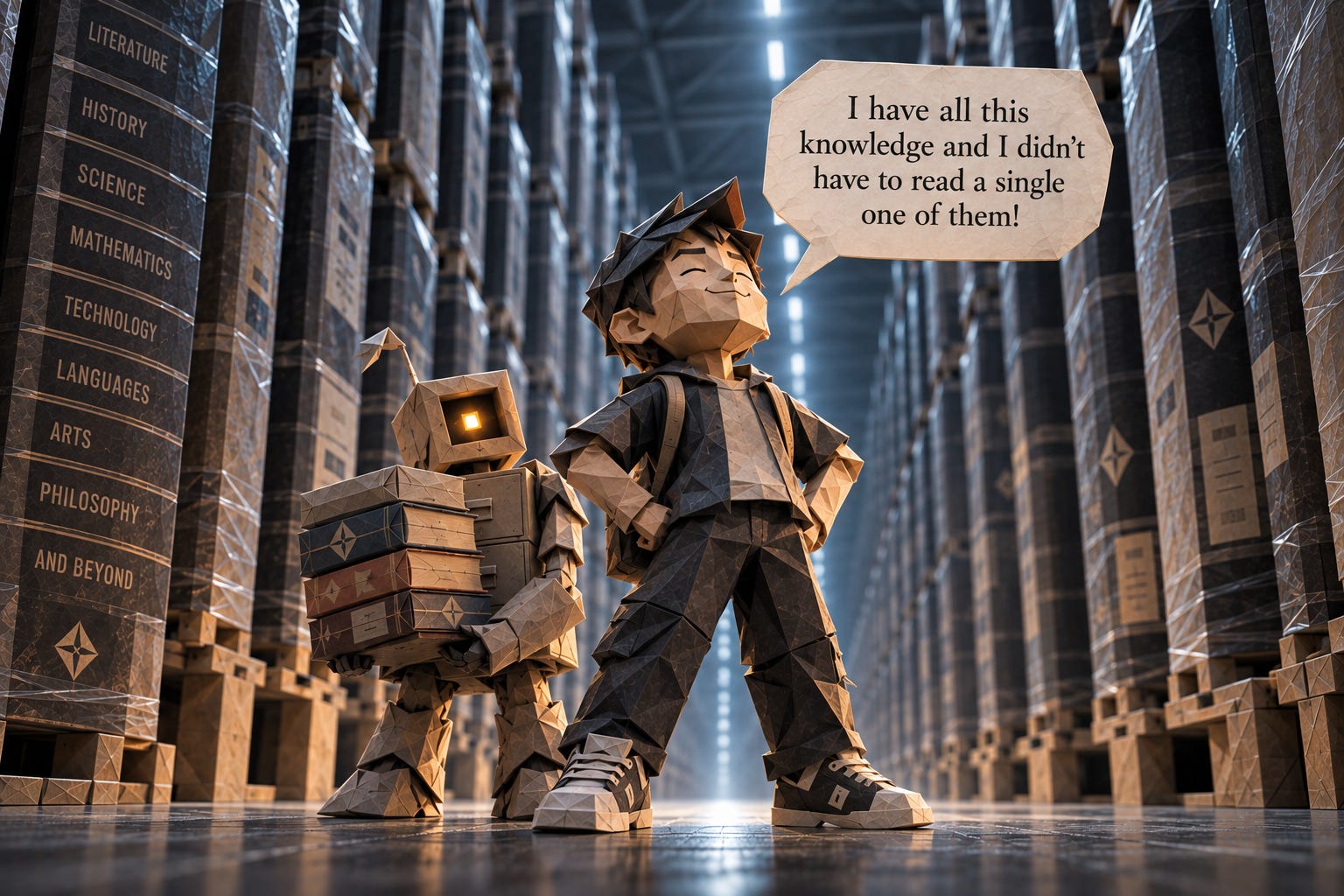
I was chatting with my parents for my 43rd birthday. We talked about life, the news, and, inevitably, AI. I shared a nascent idea I’ve been playing with: the commodification of knowledge. I love the way that sounds. It suggests the things we know can be bought and traded, or at least that we can buy and trade the appearance of knowing them. To me, it’s so much like the idea of buying a book and putting it on your bookshelf, then letting all your guests think you read it as they admire your living room. “Honey, look, Alex has read The Unabridged Encyclopedia of Humanity; I’ve heard it is a real shocker at the end! Since he owns it, he must have memorized and understood the whole thing. It’s only 150 volumes.”
Paying for a personal trainer and watching her work out doesn’t make you fit. Living in Norway doesn’t mean you speak Norwegian. Using AI to summarize a stack of PDFs doesn’t mean you understand them. Access creates an opportunity to learn, but access alone doesn’t mean acquisition of knowledge. The central idea of this article is that teachers create the time, space, and guidance for students to practice self-awareness of their own learning and growth.
AI offers a way to catch up and provide a competitive edge, but it also makes us feel further behind. In the rush to become early adopters of a promising new technology, we risk letting go of the very things we hoped to acquire: skills, knowledge, understanding. And for what? Productivity? Being first? The fear of missing out? We’re so busy trying to keep up that we rarely stop to ask what we’re actually learning.
In this article, I want to ask: if we’re using AI to acquire new skills, knowledge, and abilities, how do we know what we actually learned? My hunch is that we are creating a learned dependence on AI because we never really read the books, learned to code, or to design. I mean, ask anyone today, and they’ll say, “my god, how did we ever live without AI?”
The Good Student Who Follows Instructions
We use AI to speed things up, to summarize books, explain difficult ideas, and produce reports that we don’t truly read, understand, or spend time with. We ask for a summary, then a shorter summary, then the three things we need to know. At each step, we get something faster to consume.
The problem is that students may not recognize what they lose when they rush, and our classroom routines may reinforce those blind spots. If completing the work efficiently gets a good grade and pleases their parents, why would they question whether they have understood it?
Let’s look at it from a student’s perspective. Let’s call him Sam. Sam was asked to produce an essay in two days and submit it to you for your review. You didn’t talk about AI much; you just said to complete it on time and to address the learning objectives. You told him he couldn’t use AI to write the essay, but said little about other uses. Thinking he was in alignment with your expectations, Sam went home and quickly acquired all the relevant literature from a website. He loaded them into Gemini Notebook (formerly NotebookLM), read the first 20 lines of a summary report, thinking that he understood the assignment, and quickly wrote the essay out. After all, Sam has other homework, dinner with his family, and will meet his friends before bed for some online gaming, his one social outlet for the day. He went back to school and turned in the assignment, feeling proud and happy that he did the right thing. He did, after all, want to do the right thing and make his teacher and parents proud.
What actually went wrong? To me, it’s busy people rushing through the place where the thinking should have happened: reading the texts, processing what he read, and writing, which he rushed through as a task rather than a form of thinking.
I think it continues to go beyond that, though. It’s also the teacher who left the AI conversation at the surface level of “no writing with AI” rather than addressing the other forms of interacting with it. It was the uninvited guest sitting next to each child whom the teacher did not introduce.
Finally, the environment. I can’t help but also wonder if the teacher reinforced a rushed, transactional classroom. We only have so much time to get through all this content, so there’s no time to think, just act. Or, class time is filled with the things I need to tell you, so do the thinking at home.
The rushed classroom existed before AI, and AI just reveals old problems in many ways, but if schools keep operating that rushed sort of way, we’ll see these problems more and more.
The Illusion of Explanatory Depth
Rozenblit and Keil (2002) called the core problem of this article the illusion of explanatory depth. In their experiments, participants rated how well they understood everyday devices, like a zipper, then tried to write out detailed explanations of how they worked. The attempt to give a detailed explanation exposed gaps to themselves, and their self-assessed ratings dropped. The researchers proposed that the drop in their scores was a sign that people often confuse what they can see and use with what they actually understand.
Here’s a great video from YouTuber Pseudoodle that explains it beautifully. It's worth showing your students too.
In short, familiarity and exposure are not understanding. Explaining, teaching another person, or something similar, can help you notice more accurately your own level of understanding.
The Role of The Teacher
I keep coming back to the teacher’s role in helping students notice what they know. What were you trying to learn? What can you explain now? Where do you still need practice? Those questions give students a reason to pause and look beyond whether the work is finished and to consider its bigger purpose: your growth. The project matters significantly less than your growth. We are not at school to create projects, we are at school to grow into smarter, kinder, thoughtful, creative, analytical, problem-solving people. And when we forget that and focus on the test, the grade, the project, the whatever, AI is going to do it for them.
As facilitators of this sort of thinking classroom, we might be the ones creating pauses, especially at first as we develop those habits. We as teachers might ask the question, make time for an explanation, and help students notice a gap without treating it as a failure, but rather an opportunity to learn. Over time, we want students to begin asking those questions themselves as self-regulated learners.
Monday-Ready Resources
Let’s use metacognitive questions, structured as Foresight, Oversight, and Hindsight to help guide students to be independent and wise users of AI.
The questions can really take different shapes depending on the age, independence, subject area, culture, and context of your classroom. That being said, I have written a few guiding questions to provoke thinking, intentionality, and deliberate learning as opposed to task-completion and doing-without-thinking. It has been my claim throughout this article that AI can make it seem that we have depth of knowledge when we speed things up and use AI to summarize texts for us. A student who hasn’t developed a level of self-awareness around their actions needs guidance to use a tool as powerful or potentially harmful as AI. Teachers can support this development through metacognition and well thought out questions.
Below I have question banks in the form of text and PDFs that are ready to be presented in class. Let’s go process by process and check out the resources.
Foresight
One of the metacognitive moves I would highly recommend is getting students to plan in advance and consider how they will know if they have met the targets. What things will they see that they were able to accomplish, do, express, or as today’s article has been suggesting, be able to explain. That’s a hard one, but spending a few minutes on it and revisiting it throughout the work can be a helpful way to keep them on track and to be intentional about when and how they use AI. The purpose is to have students develop self-awareness around both what they want to achieve as their goal, how AI can aid in that work, and how it might derail those intentions. Here are questions you can ask your class.
Foresight Guiding Questions
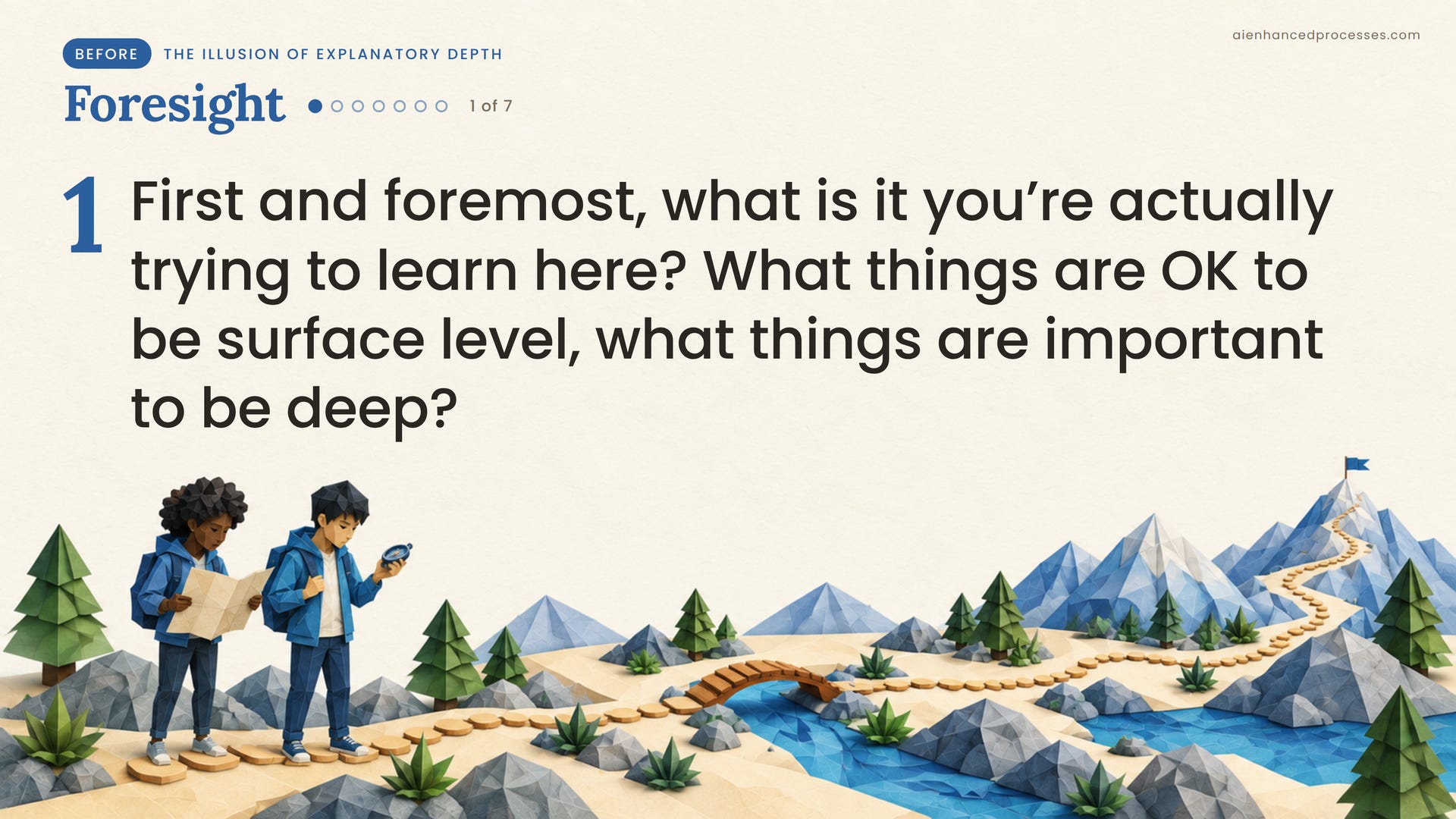
First and foremost, what is it you’re actually trying to learn here? What things are OK to be surface level, what things are important to be deep?
Looking at our rubric, what things will you be able to explain to show your depth of knowledge?
How might you use AI to ensure it supports you to gain a deeper understanding?
The opposite, what things do you want to avoid doing with AI that would give you the illusion of understanding?
After which step in the process could you self-assess and check in with yourself?
Which parts of the process are better with another person and which parts are better with AI?
If you had to make a prediction right now about your current theories about this work, what might they be?

Oversight
The students set their intentions before starting with AI, and now they are midway through a task. It’s time for a pause. It could be during a lesson for a few minutes, it could be a sequence of lessons in a unit and starting a class with some good old fashioned metacognition. The point being that the students orient themselves and look at their process and whether they are behaving in ways that are consistent with their plans. The focus at this point is self-awareness and noticing both where they are at in terms of their growth, but also considering how their actions are either helping or hindering their intentions. Here are questions you can ask your class.
Oversight Guiding Questions
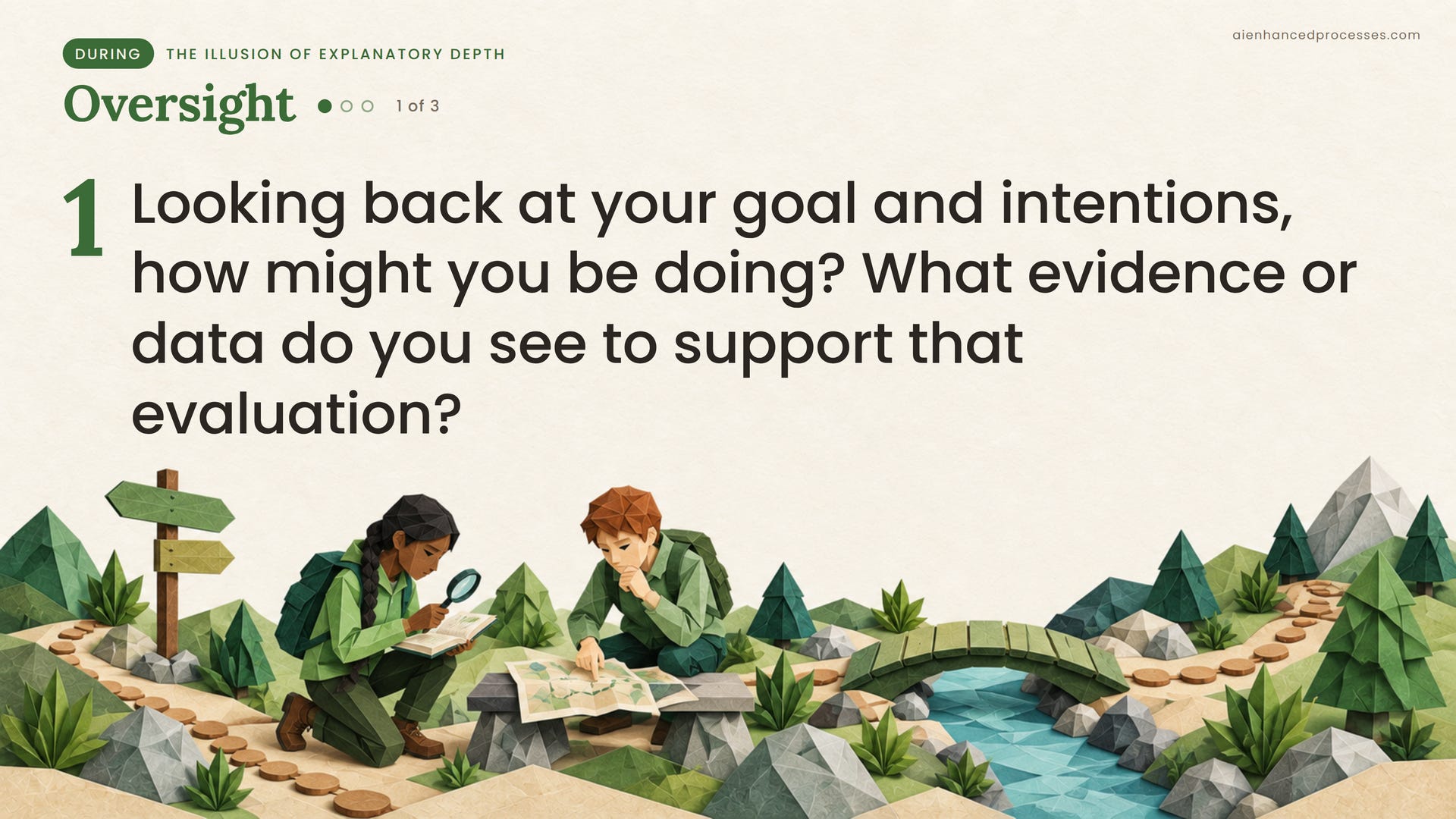
Looking back at your goal and intentions, how might you be doing? What evidence or data do you see to support that evaluation?
If you were to self-assess how might you score yourself on the rubric?
When we practiced foresight, you created a theory, do you still agree with those ideas? How might you change or update them now that you have had a chance to think a little bit more?
Hindsight
Just like self-reported grades as a high-impact strategy (Hattie, 2015) in that it gets students to notice their own current reality and the gaps in their understanding, getting students to explain something after they have interacted with an AI model as a source of information is one way for them to notice their current reality and assess their knowledge with greater accuracy. The key is helping students to be self-aware and to make meaning from an experience. In this case, we want them to consider how they used AI and whether it actually led to meaningful growth.
Hindsight Guiding Questions
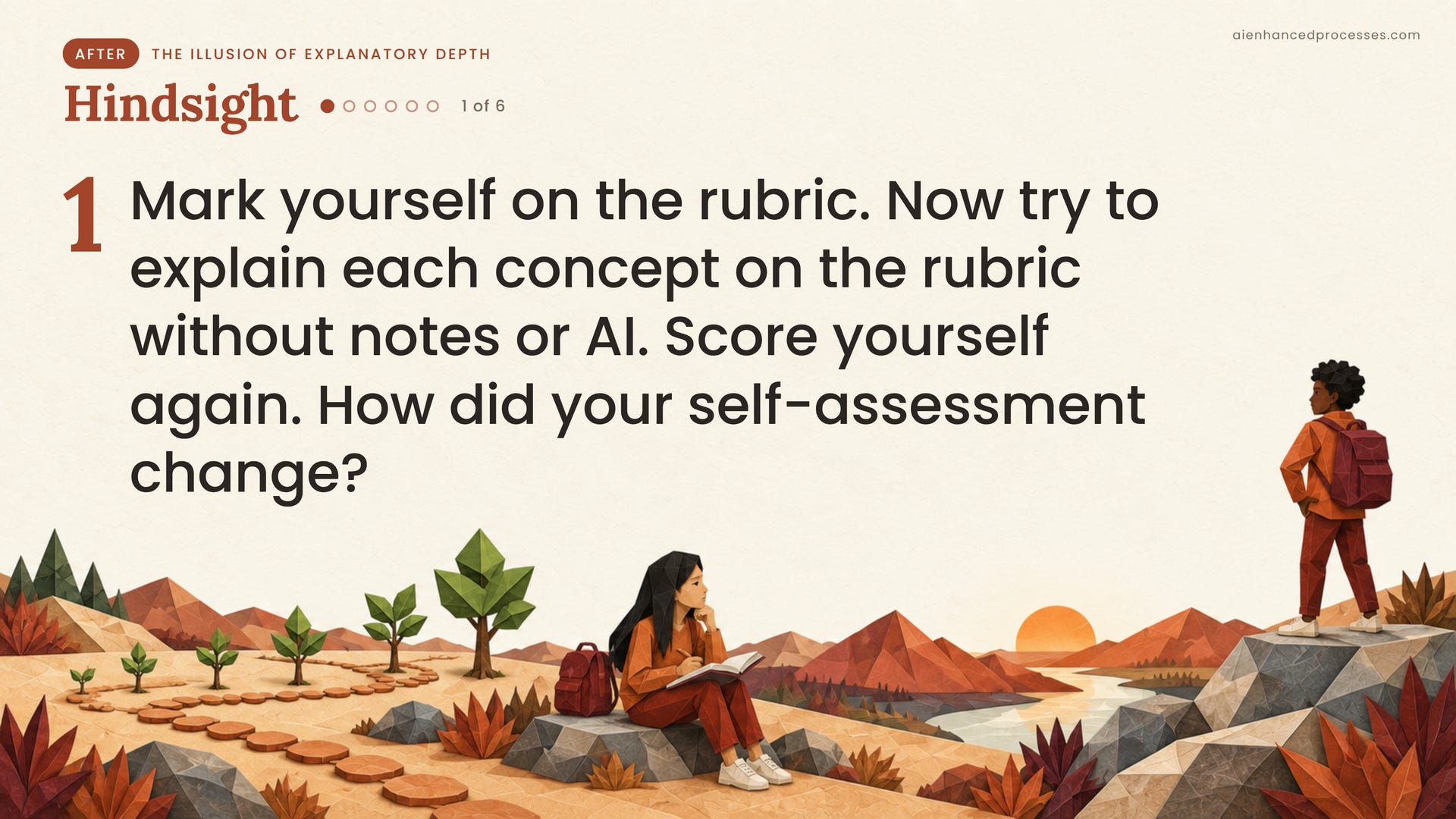
Mark yourself on the rubric. Now try to explain each concept on the rubric without notes or AI. Score yourself again. How did your self-assessment change?
Which part was hardest to explain? Was that a part you worked through yourself, or one AI summarized for you?
What learning strategies did you use, and which parts of the thinking did you do versus AI? How did that work for you?
How did you perform compared to how you thought you would do? What evidence shows that?
Based on what you couldn’t explain, where will you put your energy next time? How could AI support that work without doing it for you?
If you could travel back in time to when you started, what would you tell yourself to make sure you were successful? Why do you say that?
Ways to Use The Above Questions
Ok, so I shared several questions that I hope inspire some thinking, but how could they be used in class? It’s up to you! Here are three simple ideas, but I bet you have even more.
Verbal Question Asked to Whole Class. Ask the students to close their devices, clear their desks, and practice an internal reflection with you in silence. Class, here is a question to help you to practice intentionality about your behavior and how you spend time today.
Note Taking. Tell the students that writing is a form of thinking. Writing uses many different parts of our brains to be creative, critically think, recall, and to make new connections. It’s such a powerful practice to do deep thinking. On your own, set your intentions and your goal today by taking a note just to yourself about the theories you have. You will revisit this note later. I will give you a few minutes of quiet to write.
Partner Talk. Tell the students to choose a question from the board. Tell them that the questions are meant to get them to check in with themselves about how they are using AI in class and to consider their depth of understanding. Turn to a partner and explain the concept to them of the thing you’re working on. If you want to add some fun, try to explain it in simple terms (or often what Reddit calls “Explain it like I’m 5”).
At first, we create the space and offer the questions. With practice, we want students to make those pauses for themselves, notice what they understand, and decide how AI can help them keep learning. Our role as teachers is to make time for students to question, explain, and assess their own thinking, so they develop an accurate picture of what they’ve learned, how deeply they understand it, and where they still need practice when working with AI.
AI Disclosure
This article took two weeks of going back and forth between Claude Fable and ChatGPT Astra, looking into research through Consensus, and talking through the ideas with my partner on our walks to school. Seeing different versions helped me recognize what I was trying to say, and what I wasn’t. I kept paraphrasing my own argument until I could see the connection I wanted to explore: the biases we bring to AI, the habits we’re forming around it, and the possibility that we’ll recognize some of their consequences only after those habits are set. The models helped draft, restructure, and challenge the writing. The process involved repeatedly deciding what I meant, examining the evidence, and taking responsibility for the claims here.
References
Hattie, J. (2015), "The applicability of Visible Learning to higher education," Scholarship of Teaching and Learning in Psychology, 1(1), 79-91.
Rozenblit, L., & Keil, F. (2002). The misunderstood limits of folk science: An illusion of explanatory depth. Cognitive Science, 26(5), 521–562. Read the paper
Pseudoodle. Video explaining the illusion of explanatory depth. YouTube. Channel’s Shorts page; https://www.youtube.com/shorts/j4nWk3FpTPM
Extended Research
Research not present in the post, but helpful things you might want to read if you like the ideas present here.
Fisher, Goddu & Keil (2015): Searching for explanations: How the Internet inflates estimates of internal knowledge.
Bastani et al. (2025): Generative AI without guardrails can harm learning: Evidence from high school mathematics.
Fernandes et al. (2025): AI makes you smarter but none the wiser: The disconnect between performance and metacognition.
Fiorella & Mayer (2013): The relative benefits of learning by teaching and teaching expectancy.
More Posts By Me
Check out these downloads and articles related to the concepts in this article from my website.
Metacognition Cards. A set of prompt cards to help students practice Foresight, Oversight, Hindsight. The cards are helpful across different contexts.
Scaffolding. How teachers can help students plan, notice difficulties, and choose strategies, gradually building independence so AI supports their thinking.
Foresight, Oversight, Hindsight. Three metacognitive processes that help students set intentions, monitor their understanding, and reflect on how to use AI purposefully in their learning.
Student-Led Processes. How students can take ownership of their learning by designing their own processes, deciding where AI belongs, and reflecting on whether it helped them learn.
Documenting Student Thinking. How recording decisions, questions, and revisions helps students see their thinking develop, evaluate AI’s contribution, and choose their next steps.
Keep The Conversation Going
After reading over the post, what’s something you’re leaving with? Or, perhaps there’s a question from the Monday-ready resources; which one would you like to try with your students?
Or perhaps you know someone who would enjoy this article. Share it with the button below.
As always, thanks for reading!